By Unflag Team
AI Content Detector: How It Works and What Your Score Means
Learn how an AI content detector scores text, why results vary, and what limits to expect. Practical guidance for interpreting detector output in 2026.
Most advice about an AI content detector is backwards. A score is not a verdict, it's probabilistic evidence, and if you treat it like proof, you'll make bad calls in classrooms, hiring, and publishing.
An ai content detector is useful when it helps you decide what to review next. It's risky when a single number decides authorship, because the same text can look very different across tools, thresholds, and editing styles.
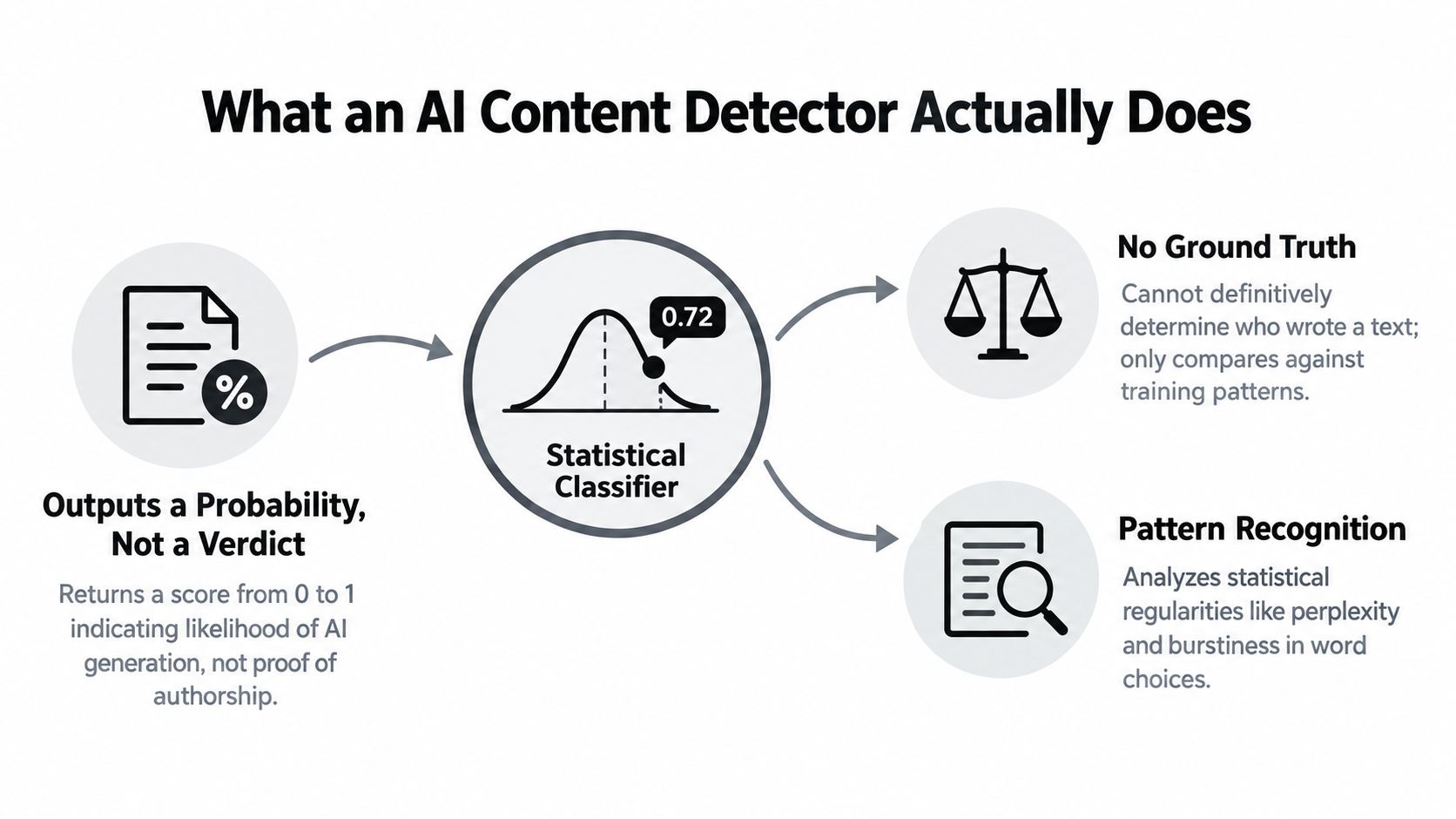
Table of Contents
- What an AI Content Detector Actually Does
- The Four Signals Detectors Look For
- Why Detector Accuracy Drops Outside the Lab
- How to Read an AI Score in Practice
- Where Detector Scores Go Wrong
- A Practical Workflow for Interpreting Detector Results
- What This Means for Schools, Editors, and Hiring Teams
- Frequently Asked Questions About AI Content Detectors
What an AI Content Detector Actually Does
An ai content detector is a statistical classifier. It does not identify the writer, it estimates how closely a passage matches patterns learned from human and machine writing. Read the score as probabilistic evidence, not as proof of authorship.
That matters because the result can affect a grade, a hiring decision, or a publication review. A detector may highlight a document, flag specific sentences, or soften uncertain results with a low-confidence band, but none of those outputs turns the score into fact. A 2023 evaluation of 14 publicly available and commercial detectors found that none reached 80% overall accuracy, and every tool produced both false positives and false negatives (arXiv evaluation).
Document scores and sentence flags
A document-level score shows how closely the whole text resembles machine-generated writing. Sentence-level highlights are narrower, and they can mislead if you read each line in isolation. Turnitin's guidance notes that highlighted sentences can still be human-written, so the score belongs inside a review process, not in place of one (Turnitin guidance).
A useful review asks for evidence the score cannot provide on its own. Drafts, revision history, and a clear oral explanation of how the text was written give you a better basis for judgment than a single number.
| Signal | What It Measures | Where It Misleads |
|---|---|---|
| Document-level score | The overall likelihood that the whole text looks machine-generated | Can hide mixed authorship and editing history |
| Sentence-level highlight | Local passages that look statistically unusual | A single flagged line can still be human-written |
| Low-confidence band | Results the tool treats cautiously | A low score is not proof that AI was not used |
If you are checking a draft before submission, a tool like Unflag's AI Detector can give you a quick signal to compare against your own editing trail. If you are still revising, run the revised draft through Unflag's free AI Humanizer and compare the score before and after.
The Four Signals Detectors Look For
Detectors usually look for token likelihood, perplexity, burstiness, and broader stylistic patterns. This is like a music teacher listening for whether a performance sounds rehearsed in an overly regular way, not whether the performer is “guilty” of anything.
From predictability to pattern
Token likelihood is about how expected each next word is. If a passage keeps choosing the most obvious phrasing, a detector may score it as more machine-like. Perplexity is the related idea of how “surprised” the system is by the text, low perplexity often means the wording is easy to predict.
Burstiness looks at variation in sentence length and structure. Human writing often mixes short, sharp lines with longer explanations, while many AI drafts come out flatter. Stylistic patterns are the broader fingerprints, repeated transitions, formulaic openers, and overly even paragraph rhythm.
| Signal | What It Measures | Where It Misleads |
|---|---|---|
| Token likelihood | How predictable each word choice is | Formal human writing can look highly predictable |
| Perplexity | How surprising the passage is overall | Simple topics can naturally read “smooth” |
| Burstiness | Variation in sentence length and cadence | Careful editing can flatten or exaggerate rhythm |
| Stylistic patterns | Repeated phrasing and structure | A skilled writer can mimic or avoid these patterns |
If you want a quick field checklist for spotting the same patterns by eye, compare the text with the guidance in Unflag's signs of AI writing checklist. It's a useful companion when a score feels off but you can't say why.
Why Detector Accuracy Drops Outside the Lab
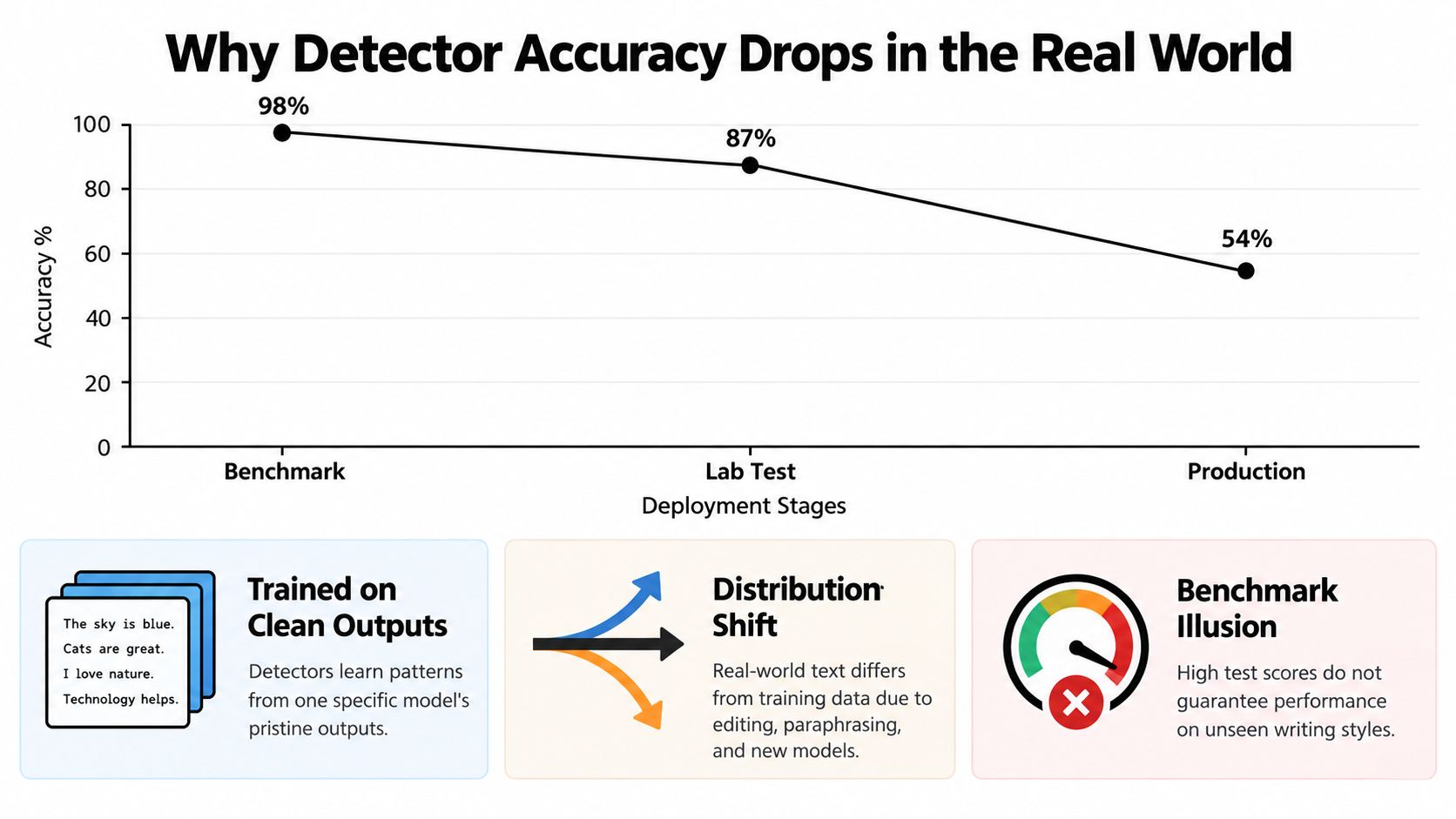
A detector can look strong in testing and still stumble in daily use because of distribution shift. In plain English, the text it sees in production is often different from the text it learned from, or the writing has been altered enough to blur the pattern.
A cross-benchmark analysis reported an F1 score of 0.9734 on PAN-CLEF 2025 but only 0.8025 on COLING 2025, a reminder that benchmark numbers do not transfer cleanly to field conditions. The gap grows when text is paraphrased, translated, lightly edited, or built from mixed human-AI authorship.
Editing changes the signal
Paraphrasing and human revision can strip away the statistical cues detectors depend on. Independent evaluations found that performance can collapse after rewriting, and one academic paraphrasing study reported GPT-Zero accuracy falling to 0.04 to 0.16 on paraphrased text. Translation and hybrid authorship create similar problems, because they change the surface form without clarifying who wrote it.
A detector learns a style; it never learns a soul.
A score can still be useful and still be wrong. That is why benchmark bragging rights should never replace a close review of the text in front of you.
When readers ask whether an ai content detector can handle rewritten text, the honest answer is that reliability drops as the writing moves farther from the patterns the tool was trained to recognize. For drafts that need a natural sound, Unflag's AI Humanizer can help before review, and its detector can then compare the revised version against detector-style scrutiny.
How to Read an AI Score in Practice
A score only means something if you know what kind of text it came from, which tool produced it, and where that tool draws its line. Without that context, the number can look precise while telling you very little.
Three common reading mistakes
A 95% AI result is not proof of misconduct. It means the tool sees patterns that resemble machine writing, and the result still needs checks against drafts, revision history, and the writer's own explanation. A 15% score in a tool like Turnitin may also carry an asterisk, because its published guidance says results below 20% are low-confidence and more likely to produce false positives (Turnitin update).
A flagged sentence inside an otherwise human-looking document is another common trap. Per Turnitin's published guidance, document-level false positives stay below 1% when a document contains at least 20% likely AI-generated writing, while sentence-level false positives are about 4%. That means a highlighted line is a signal, not a verdict.
Ask four questions every time:
- Which tool made the score?
- What threshold does it use?
- What kind of text is this, a draft, final submission, translation, or edited mix?
- What other evidence supports or contradicts the score?
That workflow keeps an ai content detector in its proper role. It screens for patterns. It does not prove authorship by itself. If you are comparing two drafts, run both through Unflag's detector and note how the score moves with each edit.
Where Detector Scores Go Wrong
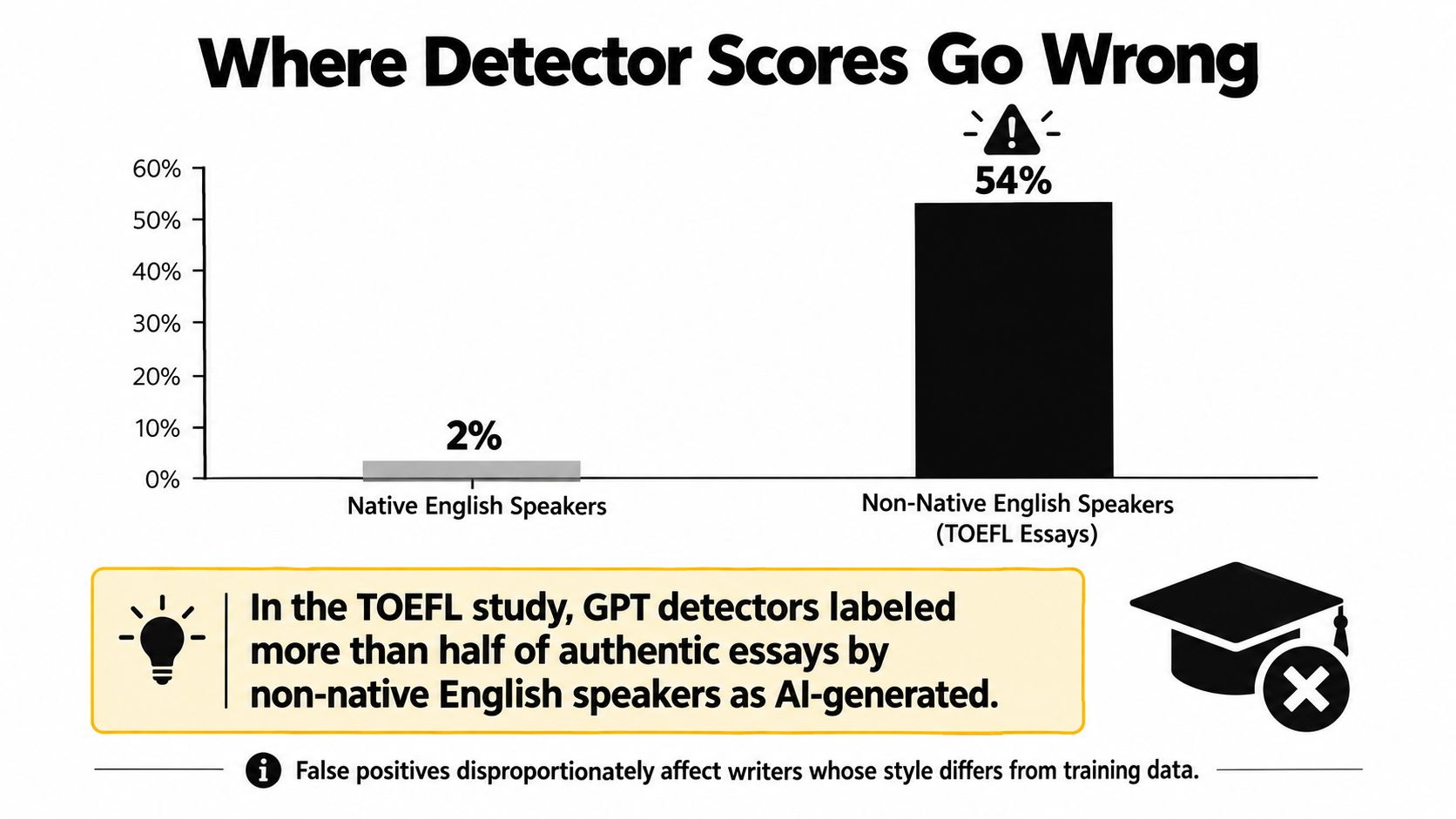
The biggest fairness problem is that detectors often treat non-native English writing as suspicious. Research summarized from Liang et al. found that GPT detectors labeled more than half of authentic TOEFL essays written by non-native English speakers as AI-generated, while comparable essays by native speakers were recognized as human-written nearly flawlessly (Liang et al. summary).
Why language background matters
Detectors often reward the same traits teachers sometimes ask students to use, clear structure, predictable vocabulary, and low variation. Those traits can appear naturally in second-language writing, which is why a score can confuse fluency differences with machine authorship. In multilingual education, publishing, and hiring, that confusion can create a serious trust problem.
You can see that concern in institutional decisions. The University of Waterloo discontinued Turnitin's AI-detection feature in September 2025 after reliability and bias concerns, including internal testing where human-written work was classified as 100% AI-generated. The University of Cape Town disabled its AI score from October 2025 for similar fairness and trust concerns (University of Oklahoma guide).
What that means in practice
If a writer's English is careful, direct, and formulaic, the detector may misread that as machine output. If the writer is more expressive, the same tool may behave differently. That's why a score should be a review signal, not an automatic disciplinary trigger.
Fairness rule: when the writer's background could explain the score, the burden should shift toward review, not punishment.
For a side-by-side look at how humanizers and paraphrasers are often discussed differently, see Unflag's paraphraser vs AI humanizer guide. The distinction matters because the writing process, not just the wording, is part of what detector scores are reading.
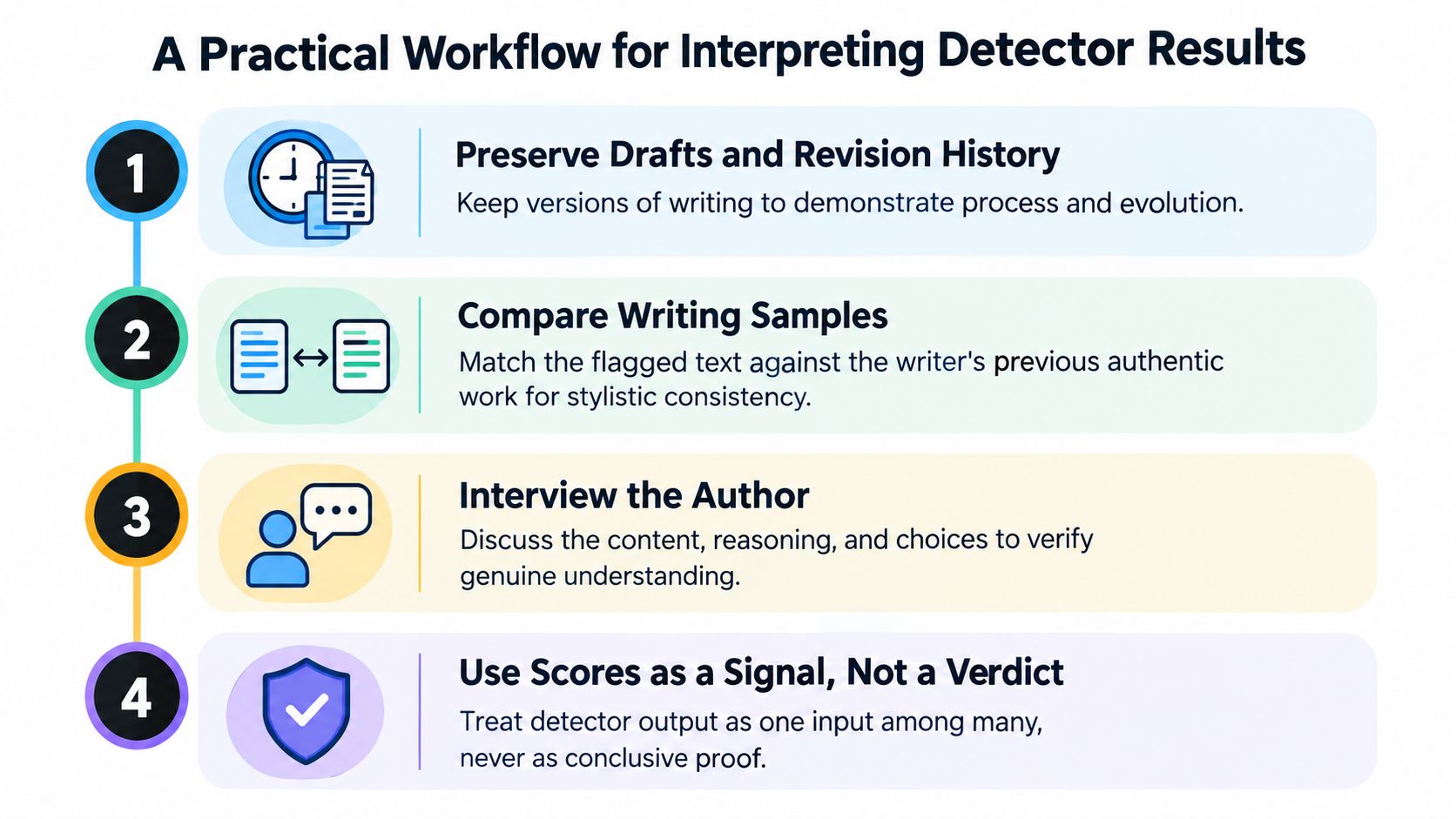
A Practical Workflow for Interpreting Detector Results
When a submission gets flagged, the first move is to collect evidence, not issue a conclusion. A detector score can start a review, but it shouldn't end one.
A workflow that holds up under pressure
Preserve drafts and revision history. Keep the document versions, timestamps, and edit trails. That shows how the text developed and whether the writer changed direction over time.
Compare writing across time. Don't compare the text to an abstract “ideal,” compare it with the writer's own earlier work. Style drift can be informative, but it can also reflect topic, audience, or language background.
Ask for an explanation of the claims. A quick oral or written walkthrough often reveals whether the writer understands the argument, sources, and choices behind the piece.
Verify citations and source support. Check whether the claims are backed by usable sources, not just whether the prose sounds polished.
Use a structured appeal path. Define what counts as stronger evidence, and make room for the writer to respond before any decision is finalized.
The best detector result is one that leads to a better conversation, not a shortcut. Independent evaluation summarized by Nature found that GPTZero and Pangram flagged nearly all AI passages generated with basic prompts, but about 8% of passages made to imitate a particular author were classified as human (Nature summary). That kind of gap is exactly why no single score should sit alone.
What This Means for Schools, Editors, and Hiring Teams
Schools, editors, and employers are all asking a probabilistic tool to make a deterministic decision. That's the core mismatch, and it's why detector scores belong inside a broader review process.
In practice, that means an AI score should sit beside drafts, revision history, citations, interviews, and human judgment. It should not act as a standalone plagiarism verdict, a hiring filter, or a punishment trigger. The right response to a flagged submission is review, not reflex.
Quoteable line: An AI score is a probability, not a verdict.
Quoteable line: Better detection is not the same as safer detection.
Quoteable line: The right response to a flag is evidence review, not automatic punishment.
If you want a simple definition to carry into policy meetings, use this one: detector output is a screening signal, not authorship proof. That's the standard worth defending in education, publishing, and hiring, and it's the reason tools like Unflag's guide to what AI detectors colleges use are most useful when they help teams ask better questions, not when they pretend to end the conversation.
Frequently Asked Questions About AI Content Detectors
Can an AI content detector really tell ChatGPT from human writing?
Not reliably enough to treat it as proof. Research shows detectors can miss AI text and mislabel human writing, and performance changes with editing, genre, and language background. The safest use is as a review signal that points you toward drafts, revision history, and a closer look.
How reliable is Turnitin's AI score?
Turnitin treats its AI-writing output as investigative, not definitive. Its published guidance says scores below 20% are shown with an asterisk because low-confidence results can be misleading, and its sentence-level false-positive rate is about 4%. A flagged sentence still needs context.
Does paraphrasing make AI text undetectable?
No tool can guarantee that. Independent testing shows detector performance can drop sharply after paraphrasing or rewriting, and NIST notes that recursive paraphrasing can reduce watermark detection rates to 20% for text of about 225 words (NIST report). That means rewriting changes the odds, not the truth.
Should a university or employer make a decision based only on a detector score?
No. A score alone can't prove authorship, and false positives can harm students, applicants, and staff. The better approach is to review drafts, ask for an explanation, check citations, and use the score as one piece of evidence rather than the final decision.
If you want a clearer way to check text before it goes out, Unflag gives you an AI detector, a humanizer, a paraphraser, and a fact checker in one place. Use it to review drafts, compare how text reads to detectors, and catch weak claims before they become someone else's problem.
More guides
View all10 Best AI Text Rewriter Free Tools for 2026
Compare the best AI text rewriter free tools for 2026, with word caps, privacy limits, before-and-after examples and tips for reliable rewrites.
Paraphrasing Tool Free: 10 Options Compared for 2026
Compare the best paraphrasing tool free options on quality, languages and privacy. See limits, pros and cons, and where Unflag fits in 2026.
10 Best AI Essay Rewriter Tools for Students in 2026
Compare 10 AI essay rewriter tools for tone, structure, originality, and fact-checking, with student examples and an honest Unflag review.
10 Fact Checking Tools for Journalists and Writers in 2026
Compare 10 fact checking tools for journalists and writers in 2026, with pros, cons, and workflows for checking images, sources, claims and numbers.