By Unflag Team
10 Best AI Writing Checker Tools for 2026
Compare the 10 best AI writing checker tools for detection, grammar, style, and fact-checking, plus practical tips for interpreting results.
An AI writing checker can flag authentic writing while missing AI-generated text. In a 2023 evaluation of AI-detection tools, one classifier identified only 26% of AI-written text as likely AI-generated and incorrectly flagged 9% of human-written text. Those results aren't a verdict on every current detector, but they explain why a score alone isn't enough.
The best AI writing checkers do more than flag AI. They help you review a draft, understand uncertain results, improve its language, and check whether its claims hold up. Unflag is our first choice for an integrated revision workflow, while dedicated platforms such as Originality.ai, GPTZero, and Turnitin fit different editorial or institutional needs.
Choose around the work you need to do:
- Detect likely AI text: Use a detector to identify passages that deserve review, not to establish authorship.
- Check grammar and style: Improve clarity, sentence structure, and tone without confusing fluent writing with verified writing.
- Identify factual problems: Check claims against supporting sources. A human-looking paragraph can still be wrong.
- Rewrite naturally: Remove repetitive, formulaic phrasing while preserving meaning and required disclosures.
Plagiarism screening is another distinct task. It looks for matching material, whereas AI detection estimates whether text resembles machine-generated writing.
The ranking below prioritizes workflow fit, not an unsupported accuracy leaderboard. Product features and plan restrictions come from the named providers; prices, credits, and packaging can change. For consequential decisions, preserve the original draft and judge detector feedback alongside sources, revision history, and the writer's explanation.
Table of Contents
- 1. Unflag
- 2. Originality.ai
- 3. GPTZero
- 4. Copyleaks
- 5. Turnitin
- 6. Winston AI
- 7. Crossplag
- 8. Sapling AI Detector
- 9. ZeroGPT
- 10. QuillBot Premium
- Top 10 AI Writing Checkers: Feature Comparison
- Choose a Checker by Purpose, Not by Score Alone
1. Unflag
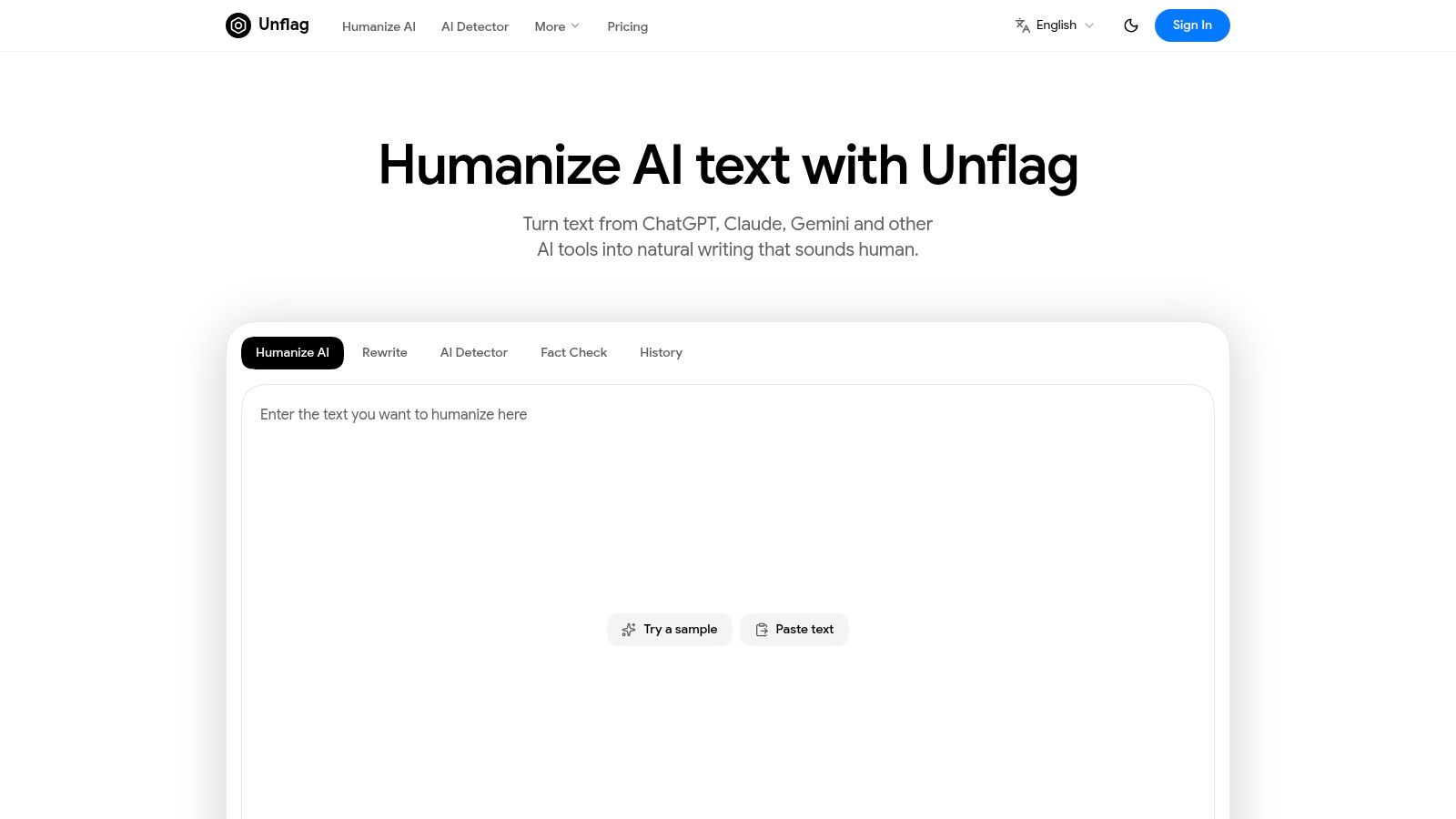
Unflag brings four checker jobs into one writing workflow: detecting likely AI text, refining grammar and style, reviewing factual claims, and rewriting drafts. That makes it useful when a writer wants to revise and review in one place. It does not make an AI score a verdict on authorship or factual accuracy.
Its humanizer works with drafts from ChatGPT, Claude, Gemini, and other AI tools. The Paraphrasing Tool supports English, Spanish, Chinese, Arabic, and other languages. Use it to improve phrasing while checking that the rewritten draft still means what you intended.
What makes its AI writing checker useful
The AI Detector provides a writing score and feedback. The Fact Checker compares claims with web sources. Those features serve separate purposes: detection flags text for closer review, while fact-checking helps assess whether claims have support. Neither replaces an editor's judgment.
Unflag's product and plan information states that its most advanced model has 99.5% accuracy, that the service has 30,000+ users, and that free checks support 600 characters at a time. Plus offers 45× more usage at $45.99 annually, approximately $3.83 monthly, advertised as 57% off monthly billing. Treat the accuracy figure as a company-stated claim, not an independent certification or a guarantee of how another detector will classify a draft.
- Pros: Detection, rewriting, paraphrasing, and factual review are available in one service, alongside web access and native iOS and Android apps.
- Limitations: The free text limit restricts longer drafts, and fact-checking requires Plus.
- Privacy considerations: The company describes GDPR compliance, says it doesn't sell personal data, and identifies Stripe, Apple, and Google as its payment providers.
For a practical comparison, have a writer revise an AI-generated paragraph, then compare the original and edited versions. Check whether the meaning and supporting evidence remain intact, and treat any detector score as a prompt for review. Unflag helps AI drafts read more naturally and shows an AI score before submission, but it doesn't promise a particular third-party result. Student, blogger, and editor testimonials are user feedback, not controlled performance evidence.
Paste text into Unflag's AI Humanizer for free. Review its changes against your original, then verify factual claims before submitting.
2. Originality.ai
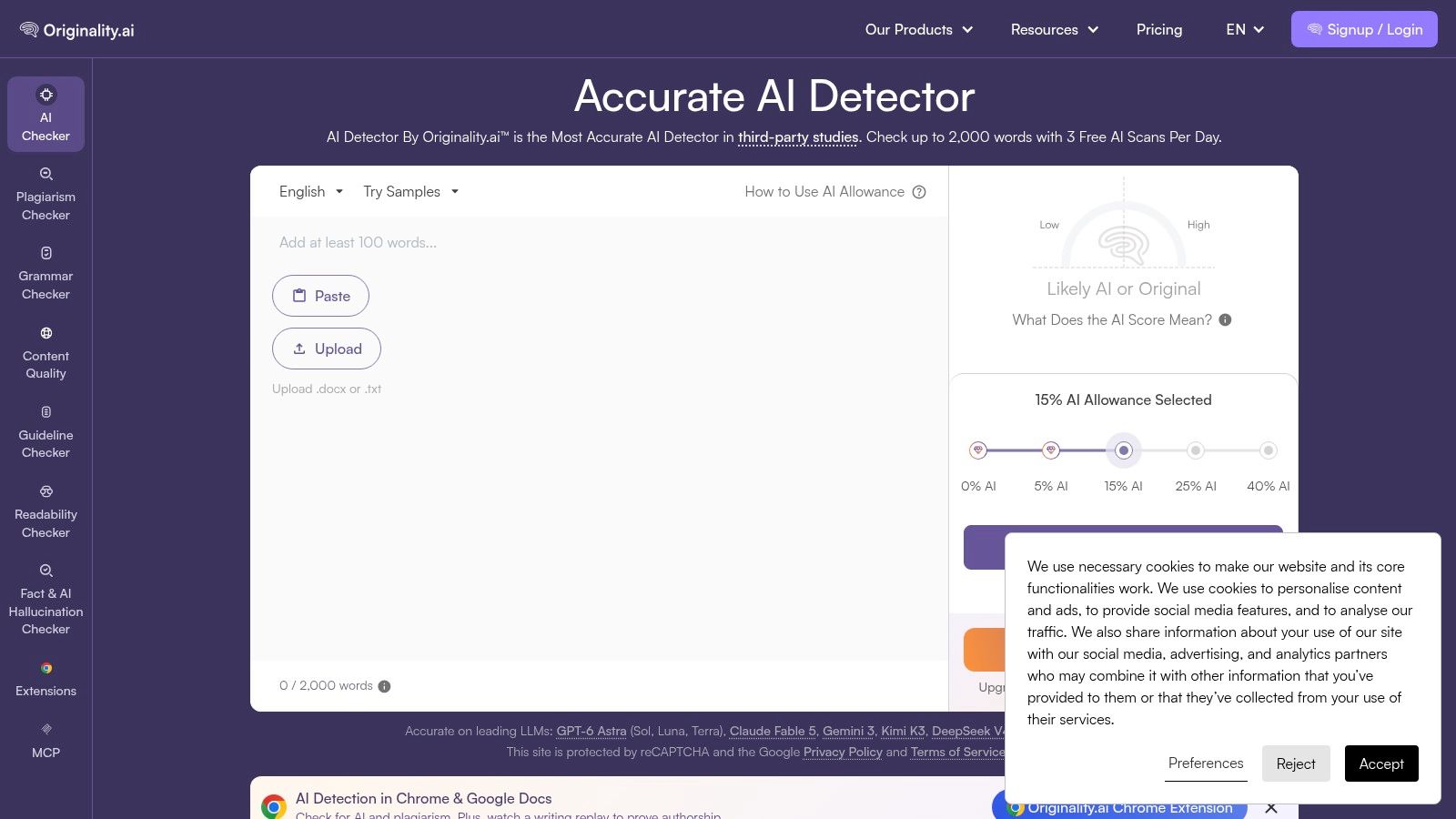
Originality.ai fits publishers who need repeatable review across contributors. Its appeal is less about polishing an individual paragraph and more about managing scans, reports, and team responsibilities.
Originality.ai offers sentence- and document-level AI probability scores, plagiarism checking, team management, project reporting, a browser extension, and API access. Its credit-based scanning model suits editorial operations that need to track usage across a queue of articles.
Best for a managed publishing workflow
Consider an editor reviewing an outsourced article. The useful sequence is to inspect source matches, examine flagged passages, ask the contributor for supporting evidence, and document the final editorial decision.
Originality.ai's reporting and team controls support that process. They don't remove the need to inspect whether a matching passage is properly quoted or whether an AI flag conflicts with the writer's drafts.
- Strength: Team controls and project-level reporting make it more suitable for coordinated publishing than a basic paste-and-check interface.
- Trade-off: Its professional-oriented interface may be excessive for someone checking an occasional cover letter.
- Billing caution: Unused monthly subscription credits expire, so predictable volume matters when choosing a plan.
My recommendation is to choose Originality.ai when review administration is the bottleneck. Choose Unflag when the writer needs to revise the text, not merely hand a report to an editor.
Before purchasing, confirm how credits apply to the scans you intend to run. Don't assume that a visible per-word price covers every feature or that a larger credit balance automatically makes a plan better value.
3. GPTZero
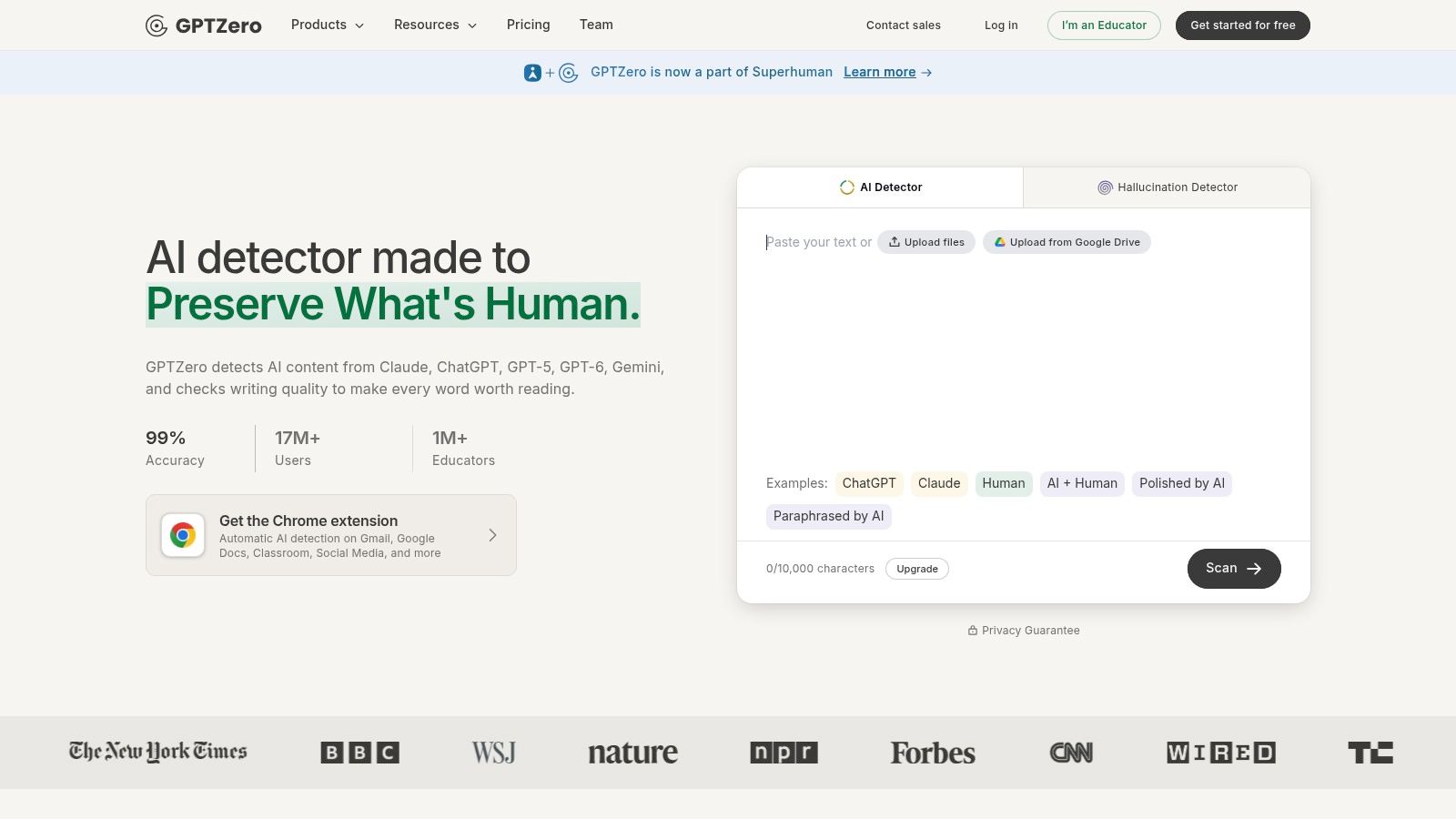
For teachers screening essays and reports, GPTZero offers an education-oriented starting point. Document reporting, sentence indicators, batch uploads, and institutional plans make it more relevant to classroom review than a general rewriting app.
GPTZero provides individual checks alongside EDU and enterprise options, including institutional support and compliance options. The free plan has limits, while advanced functionality requires paid access.
A detector can identify a passage to discuss. It can't replace the discussion.
Use it to guide review, not punishment
A teacher can use a highlighted passage to ask a student about their argument, source selection, or revision choices. A student can use the same feedback to inspect repetitive phrasing before submission, while retaining evidence of how the assignment developed.
Those are more defensible uses than interpreting a sentence indicator as proof. As the opening research illustrates, detector classifications can be wrong in either direction.
For a practical explanation of what these outputs mean, Unflag's guide to AI content detectors distinguishes screening from authorship evidence.
GPTZero's advantage is its educator-oriented reporting and route to institutional deployment. Its limitation is that the report still requires interpretation, especially when text is short, heavily edited, or mixed with material written by the student.
If you're choosing for a school, test the complete review process rather than only the detector interface. Check whether teachers can explain the result, students can respond, and administrators can preserve the evidence behind any consequential decision.
4. Copyleaks
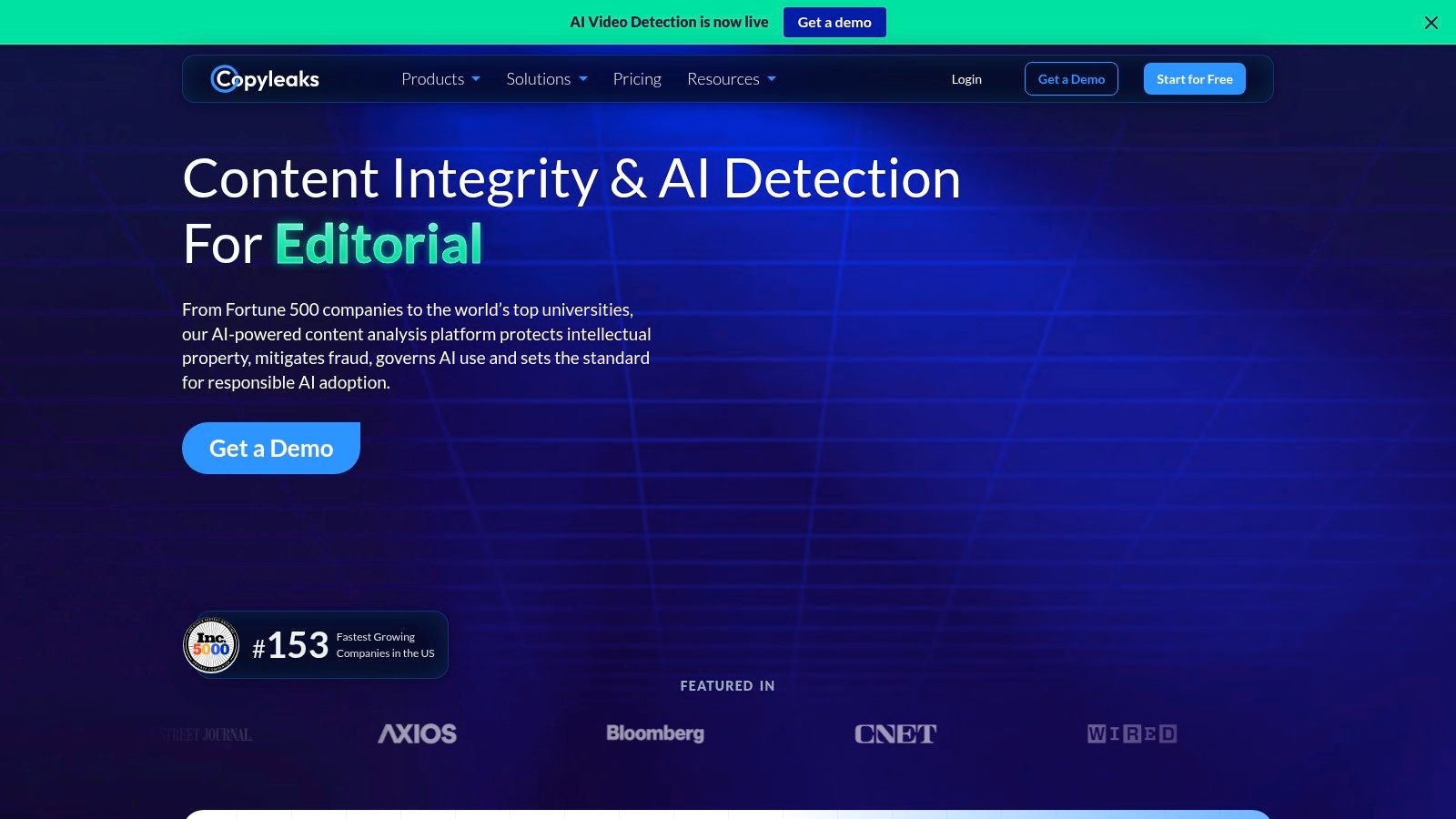
Copied text and AI-generated text aren't the same problem. Copyleaks is worth considering when an organization needs to investigate both within an integrated review environment.
Copyleaks combines AI-content indicators with plagiarism checking and offers a web app, LMS integrations, API access, administrative dashboards, and organizational controls. It also offers image AI detection separately from its text-checking capabilities.
Keep originality and authorship separate
A similarity match identifies material that needs inspection. It might be an appropriate quotation, a reference, or unattributed copying, so an editor or teacher still needs to examine the surrounding context.
An AI indicator answers a different, probabilistic question. Combining the reports can make review more convenient, but it doesn't make either result self-explanatory.
- Best fit: Education and enterprise teams that need originality checks, AI signals, and integrations within an organizational workflow.
- Real advantage: Administrators can manage review through dashboards and policy controls rather than relying on disconnected individual scans.
- Purchasing limitation: Pricing varies by product and use case. Image and video checks are separate modules, not automatically part of a complete text-review plan.
For procurement, list the content types you handle: assignments, website articles, internal documents, or visual assets. Then confirm which modules, integrations, and permissions are included.
I'd choose Copyleaks over a rewriting-first product when organizational originality review is the main requirement. For an individual who mainly wants clearer sentences and factual checking before sending a report, those enterprise capabilities may add complexity without solving the immediate writing problem.
5. Turnitin
Turnitin is an institutional academic-integrity service, not a direct-to-student checker. Its AI-writing indicator sits alongside similarity reporting in an educator-oriented environment, with LMS integrations, administrative controls, and institution-wide reporting.
Access to Turnitin depends on institutional procurement. That makes it a logical consideration for campus deployment, but not a straightforward purchase for someone checking a personal draft.
Its published thresholds need careful reading
Turnitin states that its document-level false-positive rate is below 1% for documents containing at least 20% likely AI-generated writing, while it doesn't display scores or highlights for results between 1% and 19% because false positives were more common in that range, according to its explanation for academic leaders.
The company separately reports an approximately 4% sentence-level false-positive rate in its sentence-level error documentation. Don't confuse that testing metric with the probability that any particular highlighted sentence was written by a person.
Its published information also specifies a 300-word minimum and reports false-positive rates of 0.014 for English-language learners and 0.013 for native English writers in qualifying documents, according to Turnitin's AI-checker information.
- Pros: Campus-oriented integrations, centralized administration, and academic-integrity reporting.
- Cons: Individuals can't buy it directly, and access and pricing depend on the institution.
The practical distinction is deployment versus revision. Turnitin helps an institution review submitted work; Unflag helps a writer revise and check a draft before submission. Neither workflow eliminates the need for sources, writing history, and a fair opportunity to explain the work.
6. Winston AI
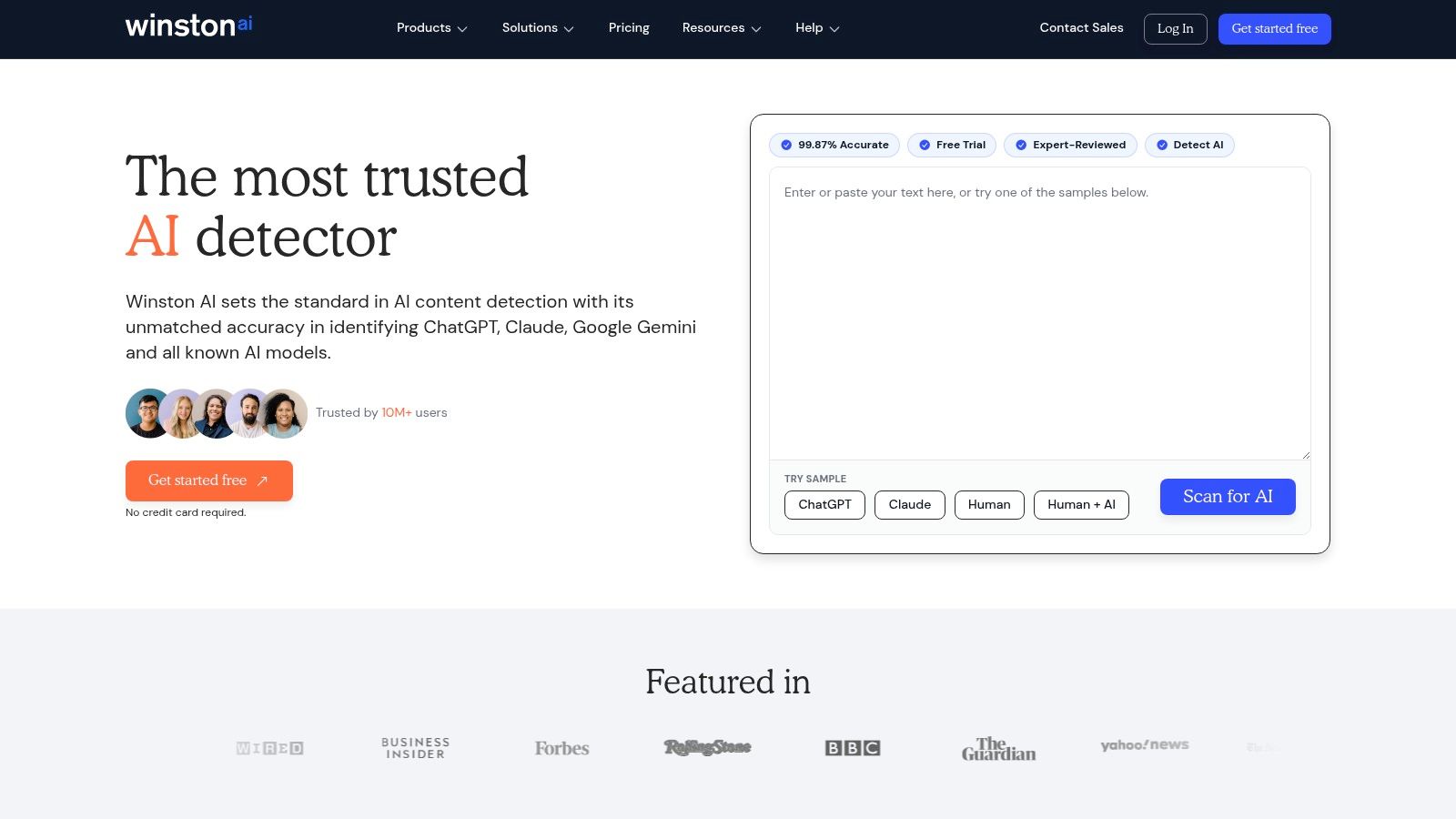
A freelancer handing work to a client may care as much about a readable report as about the scan itself. Winston AI fits that use case with an overall score, sentence-level flags, and shareable PDF reporting.
Winston AI offers reports with timestamps and metadata, browser add-ons, a free tier, and paid plans using monthly credits. Its interface is positioned for educators, freelancers, and publishers who want an accessible checking workflow.
Treat the report as documentation
A dated report can record what was checked and what the tool returned at that moment. It can't certify authorship, establish factual accuracy, or prove compliance with a client's AI-use policy.
An editor should therefore attach meaning to the report through their process. Preserve the submitted version, document any corrections, and record why the final draft was accepted.
- What works well: Clear reports can support communication with clients or instructors.
- What to verify: Lower plans don't include built-in plagiarism scanning, so AI screening and originality review may require different access.
- Pricing caution: Credit allowances, promotions, and plan names can change. Confirm the current package before committing.
Winston AI is a reasonable choice when report sharing matters more than rewriting. It's less suitable as the sole answer to a draft that also needs grammar correction, natural phrasing, and claim verification.
Don't buy a reporting feature to obtain a reassuring score. Buy it if someone in your workflow needs a consistent record, and make sure that person understands what the record does and doesn't establish.
7. Crossplag
Crossplag deserves attention for multilingual and cross-language workflows. It offers web-based AI probability scans for individuals alongside cross-language plagiarism checking and organizational offerings for education and business.
Crossplag provides free individual AI-detector access with usage limits. Advanced plagiarism checking is a separate paid capability, so a free AI scan shouldn't be mistaken for access to the complete originality platform.
Language support isn't universal calibration
A review of multilingual AI detection notes that detectors can be less reliable on non-English or translated writing. Language support is therefore useful, but it doesn't establish equal performance across languages, genres, and editing histories.
For a multilingual student, the useful evidence includes notes, drafts, original source material, and any translation or editing steps. Those records help explain how the final wording developed when a score creates uncertainty.
Better English and a more human-looking detector result aren't necessarily the same outcome.
Crossplag's advantage is its relevance to cross-language originality review, not an independently established claim of superior multilingual detection. Its trade-off is that users must distinguish the free detector from paid plagiarism capabilities.
Before choosing it, confirm support for your actual language and document type. An institution should also specify how it will evaluate translated work and permitted language assistance.
My recommendation is to prioritize Crossplag when cross-language matching is part of the job. If you mainly need fluent rewriting in your own language, a multilingual revision tool may be a closer fit, with detector feedback treated as supplementary.
8. Sapling AI Detector
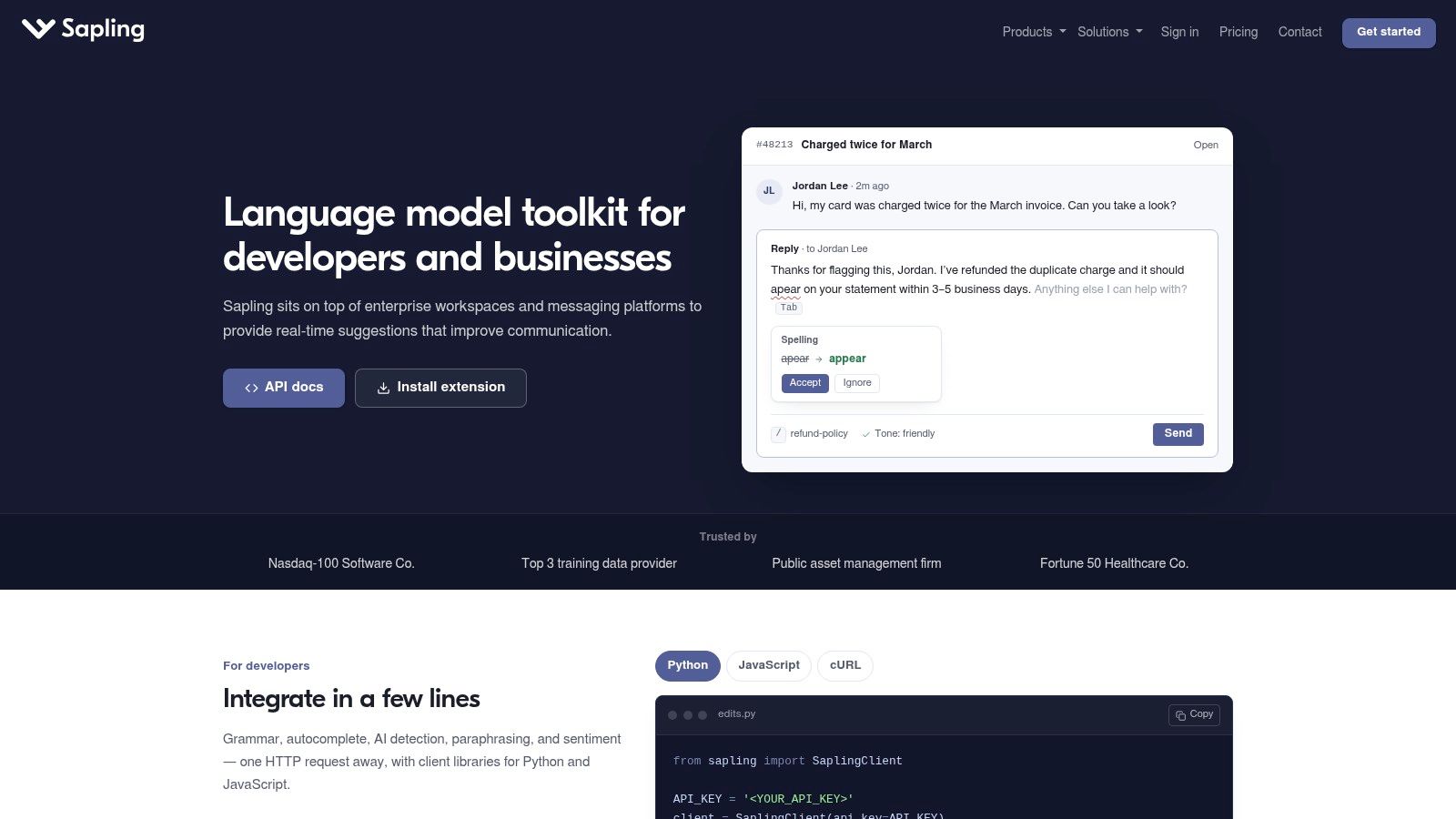
Sapling AI Detector is the developer-oriented choice. It suits teams building text assessment into an application, learning platform, or internal review system rather than asking users to visit a separate checker.
Sapling offers document-, sentence-, and token-level probability outputs, API integration, volume discounts, and sales-led self-hosted and BAA options. Its broader writing-assistance features are available separately.
More detailed outputs require better interpretation
Fine-grained results let developers build interfaces that identify specific passages for review. They also create a risk: users may interpret a detailed display as more certain than the underlying classification warrants.
A highlighted token doesn't establish who wrote it. Product teams need to decide what explanation accompanies the score, when the system recommends human review, and how users can challenge an incorrect interpretation.
- Pros: API integration and granular outputs can support custom review interfaces and organizational policies.
- Cons: Implementation requires engineering resources, and it isn't primarily a consumer dashboard for teachers or students.
- Deployment checks: Confirm hosting, data handling, contractual requirements, and volume pricing with sales where relevant.
Sapling is a better fit than a consumer writing suite when integration control is essential. It's a weaker fit when the user needs to paste an essay, improve its style, and verify claims.
The most useful implementation would preserve the original text and show explanatory feedback alongside any score. A system that automatically rejects content based on an isolated likelihood output would turn an uncertain screening signal into an unsupported decision.
9. ZeroGPT
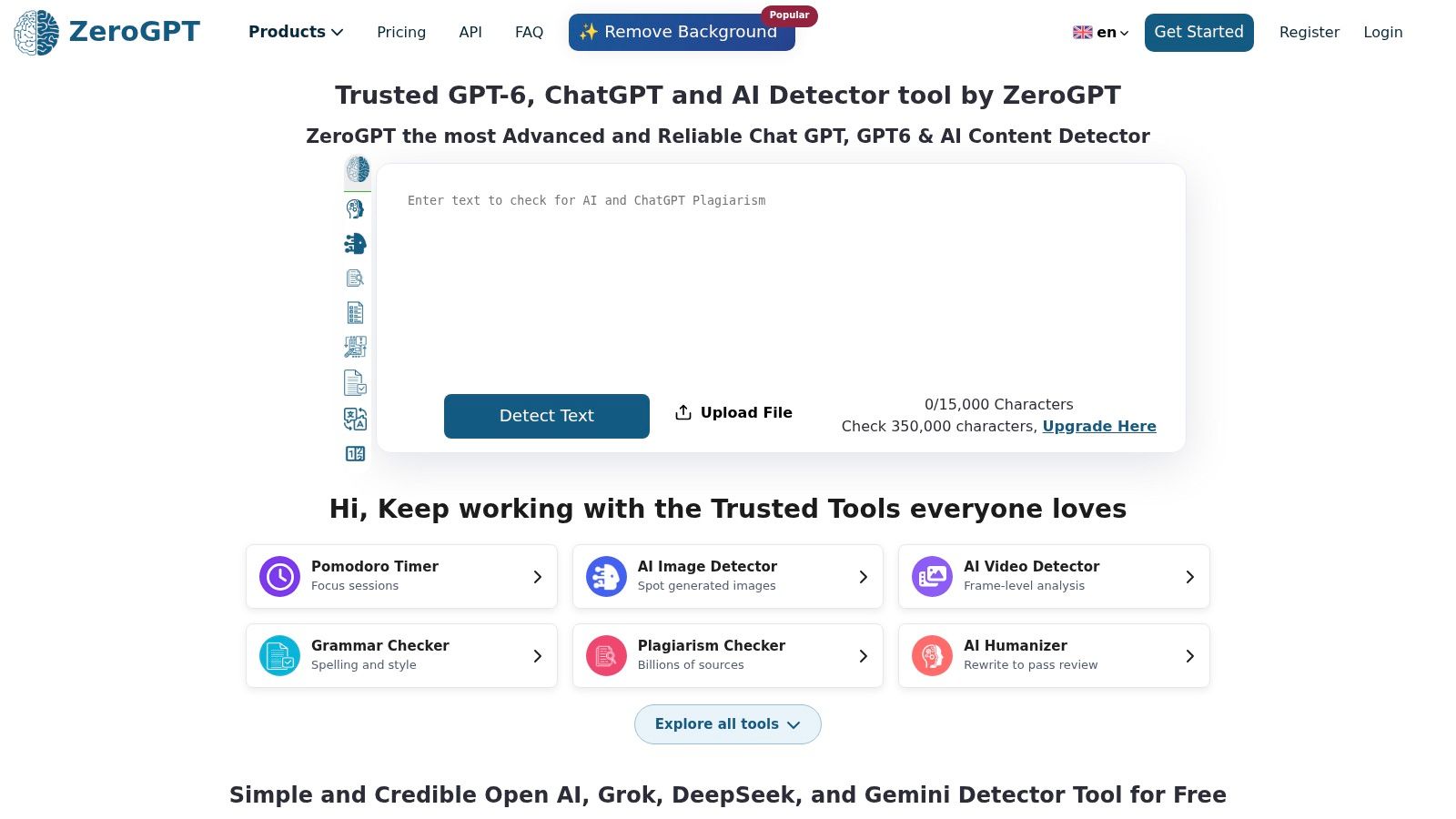
ZeroGPT is suited to quick, low-friction checks. Its general-purpose web interface offers sentence-by-sentence labels and an overall verdict, with free usage available to try.
ZeroGPT also offers API access and personal, business, and education plan types. Some endpoints include multimodal add-ons, so users should confirm the capabilities of the specific plan rather than assuming all features are bundled.
A quick check is still only a screen
The simple workflow is helpful when a writer wants to inspect a draft before sending it. The limitation is that an immediate verdict can encourage an immediate conclusion, particularly when the user hasn't preserved the original or checked the sources.
An experimental evaluation of free and paid detectors examined 100 pre-2020 academic articles and 200 chatbot-generated texts; one free detector assigned the human-authored articles a median AI-generated proportion of 27.2%. That finding isn't a ZeroGPT-specific result, but it illustrates why an apparent AI share shouldn't be taken as established authorship.
- Pros: Free access and a simple interface make initial screening accessible.
- Cons: Similar names, domains, and brands can confuse users, so confirm which service you're using.
- Review requirement: Short or edited text needs cautious interpretation, especially for high-stakes decisions.
ZeroGPT and GPTZero are separate products. When sharing a report, identify the service and preserve the checked version.
Use ZeroGPT for preliminary feedback, then inspect the underlying writing. Another detector may provide additional context, but agreement between tools still isn't equivalent to independent authorship evidence.
10. QuillBot Premium
QuillBot Premium fits writers whose main need is editing, with AI screening nearby. Its suite includes a detector alongside paraphrasing, summarization, translation, and grammar tools.
QuillBot also offers team plans for classrooms or small groups. That makes it relevant to users who already rely on its writing tools and don't want a separate application for an occasional AI check.
Best for grammar and paraphrasing
A job seeker revising a cover letter may benefit more from removing awkward wording than from repeatedly checking an AI score. QuillBot's grammar and paraphrasing tools address that immediate editing task.
Its trade-off is lighter reporting and organizational control than dedicated institutional services. Annual billing may be worth comparing with standalone subscriptions, but without a current, like-for-like price comparison, it shouldn't be described as the cheapest option.
- Strength: Common writing tools and AI screening in the same suite.
- Limitation: It isn't primarily a specialized enterprise detection or academic-integrity platform.
- Editorial caution: A clearer paraphrase can still distort a claim or require attribution.
Unflag's guide to humanizing AI-generated text explains the distinction between improving naturalness and merely replacing words.
For an illustrative edit, compare “I am writing to express my profound enthusiasm for the opportunity to contribute to your organization” with “I'm interested in this role because it matches the work I want to do.” The latter is more direct, but the writer still needs to add a truthful, specific reason.
Choose QuillBot when grammar, translation, and paraphrasing dominate your workflow. Choose Unflag when you also want integrated claim checking and a humanizing-first revision process.
Top 10 AI Writing Checkers: Feature Comparison
| Product | Core Capabilities | Standout Advantage | Best For | Access / Pricing |
|---|---|---|---|---|
| Unflag, Recommended | Humanizes and paraphrases text, detects AI content, and fact-checks claims | Combines writing tools and fact-checking; supports multiple languages and native mobile apps | Students, writers, professionals, and multilingual users | Free plan; Plus is $45.99/year, with 45× more usage and fact-checking |
| Originality.ai | AI detection, plagiarism checks, team reporting, API | Bulk scanning and editorial workflow controls | Publishers, SEO teams, and content operations | Per-credit pricing; monthly credits may expire |
| GPTZero | AI detection, sentence indicators, batch uploads, LMS reporting | Education-focused tools and institutional plans | Educators and schools | Limited free plan; paid tiers available |
| Copyleaks | AI detection, plagiarism checks, LMS integrations, API | Combines AI and originality checks with organizational controls | Education and enterprise teams | Pricing varies by product and use case |
| Turnitin | AI indicators, similarity reports, LMS integrations | Established campus-scale reporting and workflows | Institutions and educators | Institutional procurement; not sold directly to individuals |
| Winston AI | AI scores, sentence flags, PDF reports | Shareable reports and a free tier to try | Educators, freelancers, and publishers | Free tier; paid plans use monthly credits |
| Crossplag | AI detection and cross-language plagiarism checks | Multilingual and cross-language workflows | Individuals, education, and business users | Free limited scans; advanced plagiarism checking is paid |
| Sapling AI Detector | Fine-grained AI scores and API | API-first design with volume and deployment options | Developers and platform teams | API pricing; volume discounts available |
| ZeroGPT | AI detection, sentence highlights, API options | Simple interface and free usage | People needing quick checks | Free usage; plan options vary |
| QuillBot Premium | AI detection, paraphrasing, summarizing, translation, and grammar tools | AI checks bundled with a broader writing suite | Existing QuillBot users, classrooms, and small teams | Premium and team plans; pricing not specified |
Choose a Checker by Purpose, Not by Score Alone
A detector score cannot decide whether a draft is accurate, well written, or compliant with a policy. Choose a checker based on the decision you need to make, then treat its score as one piece of evidence.
Unflag combines natural rewriting, multilingual support, AI detection, and Plus fact-checking. Originality.ai fits publishing operations, GPTZero and Turnitin support education-oriented review, Copyleaks combines organizational originality checks, and Sapling suits custom integrations. These tools serve different workflows, so a single score is not a fair comparison.
Compare the jobs before comparing scores
Use the same four-part framework for each candidate:
- Detection: Does it explain its result and flag passages for review?
- Language editing: Can it improve grammar and tone while preserving meaning?
- Factual review: Can you inspect supporting sources, rather than just receive a fluent rewrite?
- Workflow: Can writers revise, reviewers document decisions, and both preserve the original?
Policy matters too. A UNESCO survey conducted in May 2023 found that fewer than 10% of more than 450 schools and universities reported formal guidance on generative AI. That historical finding underscores why reviewers should interpret detector results in the context of an institution's rules, rather than treat them as a technical verdict.
What a useful human edit looks like
The following are illustrative editorial examples, not tested product outputs.
Robotic draft
Effective communication is an essential component of successful collaboration. By utilizing clear communication practices, teams can facilitate improved understanding and enhance the execution of shared objectives.
Natural revision
Teams work better when people explain what they need and ask when something isn't clear. Clear updates help colleagues understand the plan and coordinate their work.
The revision replaces abstract phrasing with specific actors and simpler verbs, without adding a statistic or claiming a measured result. A human editor should also consider whether the general statement belongs in the document, or whether a specific example would be more useful to readers.
Follow a review sequence you can explain
- Preserve the original. Keep drafts, notes, source material, and revision history.
- Check the rules. Confirm what AI assistance is permitted and whether disclosure is required.
- Review factual claims. Open supporting sources and correct statements that lack evidence.
- Revise the language. Remove repetition and awkward phrasing without changing the argument.
- Interpret detector feedback. Investigate flagged passages alongside authorship evidence; a flag alone is not proof of a violation.
A polished draft may still contain factual errors. A detector flag, likewise, does not prove that a writer broke a rule.
For a practical editing check, paste a draft into Unflag's AI Humanizer and compare the rewrite with your original. Its AI Detector and Plus fact-checking can support further review, but no humanization claim guarantees that a draft will pass GPTZero, Turnitin, or another third-party system.
Unflag brings rewriting, paraphrasing, detection, and Plus fact-checking into one workflow. Try the Unflag AI Humanizer with a draft, assess the changes against your original, and check factual claims before submitting or publishing.
More guides
View allBest AI Writing Tools for Students: 10 Picks for 2026
Compare 10 AI Writing Tools for Students, covering drafting, humanizing, citations and AI detection, with honest pros and cons for each.
How to Humanize AI Generated Text Without Losing Meaning
Learn how to humanize AI generated text with proven techniques, real before and after examples, and a workflow that preserves facts, voice, and accuracy.
AI Content Detector: How It Works and What Your Score Means
Learn how an AI content detector scores text, why results vary, and what limits to expect. Practical guidance for interpreting detector output in 2026.
10 Best AI Text Rewriter Free Tools for 2026
Compare the best AI text rewriter free tools for 2026, with word caps, privacy limits, before-and-after examples and tips for reliable rewrites.