By Unflag Team
Best AI Detector in 2026: 7 Tools Compared
Compare the best AI detector tools of 2026 on accuracy, languages, speed and use case. See free plans, scan limits, pros and cons before you choose.
Picking the detector with the highest advertised accuracy is bad advice. The best AI detector depends on the decision its score will inform, whether you're reviewing your own essay, screening freelance copy, or investigating a potential policy violation. These seven tools are ranked by workflow fit, available accuracy signals, language coverage, and ease of checking text, not by an invented head-to-head benchmark.
Unflag's AI Detector leads for writers who want detection, rewriting, and fact-checking together. But no detector proves authorship: Liang and colleagues' study found that seven detectors incorrectly classified an average of 61.22% of human-written TOEFL essays by Chinese students as AI-generated.
A rewrite can improve the writing without proving anything about its origin:
Robotic draft: Effective communication plays a vital role in facilitating successful collaboration. In addition, clear messaging contributes to improved organizational outcomes.
Natural rewrite: Teams work better when people explain what they need. Clear messages help colleagues make decisions without another round of emails.
Apply this reading method to every result:
- Check the label: Is it document classification, estimated text coverage, or confidence?
- Inspect the passage: What exactly was flagged?
- Consider the context: Was the writing translated, grammar-corrected, or collaboratively edited?
- Verify separately: Review drafts, sources, and the applicable AI-use policy.
Table of Contents
- 1. Unflag AI Detector
- 2. GPTZero
- 3. Originality.ai
- 4. Copyleaks
- 5. Winston AI
- 6. Scribbr AI Detector
- 7. QuillBot AI Detector
- How the seven AI detectors compare on free access, best use case, result format and language coverage
- Which AI Detector to Use When the Stakes Are High
1. Unflag AI Detector
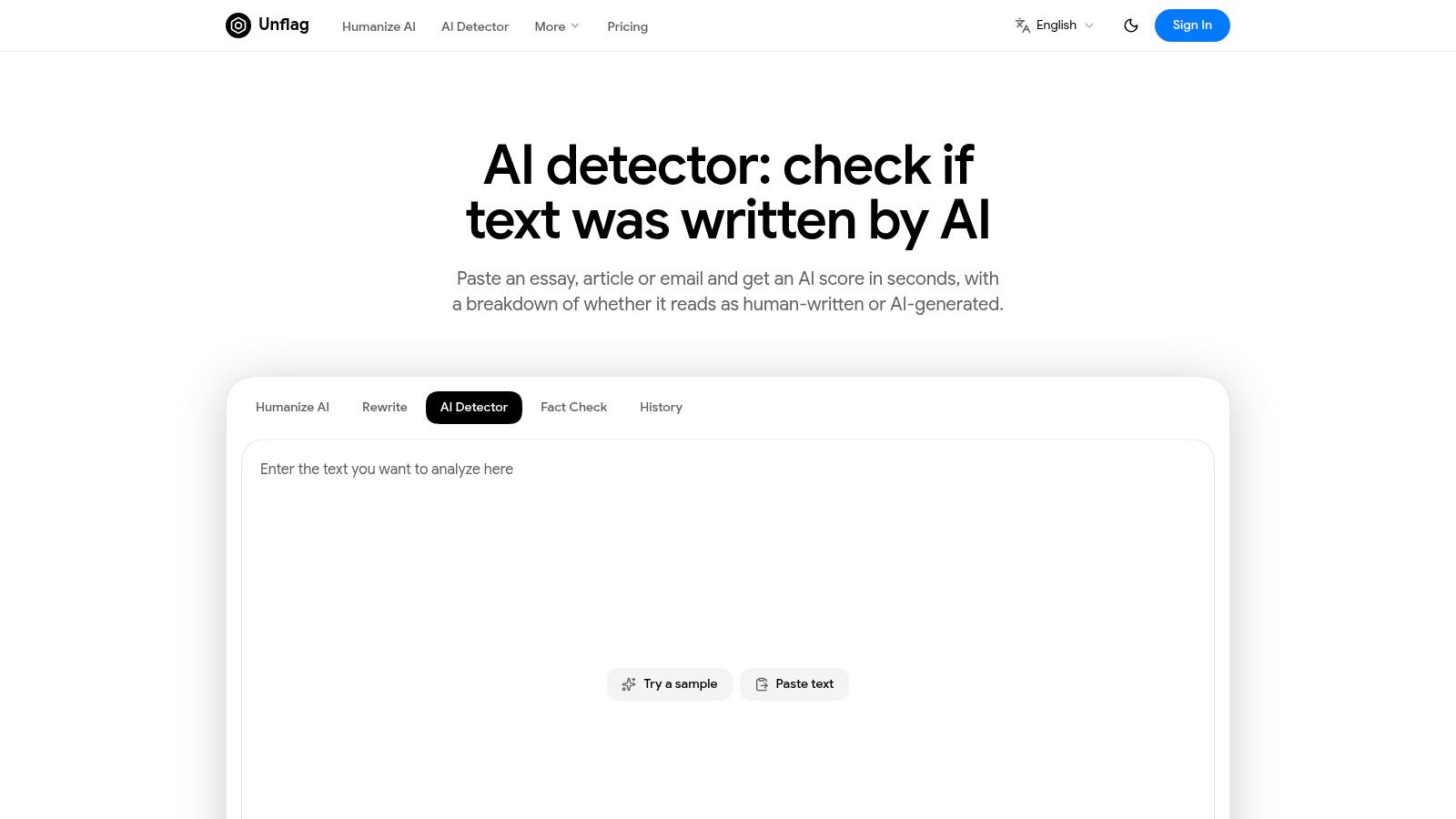
Best for students, multilingual writers, and professionals checking a draft before submission. Our detector earns the first position because checking text is rarely the final task. Writers also need to fix awkward phrasing, preserve their meaning, and verify claims.
The detector provides an AI Score and readable feedback, including classifications such as likely human-written. It sits alongside a humanizer, paraphraser, and fact checker, so you can assess a passage and work on its actual weaknesses without moving between unrelated services.
The toolkit works across multiple languages and runs on the web and native iOS and Android apps. It's free to start, including AI detection, making it practical for an essay, cover letter, article, or business report.
What the accuracy claim does and doesn't establish
Our most advanced model delivers 99.5% accuracy for essays, research papers, reports, and articles. That product claim isn't a substitute for a published detector benchmark describing test samples, classification thresholds, and subgroup false-positive rates.
Don't interpret it as a personal guarantee that your document will receive the correct classification. The detector page doesn't provide enough methodological detail to compare its performance directly with every competitor under identical conditions.
Better writing is the goal. A lower detector score is only feedback.
The humanizer helps AI drafts read naturally and pass detectors such as GPTZero and Turnitin. Results vary by detector, and bypassing a third-party system isn't guaranteed. Keep your original draft and follow any disclosure requirements that apply to your assignment or publication.
- Main advantage: Detection, humanizing, paraphrasing, and claim checking share one workflow.
- Main trade-off: A convenient writing toolkit doesn't replace independent evidence of authorship.
- Best next action: Review the flagged passage for vague language, unsupported statements, and wording that doesn't sound like you.
Paste your text into our AI Humanizer, it's free to start. Use the Paraphrasing Tool for targeted wording changes and the Fact Checker when a draft contains claims that need verification.
2. GPTZero
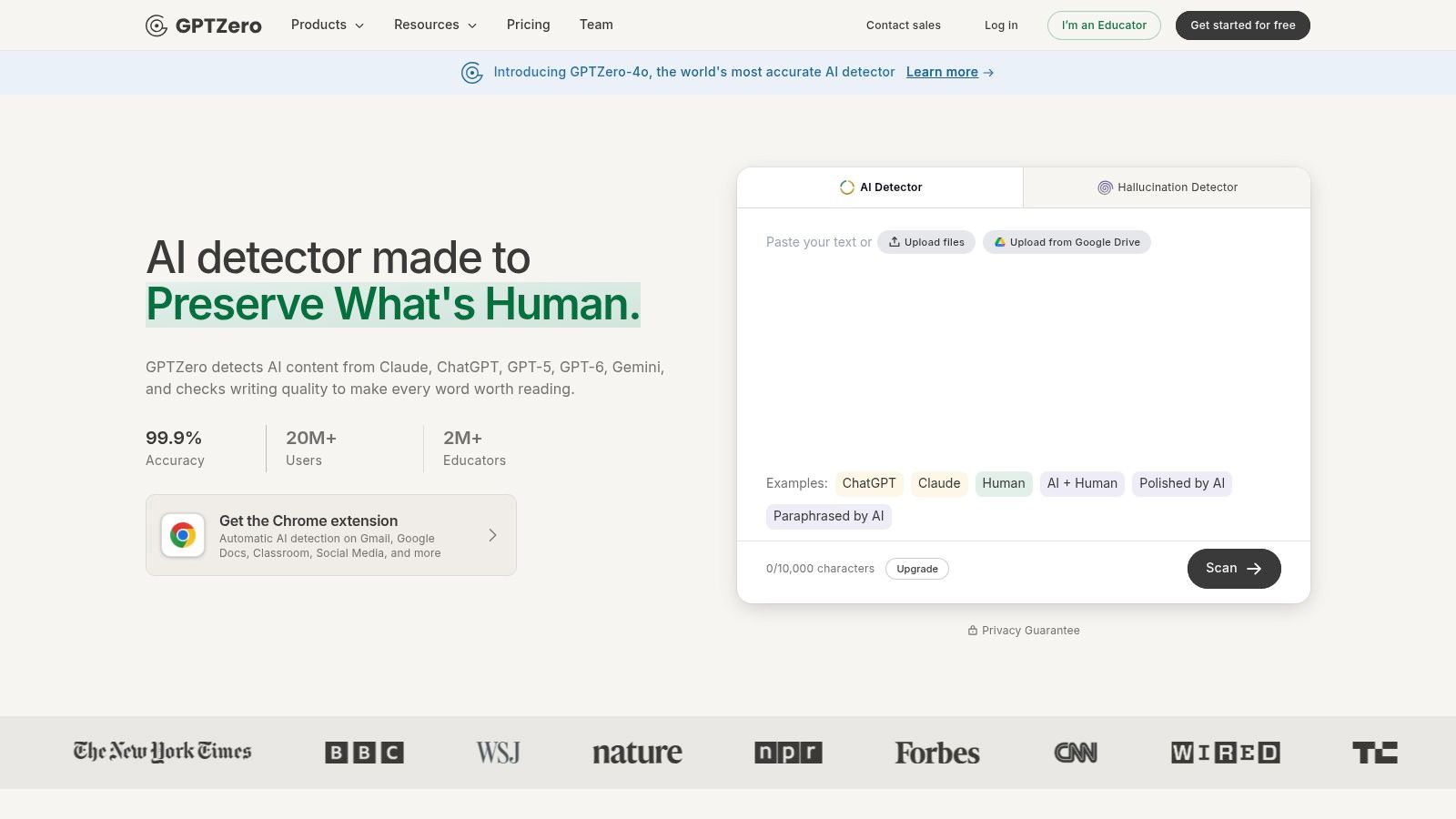
A teacher reviewing an essay needs more than a document-wide label. GPTZero is a useful fit when the next decision is which passages deserve a closer look, rather than whether an entire document should be rejected.
It accepts pasted text and uploaded files, with document-level classification and sentence-level highlighting through Advanced Scan. A free plan supports initial checks, while higher tiers add access to features such as writing feedback, plagiarism checking, and institutional integrations.
Its education-oriented workflow is the main attraction. Teachers can inspect a passage in context, and writers can compare a highlighted section with their notes rather than treating the document score as a complete explanation.
Read the highlights as prompts for review
A flagged sentence doesn't establish that a student generated it with AI. It doesn't identify who wrote the ideas, which editing tools were used, or whether any permitted assistance crossed an institutional boundary.
For example, a conventional methods paragraph may sound formulaic because the assignment requires conventional terminology. Ask whether the writer can explain the method and show the source material before drawing an authorship conclusion.
- Choose it for: Passage-level review, educational workflows, and a first look at suspicious sections.
- Watch for: Free-plan restrictions and differences in the analysis available across tiers.
- Don't assume: A tool that supports a language has equally strong validation for every proficiency level or genre.
For similarly named products, the GPTZero versus ZeroGPT comparison helps distinguish the services. Keep the choice tied to the reports and workflow you need, not the resemblance between their names.
3. Originality.ai
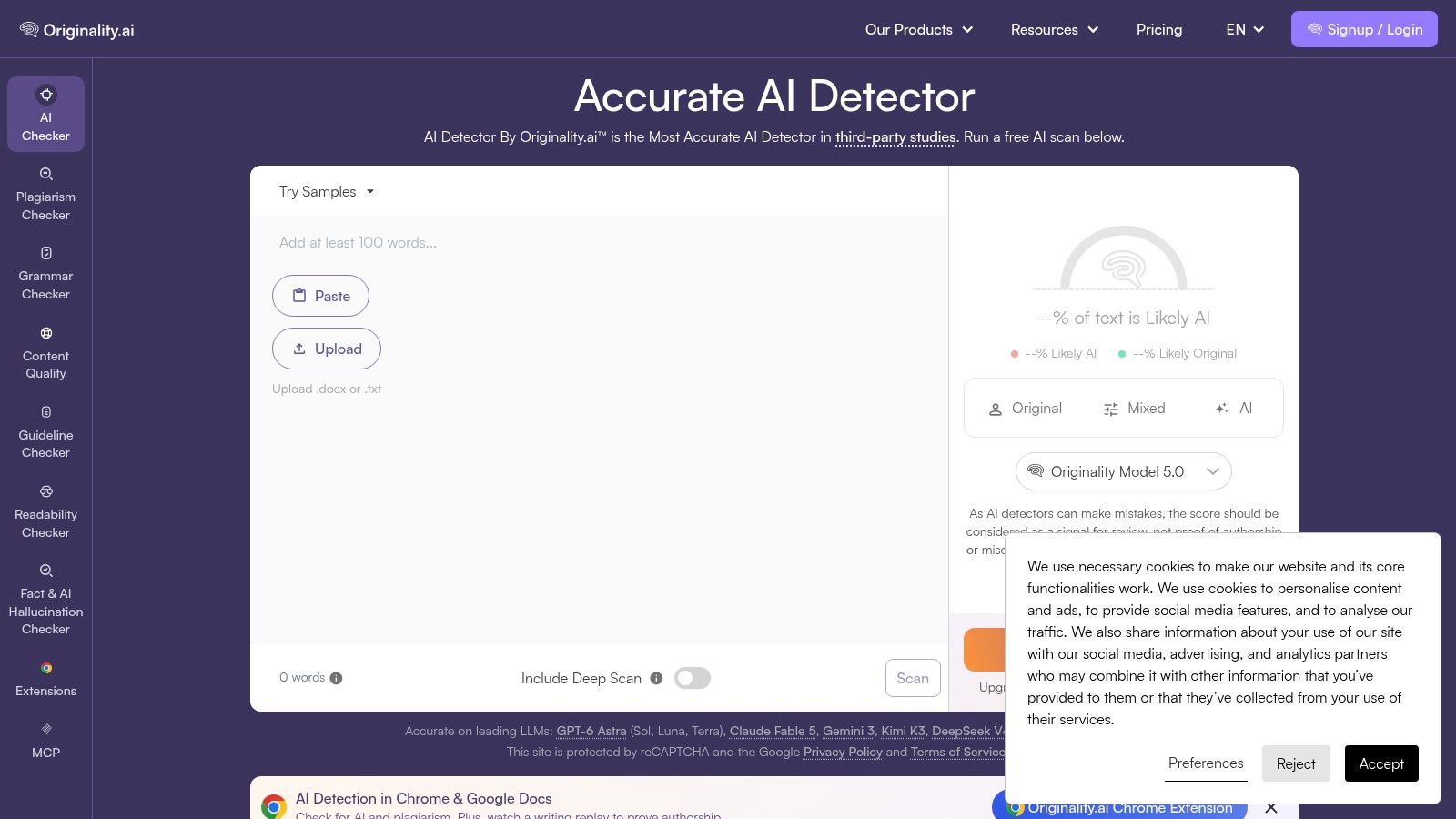
Originality.ai is the strongest fit here for editors screening freelance drafts and agencies reviewing publishable content. Its appeal is the surrounding editorial toolkit: plagiarism, readability, grammar, and fact-checking features alongside AI detection.
Sentence highlighting and a mixed human/AI category give editors more useful review options than a simplistic binary label. Bulk scanning and API access also suit recurring content operations better than manually pasting every article into a consumer checker.
The trade-off is credit management. Teams need to understand which checks consume credits and avoid running every available analysis on every revision just because the option exists.
Separate authorship concerns from editorial defects
Say a freelancer submits a polished buying guide with unsupported product claims. An AI score won't tell you whether those claims are accurate, and a human classification won't make them safe to publish.
A sensible editorial sequence is:
- Verify the brief: Check whether the contributor followed the assignment and AI-use agreement.
- Inspect sources: Confirm that references support the claims being made.
- Review overlap: Investigate plagiarism separately from AI classification.
- Discuss flagged passages: Request notes or revisions before making a contractual judgment.
The academic-writing detector evaluation found that a free detector labeled a median of 27.2% of genuine academic articles published before widespread generative AI as AI-generated. That finding concerns the evaluated detector, not an accuracy result for Originality.ai.
For practical screening guidance, the AI content detector guide explains how to keep classification separate from a final publication decision. Choose this platform for repeatable editorial review, not as an automatic freelancer rejection system.
4. Copyleaks
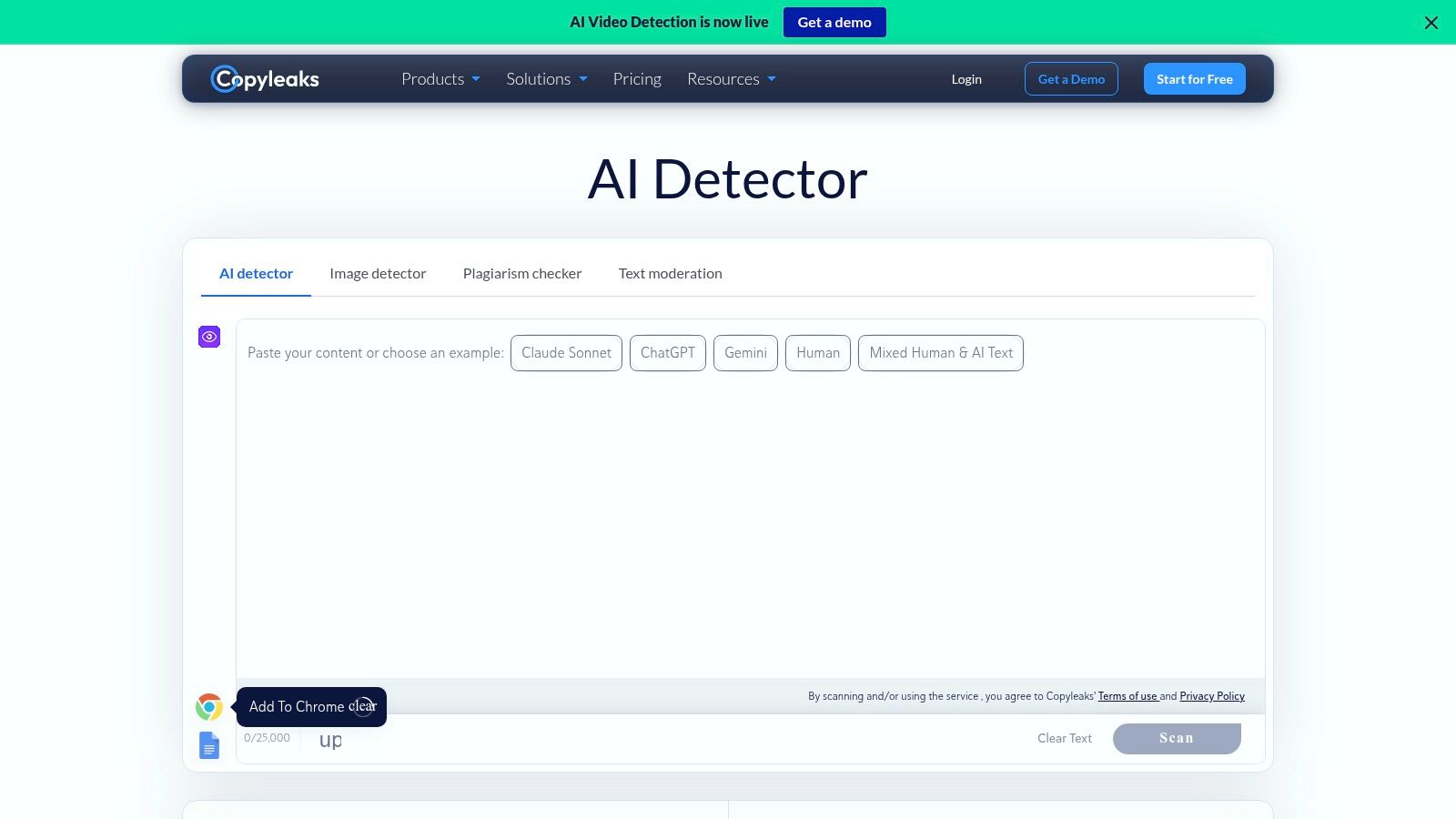
For a school or organization embedding checks into existing systems, integration matters as much as the report. Copyleaks offers LMS connections, API options, a browser extension, and a Google Docs add-on.
Its detector flags AI-related passages within mixed writing, while AI Logic provides additional context about influential signals. Plagiarism checking is available within the broader platform, which can simplify procurement for organizations that need both functions.
A free scan provides a way to inspect the interface before committing. Higher-volume use and organizational capabilities require paid access or a sales-led arrangement, so an institutional pilot should test permissions, reporting, and review procedures alongside detection.
Pilot the decision process, not just the software
Before rolling out checks across an LMS, give reviewers clear instructions on what happens after a flag. Otherwise, the same output may trigger a conversation in one classroom and an accusation in another.
Practical rule: Automate routing and documentation, not findings of misconduct.
- Pilot representative writing: Include multilingual work, discipline-specific assignments, and permitted AI editing.
- Keep review accountable: Assign a named person to inspect context and speak with the writer.
- Test the integration: Confirm who can see reports and how a student or employee can challenge an interpretation.
- Keep checks distinct: Text overlap and AI classification answer different questions.
Institutional buyers should also read how established vendors describe uncertainty. Turnitin's model guidance withholds percentages and highlighted passages for results from 1% through 19% because false positives are more likely in that range.
That policy isn't a Copyleaks performance measure. It's an example of why institutions should define low-confidence handling before anyone uses detector output in a disciplinary process.
5. Winston AI
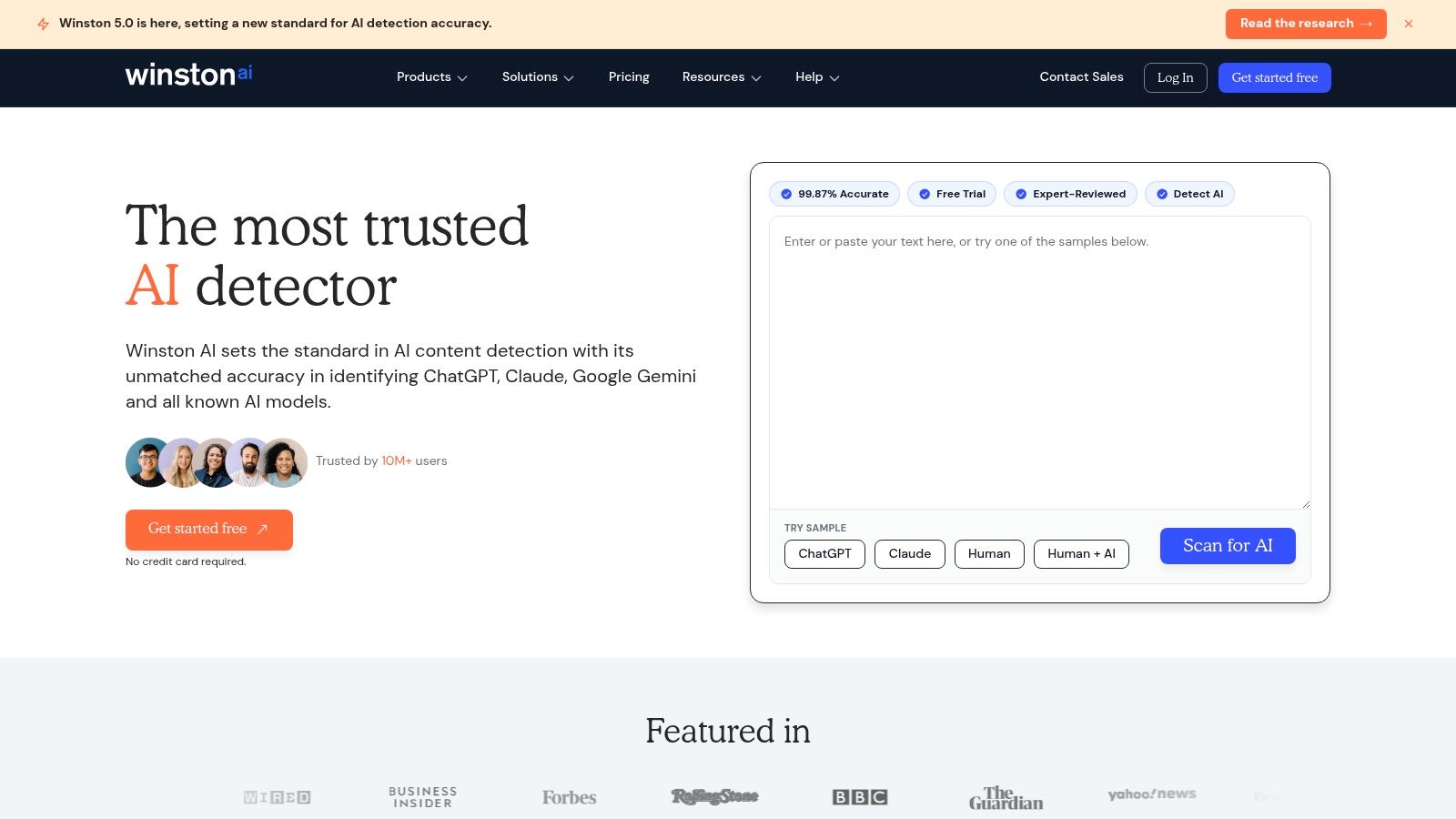
Some reviewers need a report they can inspect and share, not just a result on a screen. Winston AI suits document-based review, combining an overall Human Score with a sentence-level AI Prediction Map and report exports.
It accepts pasted text and documents and offers plagiarism checks and writing feedback. AI image and deepfake detection broaden the platform beyond text, although those features won't matter to someone checking an essay.
The sentence map helps reviewers locate passages for discussion. Its limitation is interpretive: highlighting can look more definitive than the underlying inference warrants, especially when a reader assumes every colored sentence represents confirmed AI use.
Compare the meaning of scores before comparing scores
A Human Score isn't automatically interchangeable with another platform's estimated AI text percentage. Read the report definition before converting a result into a claim about how much someone wrote.
- Useful for: Document review, exported reports, and examining sentence-level patterns.
- Less suitable for: Buyers who need unrestricted use without tracking credits.
- Trial priority: Test your own language, file formats, and document types before choosing a paid workflow.
An independent detector benchmark found that one evaluated system achieved an AUROC of 0.89 yet detected fewer than 20% of AI-written samples at a 1% false-positive rate. This wasn't a Winston AI performance result; it illustrates why a strong headline metric can conceal weak detection at a cautious operating threshold.
For procurement, ask for evidence tied to the threshold your organization will use in practice. A report that looks clear is valuable, but visual clarity and classification reliability are separate qualities.
6. Scribbr AI Detector
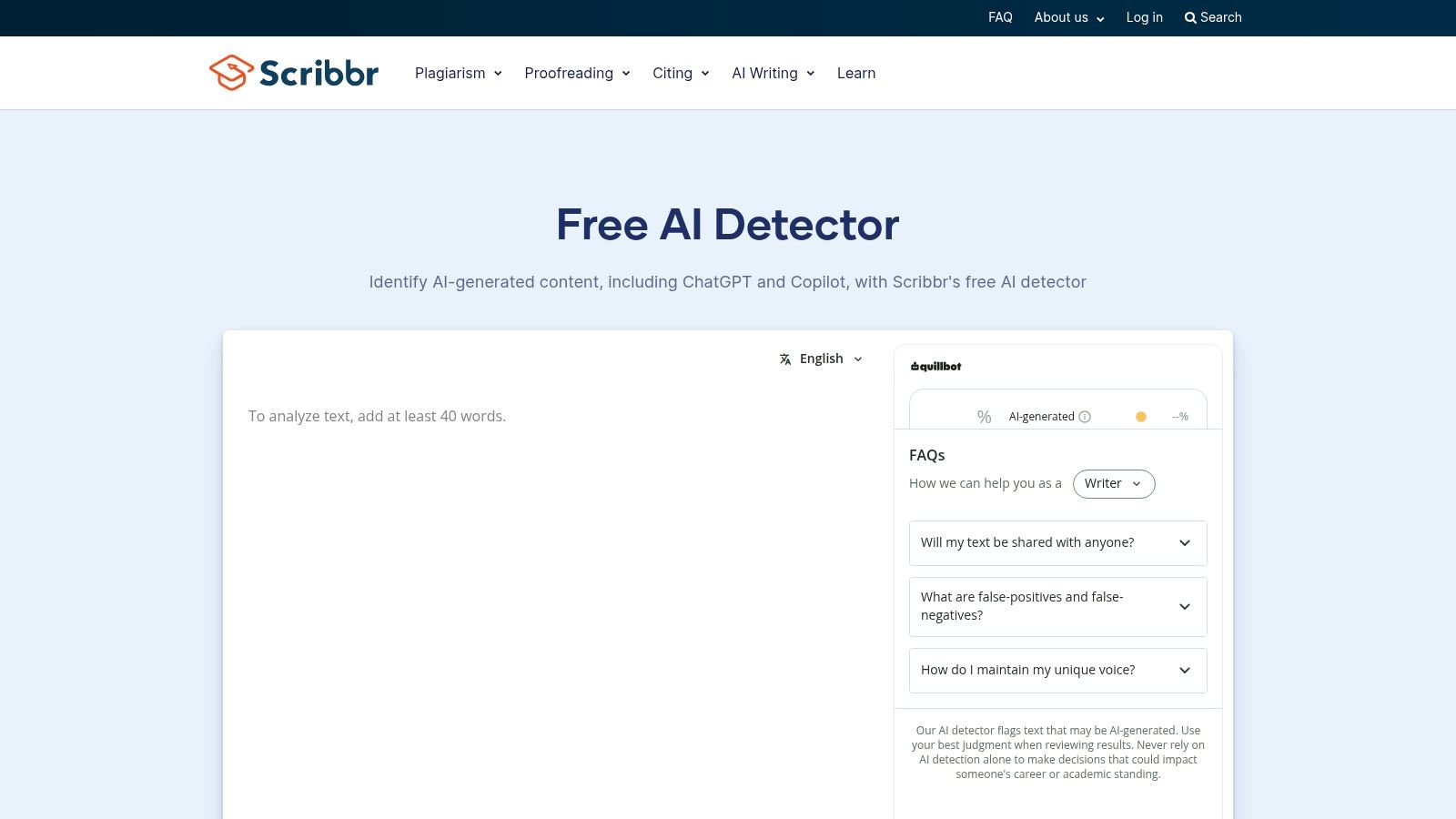
Scribbr's AI Detector is a practical starting point for a student who wants a quick check without creating an account. Its free detector suits short passages, while premium options accommodate longer-document checking and more detailed classifications.
The premium categories acknowledge a distinction that matters in real academic work: fully generated text isn't the same as human writing refined with AI. Students may use permitted grammar assistance without delegating the underlying reasoning or composition.
Those categories are useful descriptions, not proof that a detector can reconstruct the writing process. Keep your drafts and understand your course policy rather than relying on the category you prefer.
Use a student checker without chasing a perfect result
Suppose you wrote an essay yourself and used a grammar tool to improve verb agreement. If the detector flags the edited introduction, don't immediately rewrite it into unnatural English or remove accurate academic terminology.
Instead, compare the passage with your original draft. Check whether the grammar tool changed meaning, introduced unsupported claims, or replaced your vocabulary with language you wouldn't normally use.
- Main advantage: Low-friction access for an occasional check.
- Main limitation: Free submission limits and paid access for more extensive analysis.
- Best supporting evidence: Notes, outline revisions, document history, and an honest account of permitted assistance.
A detector can flag a writing pattern. It can't establish who developed the argument.
For students, the useful outcome is a clearer draft and a defensible writing process. A reassuring score doesn't excuse prohibited assistance, and an alarming one doesn't erase genuine authorship.
7. QuillBot AI Detector
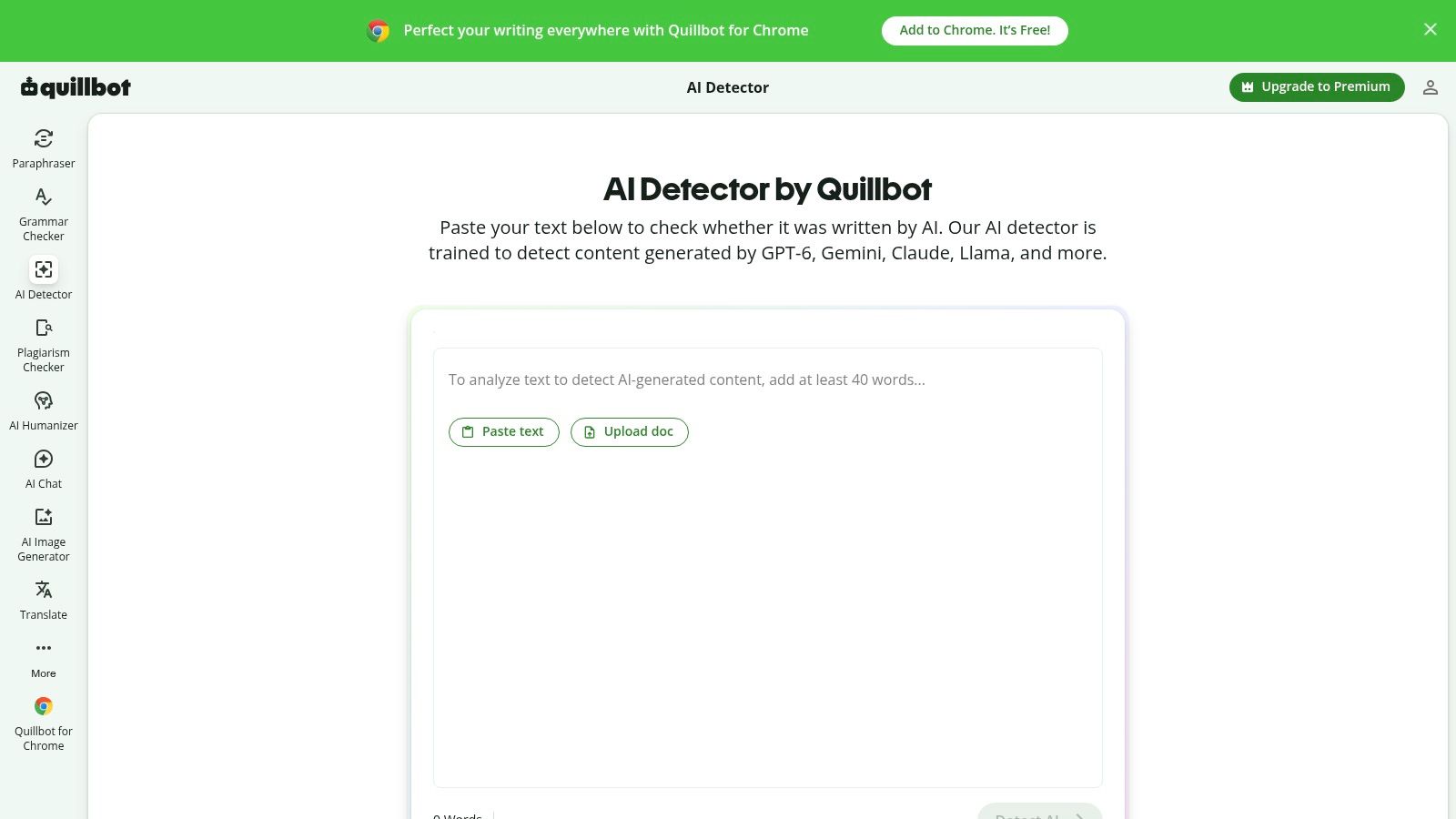
Already using QuillBot for grammar and paraphrasing? QuillBot's AI Detector is convenient for checking text without leaving that writing environment. It provides a detection score and explanations for flagged sections, with deeper explanations available through Premium.
The free version has daily and per-scan limits. That makes it suitable for occasional checks, while frequent users need to consider whether paid access matches their workload.
Its main strength is convenience, not a demonstrated right to overrule another detector. A score from a familiar writing platform still needs the same contextual reading as a score from a dedicated detection service.
Watch what happens between versions
When you paraphrase a passage, compare meaning before comparing scores. A rewrite that changes a qualification, drops a citation, or makes a tentative claim sound certain is a worse draft even if the detector result improves.
Use this review order:
- Meaning first: Preserve the author's actual claim and necessary caveats.
- Evidence second: Keep citations attached to the statements they support.
- Voice third: Replace generic phrasing with clear, specific language.
- Detection last: Treat the new result as feedback rather than certification.
The QuillBot alternative with an AI detector comparison is useful if you want rewriting and checking in a different combined workflow.
QuillBot is a reasonable choice for existing users who value a quick check beside their editing tools. It's less compelling if your main requirement is institutional case management, a publishing review pipeline, or independently demonstrated performance for a specific language group.
How the seven AI detectors compare on free access, best use case, result format and language coverage
| Item | Free Option | Best For | Result Format | Language Coverage |
|---|---|---|---|---|
| Unflag AI Detector | AI detection included in free plan | Writers seeking detection alongside writing tools | AI score with plain-language feedback | Multiple languages; specifics not stated |
| GPTZero | 10,000 words per month; scans up to 10,000 characters with limited file uploads | Students, teachers, and writers | Document-level classification and sentence highlighting | English, Spanish, French, German, and others |
| Originality.ai | Free option not specified; offers subscriptions and one-time credits | Publishers and editorial teams | AI detection with sentence highlighting and mixed human/AI category | More than 30 languages, according to the company |
| Copyleaks | Free scan up to 25,000 characters | Schools and organizations | AI-related passage detection with additional context signals | More than 30 languages, according to product information |
| Winston AI | 2,000-credit trial for 14 days | Reviewers needing sentence-level analysis and content-integrity checks | Human Score and sentence-level AI Prediction Map | Multiple languages, including English, Spanish, and Chinese |
| Scribbr AI Detector | Up to 1,200 words per submission; no account required | Students checking short passages | AI-generated, AI-refined, or human-written and AI-refined categories | English, German, French, and a separate Dutch option |
| QuillBot AI Detector | Up to six scans per day and 1,200 words per scan | QuillBot users seeking a quick writing check | Detection score with limited explanations | Not specified |
Which AI Detector to Use When the Stakes Are High
The best AI detector is the one that supports your next responsible action. Choose a writing toolkit for revision, passage-level feedback for discussion, or organizational integrations for a managed review process.
For a student checking a draft, our combined workflow is the first choice when rewriting and verification matter; Scribbr offers straightforward one-off access, while GPTZero suits closer passage review. For an editor screening freelance work, Originality.ai aligns with recurring editorial checks, and Winston AI suits document-oriented reporting.
For a school deploying LMS-wide checks, evaluate Copyleaks and GPTZero through a representative pilot. A non-native writer should prioritize fluency, meaning, and draft history rather than repeatedly changing authentic writing to satisfy a classifier.
A high-stakes score-reading checklist
- Define the result: Identify what the percentage or label actually measures.
- Inspect in context: Read the surrounding paragraph, not just the highlight.
- Account for editing: Record translation, grammar assistance, and collaboration.
- Check independent evidence: Review sources, drafts, and version history.
- Apply the policy: Separate permitted assistance from prohibited conduct.
- Give the writer a response: Discuss discrepancies before taking adverse action.
A detector score is evidence to review, not a verdict to enforce. Don't combine conflicting outputs into an improvised majority vote or assume repeated scans establish authorship.
Paste a draft into the free AI Detector, review the passages that need attention, and use the AI Humanizer if the writing sounds formulaic. Recheck only after you've confirmed that the revision preserves your meaning and follows the relevant rules.
What is the most accurate AI detector?
There's no defensible universal winner from the evidence available here. Accuracy depends on the tested language, genre, AI model, editing conditions, and classification threshold. Choose a detector with evidence relevant to your documents, and distinguish company-reported accuracy from independent testing under conditions comparable to your own.
Can AI detectors be wrong?
Yes. A detector can flag human writing or miss generated text. Treat either outcome as an estimate, not a verified account of authorship. When the consequences involve grades, employment, or publication, review drafts, sources, assignment context, and the writer's explanation before making a consequential decision.
Can Turnitin detect humanized AI text?
Turnitin may flag humanized or AI-paraphrased writing, but an edited passage can produce an uncertain or incorrect result. Don't treat a rewriting tool as a promise of clearance. Follow the institution's AI-use policy, preserve your writing history, and disclose assistance when the assignment or policy requires it.
Why does my human-written essay get flagged as AI?
Your writing may contain stylistic patterns a classifier associates with generated text, including conventional phrasing or repetitive sentence structures. A flag doesn't cancel your authorship. Preserve your outline, notes, sources, and revision history, and ask the reviewer to consider those materials rather than relying on a highlighted passage.
Is a free AI detector good enough?
A free detector can be useful for preliminary feedback on a draft. It isn't enough by itself to establish misconduct, verify originality, or approve factual claims. Check submission limits, supported languages, and report explanations, then decide whether the tool helps with your actual task rather than merely producing a score.
Does paraphrasing make AI text undetectable?
No reliable rule makes paraphrased text undetectable. Rewriting can change a detector's result without establishing human authorship or improving factual quality. Use paraphrasing to clarify meaning and strengthen your voice, not to replace source checking or evade a disclosure obligation that applies to the work.
Unflag combines AI detection, humanizing, paraphrasing, and fact-checking so you can review a draft and improve it in one place. Paste your text into Unflag's AI Humanizer, it's free to start, then check that the revision preserves your meaning and sources. Visit Unflag to check your next essay, article, or professional draft before you submit it.
More guides
View allRewrite AI Content: A Five-Pass Workflow for 2026
Learn how to rewrite AI content for voice, accuracy and originality, with a five-pass workflow, before-and-after examples and tool picks.
What Is an AI Humanizer? How It Works and When to Use One
What is an AI humanizer? A tool that rewrites AI drafts to sound natural while keeping the meaning. Learn how it works, its limits, and when to use one.
LLM Hallucination Detection: Methods and Tools in 2026
LLM hallucination detection explained, with claim-level fact checking, evidence retrieval, detector tools and practical steps to catch false AI answers.
AI Essay Checker Free: 10 Best Tools for Students (2026)
Compare 10 AI essay checker free tools: accuracy, word limits, and best use cases for students. See why Unflag tops the list for essays in 2026.