By Unflag Team
LLM Hallucination Detection: Methods and Tools in 2026
LLM hallucination detection explained, with claim-level fact checking, evidence retrieval, detector tools and practical steps to catch false AI answers.
You've just checked an AI answer that looked polished, sounded certain, and cited its sources neatly. Then you searched for one of those sources and found nothing. LLM hallucination detection is the process of separating claims that hold up against evidence from claims that only sound plausible. Done well, it doesn't give a whole answer a vague pass. It points to the exact sentence you shouldn't trust, and shows why.
Table of Contents
- What LLM Hallucinations Are and Why Detection Is Hard
- Factuality and Faithfulness - The Two Checks That Matter
- How Claim-Level Verification Works Step by Step
- Comparing Detection Methods and Their Metrics
- Where Detection Fails in Conversations and Long Documents
- Reducing Hallucinations in Your Writing Workflow
- Choosing a Detection Workflow and Your Next Step
What LLM Hallucinations Are and Why Detection Is Hard
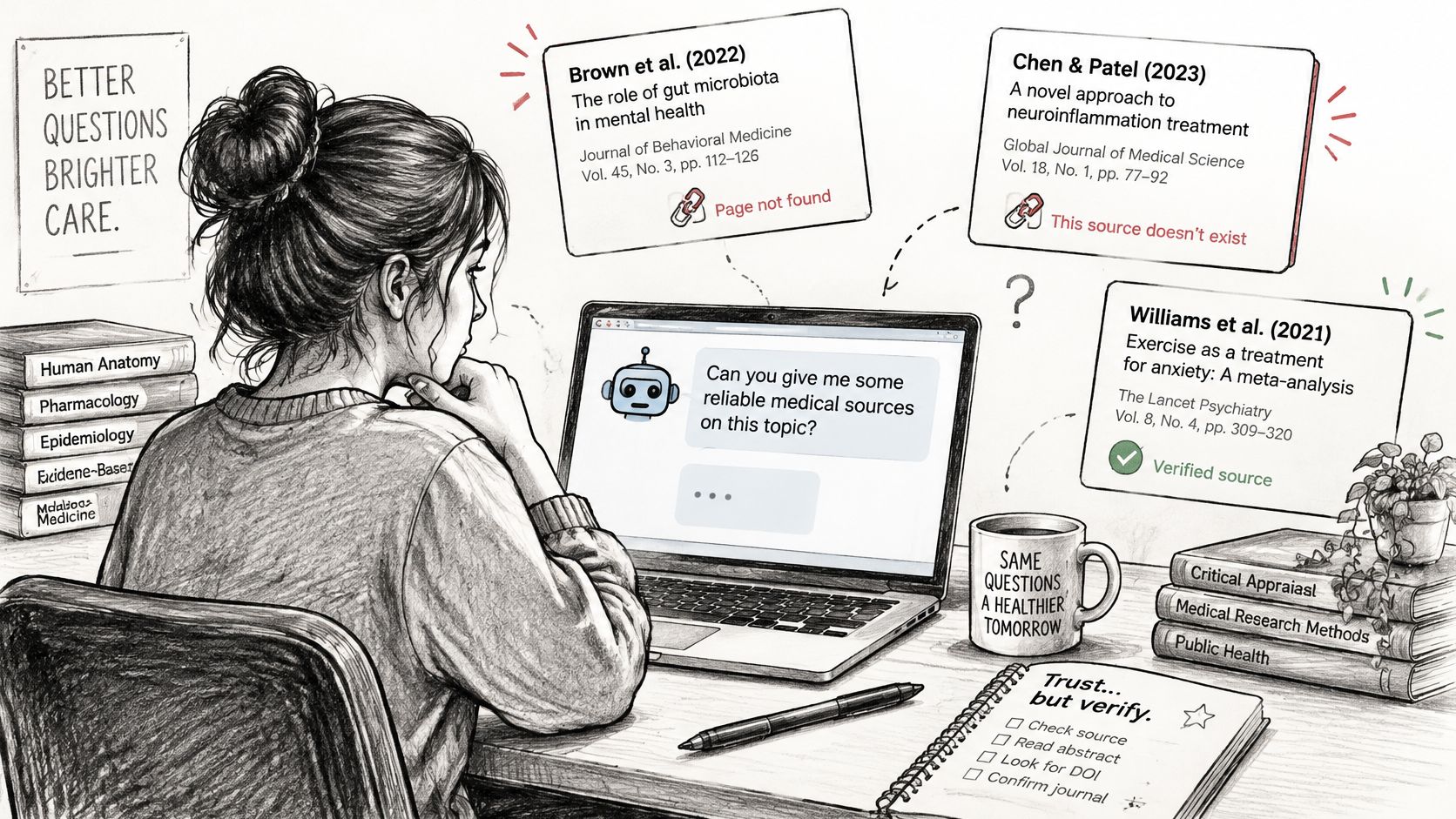
A student asks an assistant for sources on a medical topic. The reply arrives quickly, with three tidy citations, full author names, journal titles, and publication years. Two of those papers don't exist. The third is real, but it never studied the question the student asked.
That's the failure you need to picture. A hallucination is output that's fluent and confident but unsupported or false. It isn't a typo, and it isn't a model being deliberately dishonest. A language model generates likely sequences of words based on patterns it learned. It doesn't first verify a fact and then write it down.
Think of a tour guide who must keep talking. If the sentence needs a landmark, a date, or a founder's name, the guide supplies one that fits the sentence. The delivery stays smooth because fluency is the job the system was built to do.
Why reading it yourself isn't enough
A long answer can contain many correct sentences and one fabricated date. The wrong sentence reads exactly like the right ones. There's no change in tone, no hedging, no warning marker. Your eye catches awkward phrasing, not invented evidence.
This trips up careful readers. You check the claim you already know about, find it correct, and extend trust to the rest. But correctness doesn't spread from one sentence to the next. Each claim stands or falls on its own.
A confident tone tells you about the model's training, not about the truth of the sentence you're reading.
So every detection method, whatever its design, tries to answer one core question. Does each individual claim hold up against evidence outside the model's own output? If a method can't answer that, it's measuring something else, usually style or similarity.
Tools built for writers apply that same logic at the sentence level. The Unflag Fact Checker checks claims in your text against web sources and flags statements it can't support. That's a practical version of the idea, not a magic verdict. You still decide what to do with a flagged claim, but you know which line needs your attention.
Factuality and Faithfulness - The Two Checks That Matter
Most confusion about detectors starts here. People ask whether an answer is "correct" when there are two different questions, and a tool may only answer one.
Factuality asks whether a claim agrees with external reality or authoritative evidence. Faithfulness asks whether an answer is supported by the context the model was given, such as a retrieved document. A detector should separate factuality from faithfulness, as described in benchmark research distinguishing the two checks.
Two answers that fail in opposite ways
- Faithful but false: You give a model a misleading article and ask for a summary. The summary repeats the article accurately. It's faithful to its source and wrong about the world.
- True but unfaithful: You give a model a passage about a company's refund policy. The answer states a correct policy, but it appears nowhere in the passage. The model pulled it from memory, or invented a lucky guess.
Neither failure is acceptable, but they need different fixes. The first needs better sources. The second needs tighter grounding, because next time the unsupported guess won't be lucky.
This split decides which check you need. A document-grounded chatbot answering from your help center needs a faithfulness check. Its job is to stay inside your documents, even if a broader answer exists. A general research assistant answering open questions needs a factuality check against sources you trust, because no single supplied passage defines what's true.
Benchmarks reflect the split
Evaluation design follows the same distinction. HaluEval contains approximately 35,000 examples spanning question answering, summarization, dialogue, and general tasks, while PHD evaluates passage-level question answering across 300 entities with factual, non-factual, and unverifiable labels, as catalogued in the benchmark survey linked above.
That third label matters more than people expect. Unverifiable isn't a soft pass. It means the available evidence can't confirm the claim, so a careful writer treats it as unpublished until better evidence appears.
Before you trust any detector, ask which check it performs, against what evidence, and what it does with claims it can't verify. A tool that can't answer those questions is selling you a score you can't act on.
How Claim-Level Verification Works Step by Step
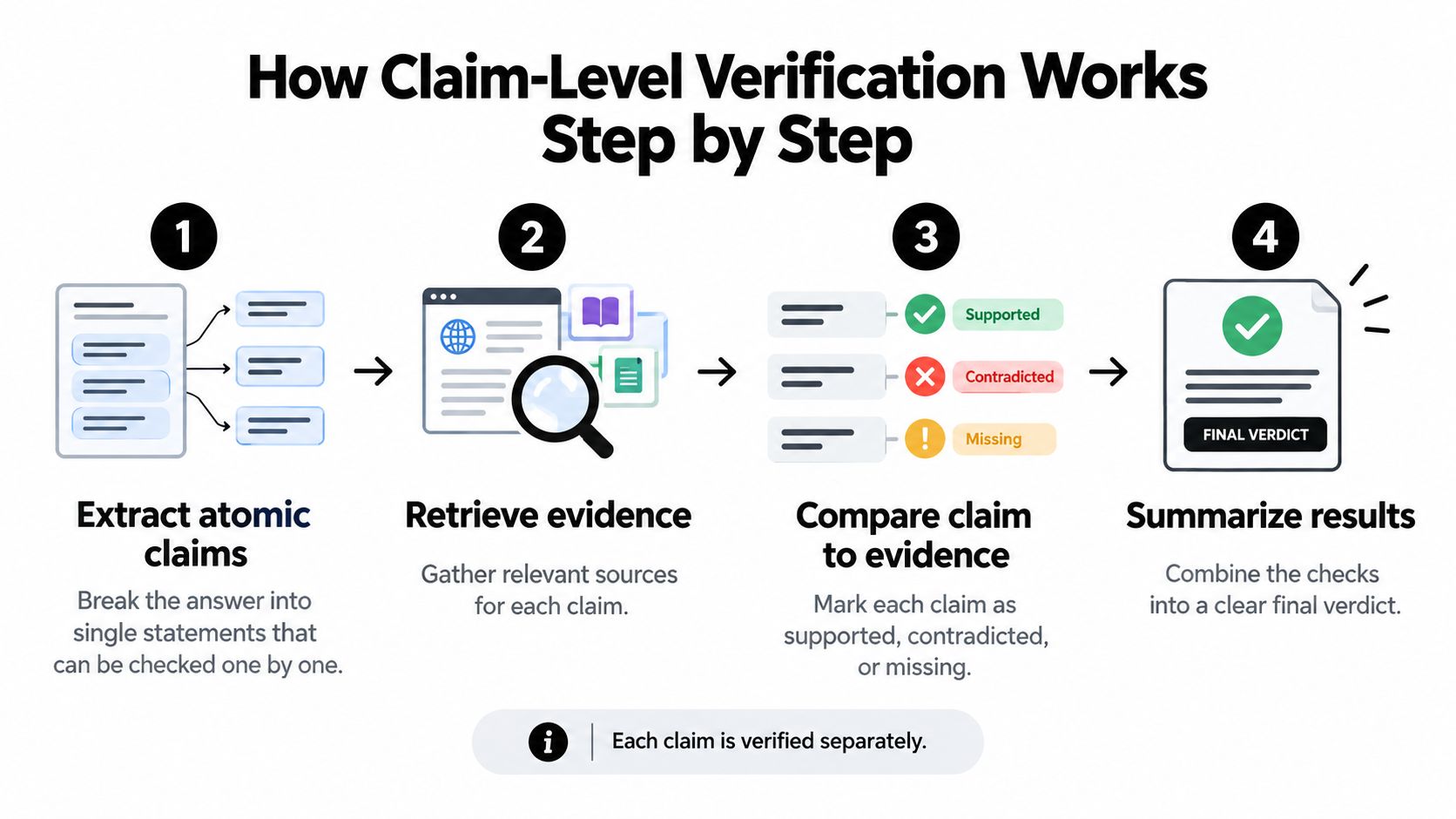
Whole-answer scoring hides the problem you're trying to find. If a response gets a passing grade overall, you still don't know which sentence to fix. Claim-level verification solves that by treating the answer as a list of separate statements, each checked on its own. It runs in four stages.
The four stages
- Extract atomic claims: Break the answer into single statements that can each be true or false. A sentence packing in a date, a statistic, and a person's name becomes three separate claims.
- Retrieve independent evidence: For each claim, gather sources from outside the model's output. The model's own wording can't count as evidence for itself.
- Classify each claim: Mark it supported, contradicted, or unverifiable by comparing it with the retrieved evidence.
- Aggregate into a risk score: Combine the labels into a response-level picture, weighted by how much each claim matters.
One claim through the pipeline
Take this sentence from a draft. "A named university study found that remote workers are far more productive than office staff." Stage one splits it into claims about who ran the study, what it measured, and what it found. Stage two searches for that study. If no such study exists, stage three marks the attribution contradicted or unverifiable, even if the general claim sounds reasonable. Stage four raises the response's risk because a fabricated citation damages trust in everything around it.
This approach has research roots. FACTSCORE, introduced in 2023, decomposes long-form answers into fine-grained atomic facts and assigns each a binary factuality label, while HaluEval 2.0 contains 8,770 questions spanning biomedicine, finance, science, education, and open-domain knowledge, as set out in the HaluEval 2.0 benchmark paper. Five domains, because verification standards differ by field. An unsupported medical claim doesn't carry the same risk as a wrong trivia answer.
Aggregation needs one more distinction. A micro hallucination rate counts the share of individual statements that are hallucinated. A macro hallucination rate counts the share of complete responses containing at least one. A long, mostly accurate guide with one invented statistic scores well on the first measure and badly on the second. A short answer built on one wrong claim fails both. Set your threshold according to the stakes, not the average.
Comparing Detection Methods and Their Metrics
No single method settles whether an answer is true. Each checks something different, and the failures are predictable once you know what each one measures.
| Method | What It Checks | Main Strength | Main Limitation |
|---|---|---|---|
| LLM as judge | Whether a second model thinks the answer is supported | Fast, flexible across topics | The judge can share the first model's blind spots |
| Retrieval-based fact checking | Each claim against external sources | Grounds verdicts in evidence you can inspect | Fails when retrieval misses or misreads sources |
| Reference-overlap metrics | Similarity between generated text and a reference | Cheap and repeatable at scale | Similarity to a reference isn't truth |
| Human expert review | Claims against domain knowledge | Catches subtle, context-dependent errors | Slow, expensive, hard to scale |
Why overlap scores mislead
Metrics such as BERTScore, F1, perplexity, and cosine similarity measure how closely generated text resembles something else, a reference answer or expected wording. A fluent answer can score well while stating a wrong date, because the wrong date barely changes the overall similarity. These scores are useful for tracking whether output drifts. They don't establish whether each claim is true in the world.
The field's measurement problem is documented. An audit of 103 hallucination-related papers found 87 focused on measuring hallucination, yet studies that quantified it used 25 different metrics, and only 35.2% of surveyed works relied on statistical metrics, as reported in the audit of hallucination measurement practices. When every team measures differently, scores from different tools aren't comparable, even when they share a name.
The same audit context includes practitioner experience, and benchmark results such as the 2024 FactCHD evaluation show wide gaps between partial and complete detection quality. Treat any single accuracy figure as incomplete information.
If you're comparing tools, our overview of fact-checking tools is a starting point, but apply the same test to everything on it. Demand three things from any vendor or paper. Name the metric. Name the evidence source. State the error rate on material like yours. A seller who can't do all three is asking you to trust a number they haven't earned.
Where Detection Fails in Conversations and Long Documents
Benchmarks present detection as a clean task. One prompt, one answer, one label. Real use looks nothing like that, and detectors trained on tidy test sets degrade in predictable places.
Conversations carry errors forward
In a multi-turn chat, an early wrong number becomes the foundation for every later answer. The model builds on it consistently, so the conversation looks internally coherent. A detector checking each reply in isolation sees answers that agree with the conversation history and misses that the history itself is wrong.
Real-dialogue evidence makes this concrete. The AuthenHallu benchmark samples genuine human and LLM dialogues and reports hallucinations in 31.4% of query and response pairs, rising to 60.0% for math and number problems, according to the AuthenHallu benchmark findings. It also finds that using a general-purpose LLM as the detector remains insufficient for real-world use. Numbers and calculation steps deserve your least trust and your closest checking.
What you need in a conversation is localization. Can the detector identify the exact unsupported sentence, and explain what evidence is missing? A session-level score doesn't help you repair a thread. A flagged span does. For related limits on self-checking, see whether ChatGPT can fact-check itself.
Long documents and retrieval strain the check
Retrieval-grounded answers sound easy to verify. The evidence is right there in the retrieved passages. In practice, long-context work creates three problems that coverage of this topic rarely answers directly.
- Conflicting sources: When two retrieved documents disagree, which one should the claim be checked against, and does the detector say so?
- Distant evidence: How reliable is the entailment judgment when the supporting sentence sits thousands of tokens away from the claim?
- Language transfer: Does performance measured on English text hold for your readers' language, or was it never tested there?
Watch the gap: A detector's benchmark score describes its test set, not your conversation, your document length, or your language.
None of this means detection is useless. It means you should match your caution to the setting. Short, single-turn, well-sourced answers are the easy case. Long chats, long documents, numeric reasoning, and non-English text are where a single accuracy number stops describing your actual risk.
Reducing Hallucinations in Your Writing Workflow
Detection catches errors after they exist. A better workflow prevents many of them and makes the rest easier to find. Four layers, each doing a job the others can't.
Layer one and two, constrain before you generate
Start with prompting for grounding. Ask the model to cite only from sources you provide, and to say plainly when it doesn't know. This won't stop invention entirely, but it changes the default from filling gaps to flagging them.
Then add source grounding. Attach the documents the answer should rest on, your style guide, the actual study, the product page. Grounding makes faithfulness checkable. Without supplied sources, there's nothing definite to check the answer against, and you're back to hoping the model's memory is accurate.
Layer three and four, verify before you publish
Claim checking is where drafts get safer. Verify names, dates, statistics, quotes, and citations individually, starting with the highest-risk claims. A fabricated statistic in your introduction does more damage than a vague adjective in paragraph nine. Our guide to ways to rewrite AI text covers the revision side, but rewriting comes after verification, not instead of it.
Human review stays mandatory for medical, legal, and financial content. No automated check understands liability, and none knows your jurisdiction, your patient population, or your client.
There's a structural reason no single layer suffices. Realistic long-context RAG benchmarks are scarce, and label noise from human or weak automated annotation directly harms hallucination detection performance, as shown in recent work on RAG detection benchmarks. The detectors themselves were trained and tested on imperfect labels. Trusting one automated pass completely means inheriting those imperfections.
Build this into a reusable checklist for every AI draft.
- Sources attached: Did the model answer from documents you chose?
- High-risk claims listed: Have you pulled out every number, name, date, and citation?
- Each claim labeled: Supported, contradicted, or unverifiable, with no blanks?
- Uncertainty shown: Does the draft say what couldn't be confirmed, instead of hiding it?
That last item matters. Report uncertainty next to any claim that stays unverifiable. Readers forgive a stated limit. They don't forgive a confident error they discover themselves.
Choosing a Detection Workflow and Your Next Step
Writers often buy the wrong tool because three different jobs get sold under similar names. Separate them before you choose.
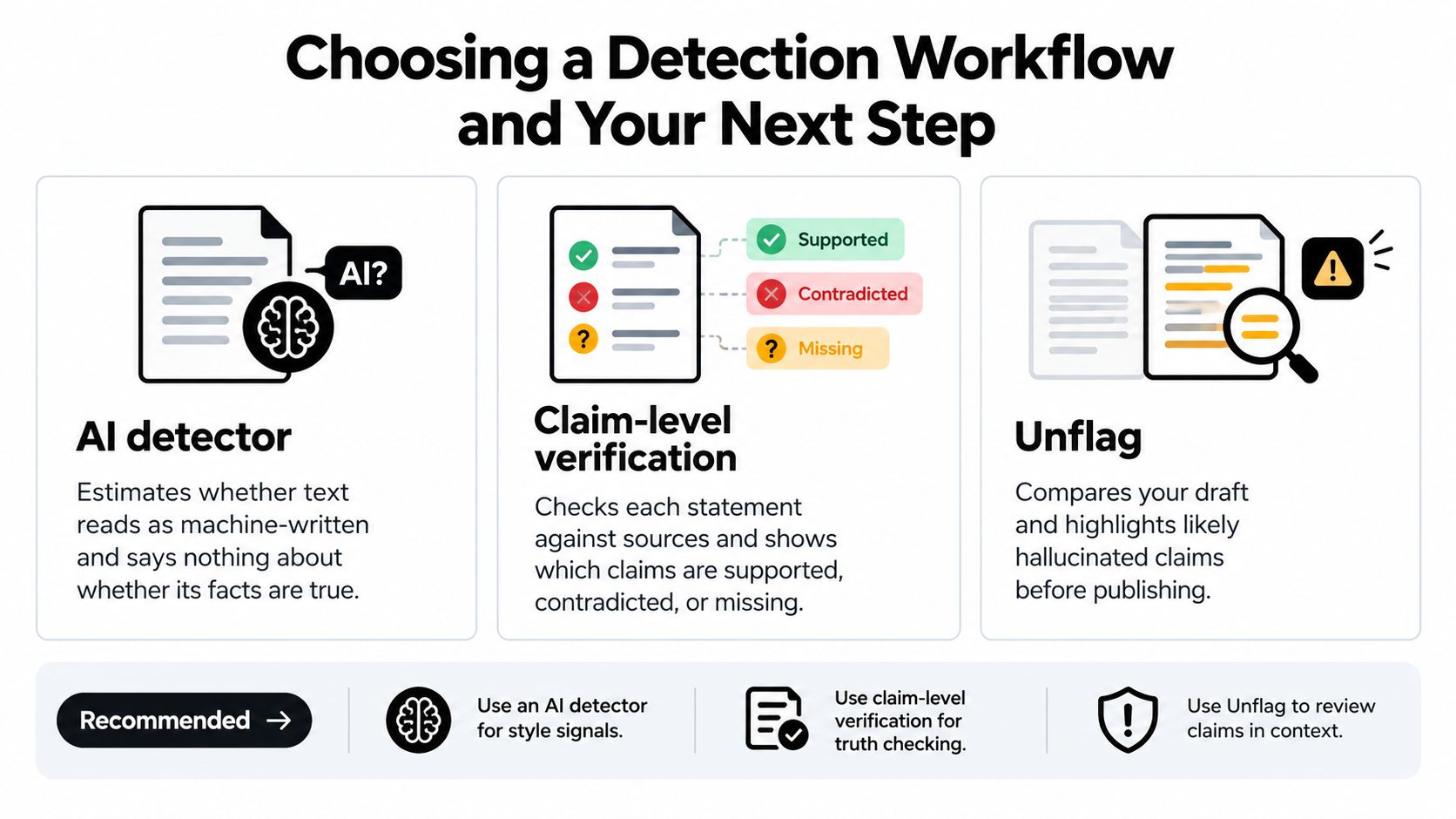
An AI detector estimates whether text reads as machine-written. It analyzes style signals and says nothing about whether the facts are true. A human-written paragraph full of errors passes it. A fact checker does the opposite job. It tests individual claims against web sources and flags unsupported statements, regardless of who or what wrote them. Manual verification is slower than both and remains the standard for high-stakes material, because a person can judge source quality and context in ways automated checks can't.
What revision does and doesn't fix
Consider a typical AI draft paragraph. "In the modern workplace, productivity is very important for success. Studies show that remote workers are significantly more productive. Therefore, companies should embrace remote work to achieve success in the modern workplace." It repeats stock phrases and leans on unnamed studies.
A revised version reads differently. "Remote staff in our support team closed tickets faster after we dropped the daily commute. Before citing any outside study, though, we checked whether the research we quoted existed." The sentences vary, the claim is scoped to evidence the writer can defend, and the unverified statistic is gone instead of polished.
That example shows the boundary. We offer Humanize AI, AI Detector, Rewrite, and Fact Check as our products, and they do different things. A humanizer changes style so text reads naturally. It doesn't verify facts. Our built-in AI detector shows how text reads to AI detectors, which is a style signal, not a truth signal. Running a fabricated statistic through a humanizer gives you a well-written fabricated statistic.
We also can't guarantee that any output will bypass third-party AI detectors, and results may vary depending on the detector used. Any tool promising certainty there is overstating what it controls.
So sequence your workflow correctly. Draft, check the claims, then fix the style. Paste your text into Unflag's AI Humanizer, it's free, once the facts survive scrutiny, and run a claim check on the figures before you publish rather than after a reader finds the error.
Don't publish another AI draft on trust alone. Unflag lets you check claims against web sources, see how your text reads to AI detectors, and rewrite it so it sounds like you, all in one place. Paste in the draft you're working on now, flag the claims you can't defend, and fix them before your readers do it for you.
More guides
View allWhat Is an AI Humanizer? How It Works and When to Use One
What is an AI humanizer? A tool that rewrites AI drafts to sound natural while keeping the meaning. Learn how it works, its limits, and when to use one.
AI Essay Checker Free: 10 Best Tools for Students (2026)
Compare 10 AI essay checker free tools: accuracy, word limits, and best use cases for students. See why Unflag tops the list for essays in 2026.
How to Rewrite AI Text Without Losing Your Meaning
Learn how to rewrite AI text so it sounds natural, keeps its meaning, and preserves facts with a practical editing workflow and examples.
10 Best Email Rewriter AI Tools for 2026
Compare the 10 best email rewriter AI tools for 2026, with tone, brevity, personalization, limitations, pricing, and job-seeker examples.