By Unflag Team
What Is an AI Humanizer? How It Works and When to Use One
What is an AI humanizer? A tool that rewrites AI drafts to sound natural while keeping the meaning. Learn how it works, its limits, and when to use one.
An AI humanizer is a tool that rewrites machine-generated text so it reads like natural human writing while trying to keep the original meaning. If an AI draft sounds stiff or repetitive, a humanizer can help smooth its wording and rhythm, but it can't prove who wrote it or guarantee how a detector will classify it.
Think of it as a copy editor revising a formal announcement into a clear note for a real reader. The facts should stay put; the sentences may change.
Table of Contents
- What an AI Humanizer Is and Why It Exists
- How an AI Humanizer Rewrites Text Step by Step
- AI Humanizer, Paraphraser, Detector and Fact Checker Compared
- A Robotic Paragraph Rewritten
- Benefits, Limits and What AI Detectors Get Wrong
- Use an AI Humanizer Responsibly and Try One Free
- Frequently Asked Questions About AI Humanizers
What an AI Humanizer Is and Why It Exists
An AI humanizer is a text-rewriting system that changes the wording, sentence structure, rhythm, and stylistic patterns of machine-generated prose. It may work on text produced by ChatGPT, Claude, Gemini, or another writing tool. The aim is to make the draft easier and more natural to read while preserving its meaning.
The word “humanizer” is informal shorthand for this kind of rewriting. It describes a change to the text, not proof of its authorship. A humanizer changes how text sounds, not who made the argument.
A useful analogy is a copy editor who turns a stiff press release into a plain-spoken note without dropping a single fact. The editor can improve flow, but the writer still needs to confirm that the claims are accurate and that the final version represents their intended message.
AI drafts can lean on evenly sized sentences, familiar transitions such as “Moreover” and “In conclusion,” and broad, cautious phrases that don't say much. A humanizer may vary those patterns. That can help readability, but it can also change nuance or remove technical precision if the revision goes too far.
Detector scores aren't reliable proof of authorship, either. In a 2024 experimental study, a free detector labeled a median 27.2% of human-authored behavioral-health articles published from 2016 to 2018 as AI-generated. Those articles predated widespread generative AI use, illustrating the risk of false positives (the experimental study on AI detection and academic integrity).
Unflag's AI Humanizer is one example of a tool in this category. Use it as an editing aid: read the rewrite, compare it with your draft, and verify any important claims before relying on it.
How an AI Humanizer Rewrites Text Step by Step
A humanizer may look for patterns such as sentences with similar lengths, repeated transitions, and predictable word choices. One related concept is perplexity, a way of describing how predictable the next word in a sequence is. Research on stylometric features and generated writing discusses predictability, sentence patterns, and stylistic variation as signals that can help distinguish texts, but detector results depend on the text and the system doing the scoring (research on stylometric approaches to AI-generated text).
Good rewriting is more than swapping in synonyms. A useful tool may restructure sentences, vary their openings, and cut repetitive transitions. Think of a tailor altering a suit: the fit changes, but the fabric and measurements must remain true to the original.
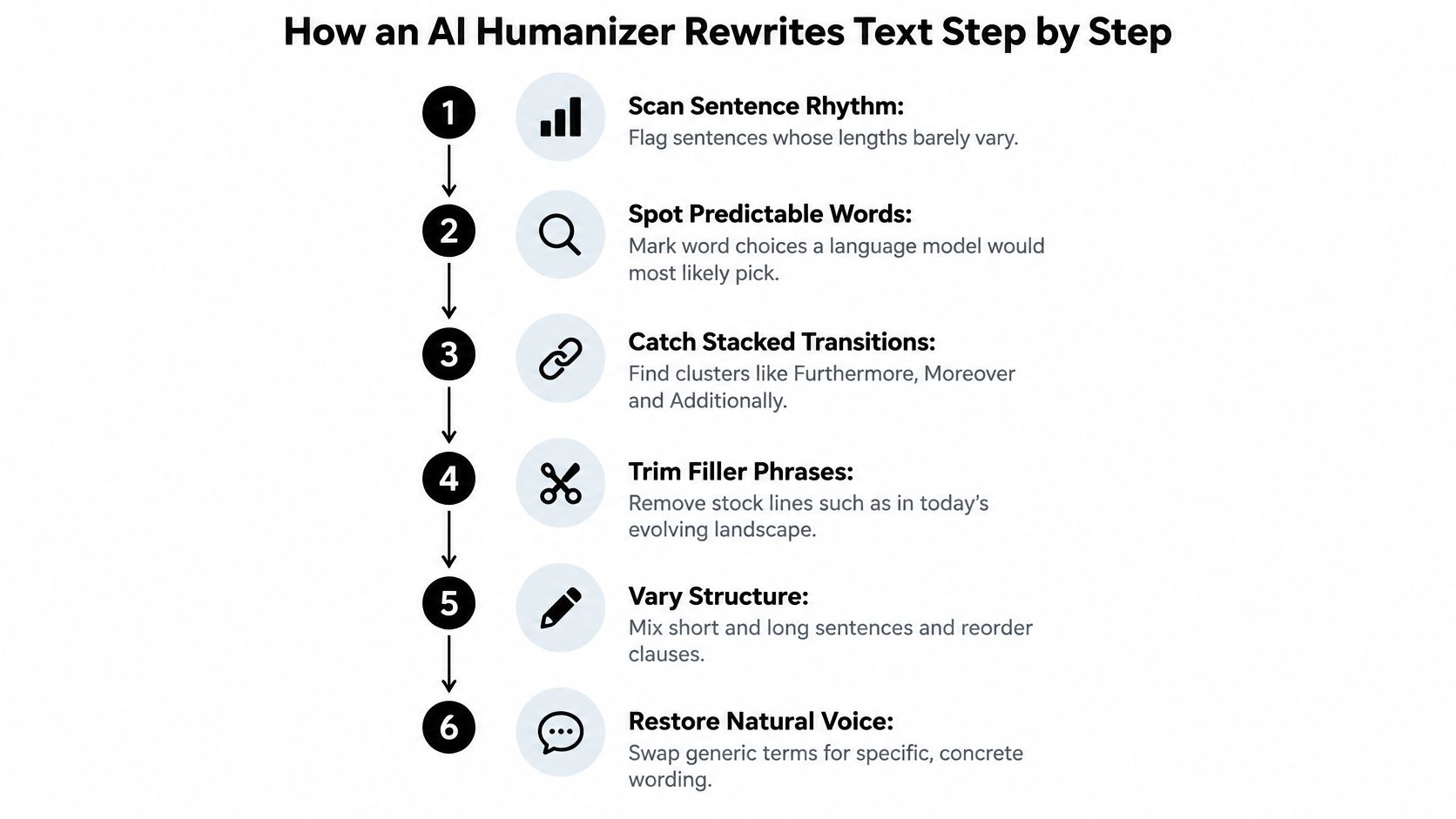
A careful editing workflow keeps meaning and factual details in view:
- Mark what must stay fixed. Identify names, numbers, dates, citations, and the central claim before rewriting. These details carry factual meaning and should not be casually changed.
- Look for repetitive patterns. Notice uniform sentence lengths, stock phrases, and repeated transitions. Flag the patterns that make the draft feel mechanical.
- Restructure for a more natural rhythm. Mix short and long sentences, vary sentence openings, and move clauses only when the logic stays clear.
- Change wording selectively. Replace predictable phrases only when the alternative means the same thing. A more unusual word isn't automatically a better or more accurate one.
- Compare the new version with the original. Check for claims that were added, removed, or made more certain. Rewriting can introduce factual drift even when the prose sounds smoother.
- Verify important claims. Check statistics and named sources against the original material, not just the rewritten text.
The table shows which elements a humanizer may revise and which should remain intact.
| Text element | Typically changed? | Why it matters |
|---|---|---|
| Sentence length | Yes, vary short and long | Uniform lengths can make prose feel machine-made |
| Word choice | Yes, replace stock phrases | Predictable wording can make a draft feel repetitive |
| Transitions | Yes, cut stacked connectors | Repeated “Moreover” and “In conclusion” can sound templated |
| Names of people and organisations | No, keep exact | A changed name creates factual drift |
| Numbers, dates, and statistics | No, keep exact | Their meaning and sourcing depend on accuracy |
| Citations and links | No, keep exact | A changed reference may no longer support the claim |
| Argument and claim structure | Only rephrase | Adding or dropping a claim changes the meaning |
If you want to revise text while keeping those checks in mind, Unflag's AI text rewriting tool is one option.
AI Humanizer, Paraphraser, Detector and Fact Checker Compared
These tools answer different questions. A humanizer edits style, a paraphrasing tool restates ideas, an AI detector estimates whether text resembles AI-generated writing, and a fact checker checks claims against sources.
| Tool type | Main job | Changes wording | Gives an AI score | Checks facts |
|---|---|---|---|---|
| AI humanizer | Makes AI-drafted text read more naturally | Yes, including structure and phrasing | Some tools include a detector | No, unless paired with a fact checker |
| Paraphrasing tool | Restates text for clarity or a different tone | Yes | No | No |
| AI detector | Estimates whether text resembles machine-written writing | No | Yes, as an estimate | No |
| Fact checker | Checks claims against sources | No | No | Yes, flags claims that may lack support |
A humanizer edits sentences, but it should not add facts. Compare its output with the original and keep each source attached to the claim it supports.
A paraphrasing tool changes how an idea is expressed. Its focus is rewording, not necessarily the patterns an AI detector may flag.
An AI detector offers an estimate, not a ruling on who wrote the text. Scores can differ between tools, and a detector cannot establish whether a claim is true.
A fact checker examines claims against sources. For a statistic, inspect the source yourself and confirm that it supports the wording you plan to use. Unflag offers Humanize AI, AI Detector, Rewrite, and Fact Check. Its fact-checking tools can help review claims against sources.
Choose a humanizer for a readability edit, a detector for an imperfect screening signal, and a fact checker to examine factual claims.
A Robotic Paragraph Rewritten
Here's a deliberately stiff example about remote work. The two versions are illustrative, not evidence from a company or a study.
Robotic draft
In today's evolving landscape, remote work is becoming increasingly important for businesses. Moreover, it can provide employees with greater flexibility and improve the overall employee experience. Additionally, companies can benefit from increased productivity and enhanced collaboration. In conclusion, remote work is a powerful strategy that can help organisations succeed.
Rewritten version
Remote work gives some employees more control over where they work. A designer might draft at home, then join a video call with teammates to review the project. The arrangement can suit people who need flexibility, but it won't fit every role or team.
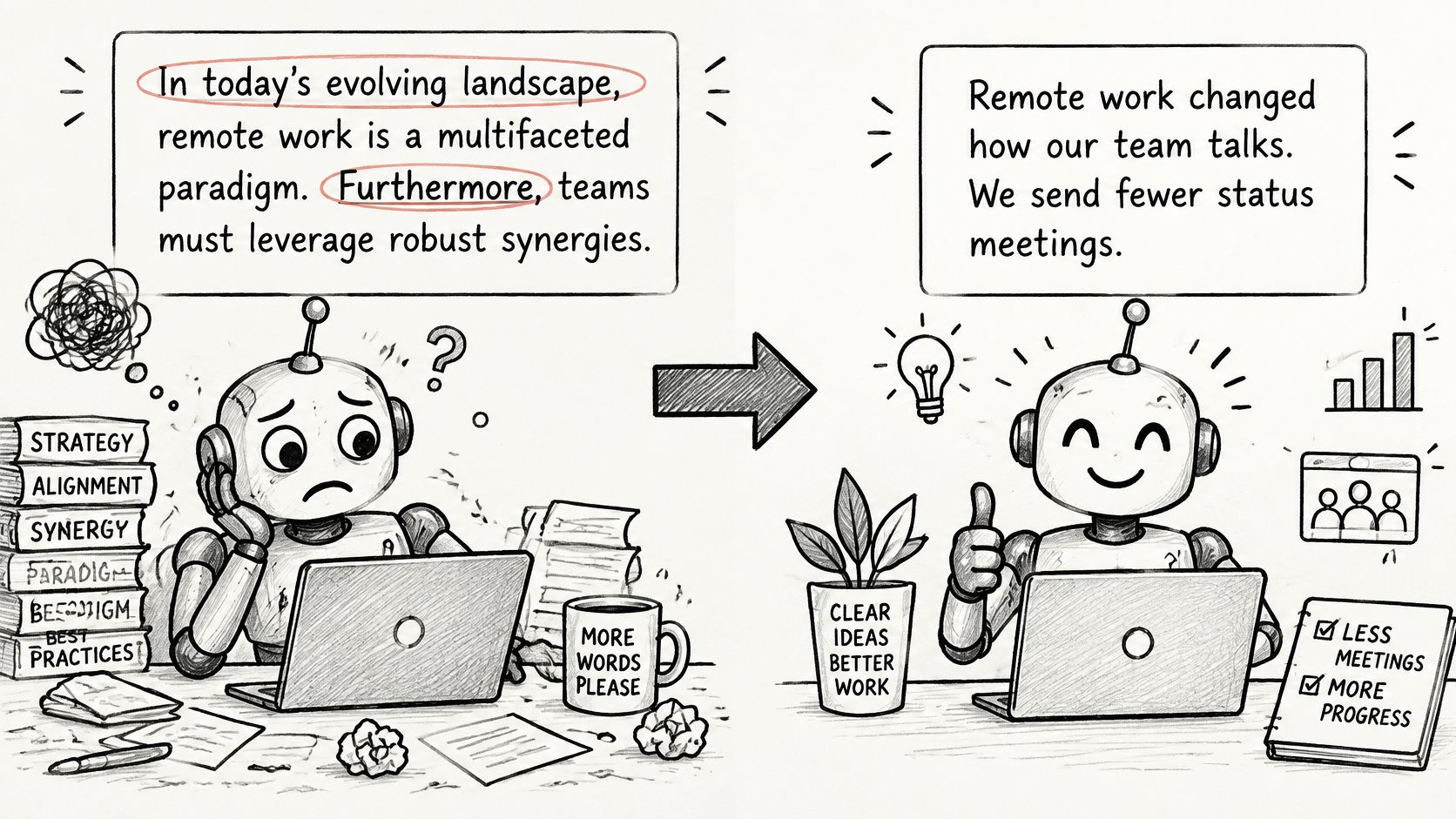
Three edits make the second version easier to assess:
- The opening gets specific. Instead of saying remote work is “increasingly important,” it names a practical feature: control over work location.
- The example shows what the point means. A designer reviewing a project makes the idea of flexible work concrete without claiming that every employee benefits.
- The blanket conclusion becomes qualified. The rewrite acknowledges that remote work won't suit every role or team, avoiding a claim of universal success.
A humanizer can also make a rewrite worse. Suppose an original sentence says, “The change cut costs by 23% in 2024,” and a rewrite changes it to “The change cut costs sharply.” The revised sentence removes the figure, so a reader can't check the specific claim. This is a hypothetical editing example, not a report about an actual organisation. Keep numeric claims fixed and verify them against their source.
For a multilingual writer, the goal should be clear, idiomatic English, not a forced imitation of a particular regional or stylised voice. The writer's own phrasing and meaning still deserve a careful read. The most natural output is the one a reader can check.
Benefits, Limits and What AI Detectors Get Wrong
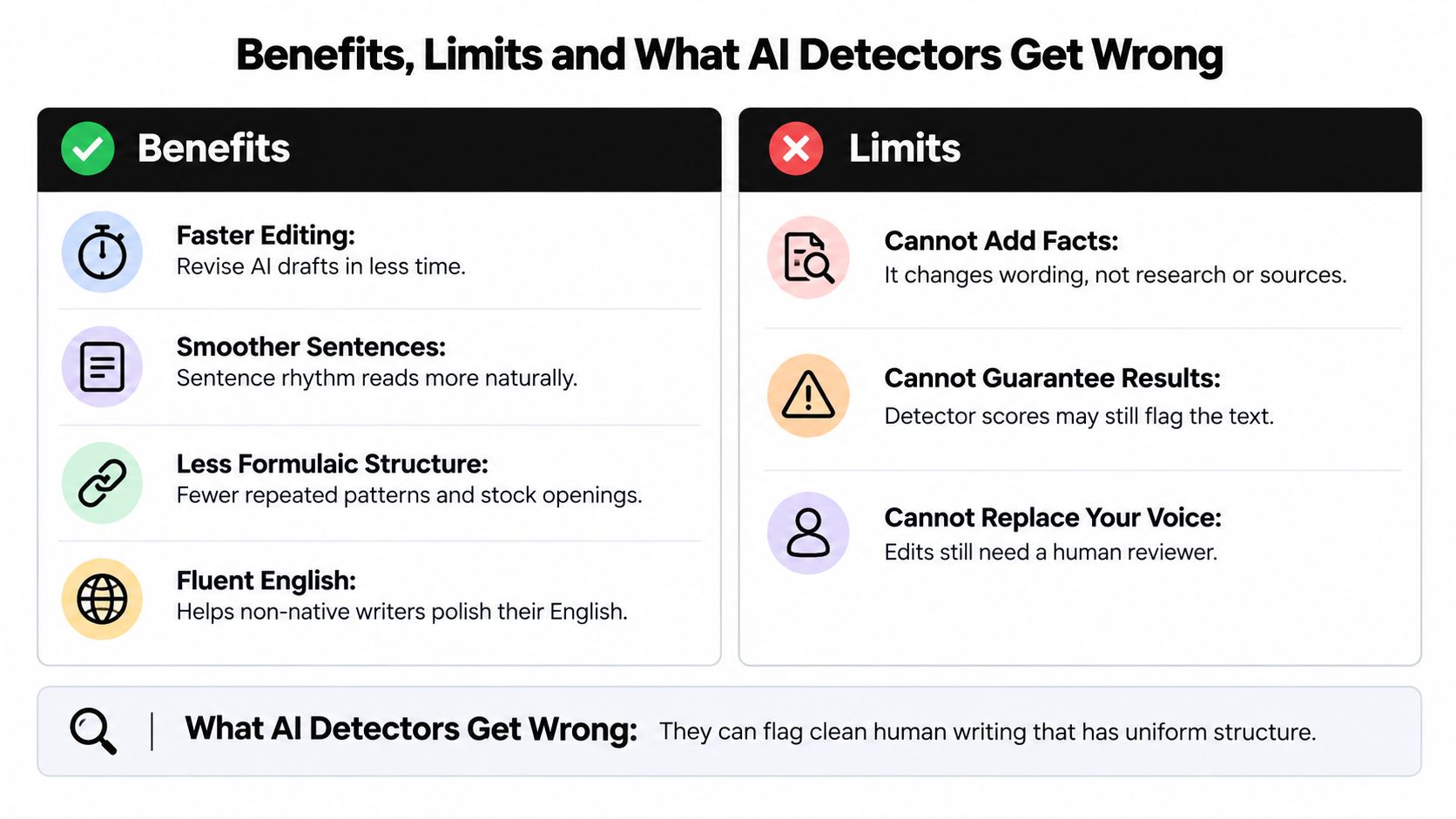
A draft can read smoothly and still make a weak argument. A humanizer may help untangle repetitive sentences or polish English, but it cannot judge whether the reasoning is sound. Treat its rewrite as an edit to review, not a replacement for your judgment.
Meaning can shift during revision. A qualification may disappear, or a polished sentence may make an unsupported claim sound convincing. Unflag cannot guarantee that its output will bypass third-party AI detectors; results vary by detector. Its AI detector can show how text reads to an AI detector, but that score is a screening signal, not proof of who wrote it.
Research illustrates why detector results need care. One study found that classifiers labeled 4.2% of LLM texts as human and 9.8% of human texts as LLM-generated (the detector-evaluation study). In other words, a detector can miss AI-generated writing or incorrectly flag human writing.
A 2026 academic review reported a mean false-positive rate of 61.3% across seven detectors when testing authentic TOEFL essays by non-native English speakers. The review also reported that 75–85% of AI-generated texts remained classified as human after polishing, while 97–100% of original human-authored texts were classified as human (the review of AI detection and language background).
| Finding | Reported rate | Source |
|---|---|---|
| LLM texts classified as human by classifiers | 4.2% | Detector-evaluation study |
| Human texts classified as LLM-generated by classifiers | 9.8% | Detector-evaluation study |
| Authentic non-native English essays flagged as AI, mean across seven detectors | 61.3% | 2026 academic review |
| AI-generated texts classified as human after polishing | 75–85% | 2026 academic review |
| Original human-authored texts classified as human | 97–100% | 2026 academic review |
A lower detector score does not establish authorship, just as a higher score does not prove that someone used AI. Detectors estimate patterns in text; they do not observe how a passage was written. Use a humanizer to improve readability, then compare the rewrite with the original and check that the meaning still holds.
A detector score is a screening signal, not a verdict.
Use an AI Humanizer Responsibly and Try One Free
A polished rewrite can still break the rules for an assignment or publication. Check the relevant school, employer, publisher, or client policy before using a humanizer, and follow its disclosure requirements.
The University of Luxembourg's 2025 guidance says AI use must be disclosed and the distinction between original and AI-generated work should remain clear. It asks users to identify the tools used, their purpose, and how their output was modified (the University of Luxembourg's guidance on generative AI).
Make your process easy to explain:
- Check the applicable rule. Find the policy for the work you are doing.
- Keep your drafts. Revision history can show how your writing developed.
- Verify claims and sources. Check statistics and named sources against reliable material.
- Compare the wording. Read the rewrite beside your draft and look for changes in meaning, emphasis, or certainty.
- Disclose when required. Explain the tool's role in the format the policy requests.
If you choose to edit with Unflag, paste in your text, select a tool, and press the button. Unflag rewrites AI-generated text to read naturally while keeping its meaning. You can check the result with the built-in AI detector, which shows how text reads to AI detectors, and use Fact Check to review claims. A lower AI score is not proof of who wrote the text, and Unflag cannot guarantee that its output will bypass third-party detectors.
Frequently Asked Questions About AI Humanizers
Is an AI humanizer the same as a paraphraser?
A paraphraser can revise text for clarity, flow, or tone. An AI humanizer focuses on making AI-generated text read more naturally. Their functions can overlap, so compare the result with your original to catch changes in meaning or emphasis.
Can an AI humanizer make text pass AI detectors?
Rewriting can affect a detector's score, but no humanizer can guarantee a particular result. Detector scores are estimates, not proof of who wrote a text. A lower score alone does not establish authorship.
Is using an AI humanizer cheating?
That depends on the rules for your assignment, workplace, or publication. Check the relevant policy before using a tool to revise substantive work. If disclosure is required, explain the tool's role and how you reviewed its output.
Does an AI humanizer change facts or citations?
It can change wording in ways that alter meaning or remove details. Check names, figures, dates, and citations against your draft, then confirm that each source still supports the claim it accompanies. Verify important facts before submitting or publishing.
How do I use Unflag to review a rewrite?
Paste your text, pick a tool, and press the button. Unflag rewrites AI-generated text to read more naturally while keeping its meaning. Review the result against your draft, then use the built-in AI detector to see how the text reads to AI detectors.
Unflag offers Humanize AI, AI Detector, Rewrite, and Fact Check. Use its tools to review a draft, while keeping responsibility for the final wording, claims, and sources. Visit Unflag to try the tools.
More guides
View allLLM Hallucination Detection: Methods and Tools in 2026
LLM hallucination detection explained, with claim-level fact checking, evidence retrieval, detector tools and practical steps to catch false AI answers.
AI Essay Checker Free: 10 Best Tools for Students (2026)
Compare 10 AI essay checker free tools: accuracy, word limits, and best use cases for students. See why Unflag tops the list for essays in 2026.
How to Rewrite AI Text Without Losing Your Meaning
Learn how to rewrite AI text so it sounds natural, keeps its meaning, and preserves facts with a practical editing workflow and examples.
10 Best Email Rewriter AI Tools for 2026
Compare the 10 best email rewriter AI tools for 2026, with tone, brevity, personalization, limitations, pricing, and job-seeker examples.