By Unflag Team
How to Rewrite AI Text Without Losing Your Meaning
Learn how to rewrite AI text so it sounds natural, keeps its meaning, and preserves facts with a practical editing workflow and examples.
An AI draft can look polished in your document and still feel wrong: the sentences repeat the same pattern, the opening could fit any topic, and the claims don't quite match what you meant to say. To rewrite AI text well, edit for the reader while protecting the original facts, qualifications, and intent. A smoother paragraph is useful only if it remains accurate and accurately represented.
Table of Contents
- Why Fluency Is Not the Same as Authorship
- A Practical Workflow for Rewriting AI Text
- How to Make AI Drafts Sound Natural
- Editing Tips for Voice Clarity and Accuracy
- Manual Editing Compared With Unflag
- A Final Review Before You Submit or Publish
- How do you rewrite AI text without changing its meaning?
- Does rewriting AI text make it human-written?
- Can AI detectors prove who wrote a text?
- How can multilingual writers make an AI-assisted draft clearer?
- Should I use a paraphraser or edit manually?
- What should I check before submitting or publishing a rewrite?
- Is it safe to paste private writing into an online rewriting tool?
Why Fluency Is Not the Same as Authorship
A fluent draft isn't necessarily a finished one. AI can produce grammatical sentences that repeat familiar transitions, lean on broad claims, or miss the context your reader needs. The fix isn't to swap in fancier synonyms. It's to identify what the draft says, decide what the reader needs, then revise without changing the substance.
A lower detector score doesn't prove that a person wrote the text. In a review of seven detectors, authentic TOEFL essays by non-native English writers were misclassified at a mean false-positive rate of 61.3%. The same review notes that paraphrasing, editing, and translation can disrupt detector signals without changing authorship or originality (review of AI-text detectors and writing evaluation). A detector result is a classification, not a record of who developed the ideas or wrote each sentence.
That distinction matters especially for multilingual writers. A tool may mistake clear, carefully edited English for generated text, while a rewritten passage may no longer trigger the same signals even if the ideas remain AI-generated. Neither result settles who is responsible for the work.
A fluent rewrite can improve the reading experience. It can't prove authorship.
It helps to separate three different jobs:
- Clarity editing fixes grammar, removes repetition, and makes the writer's intended meaning easier to follow.
- Meaning-preserving paraphrase changes wording or structure while keeping the claim and its limits intact.
- Concealing unauthorized generation tries to disguise where work came from. That isn't the same as editing, and a lower detector score doesn't make it acceptable under a school, employer, or publisher's rules.
Set the right goal before you begin: make the writing clearer and more useful, keep the evidence and meaning intact, and follow the disclosure and authorship policies that apply to the work.
A Practical Workflow for Rewriting AI Text
A reliable rewrite starts with meaning, not sentence polish. Research on machine paraphrasing describes a safer approach: identify claims, entities, quantities, qualifiers, and citations first, then rewrite and compare the result with the source using semantic and claim-level checks (study of paraphrase attacks and detector performance).
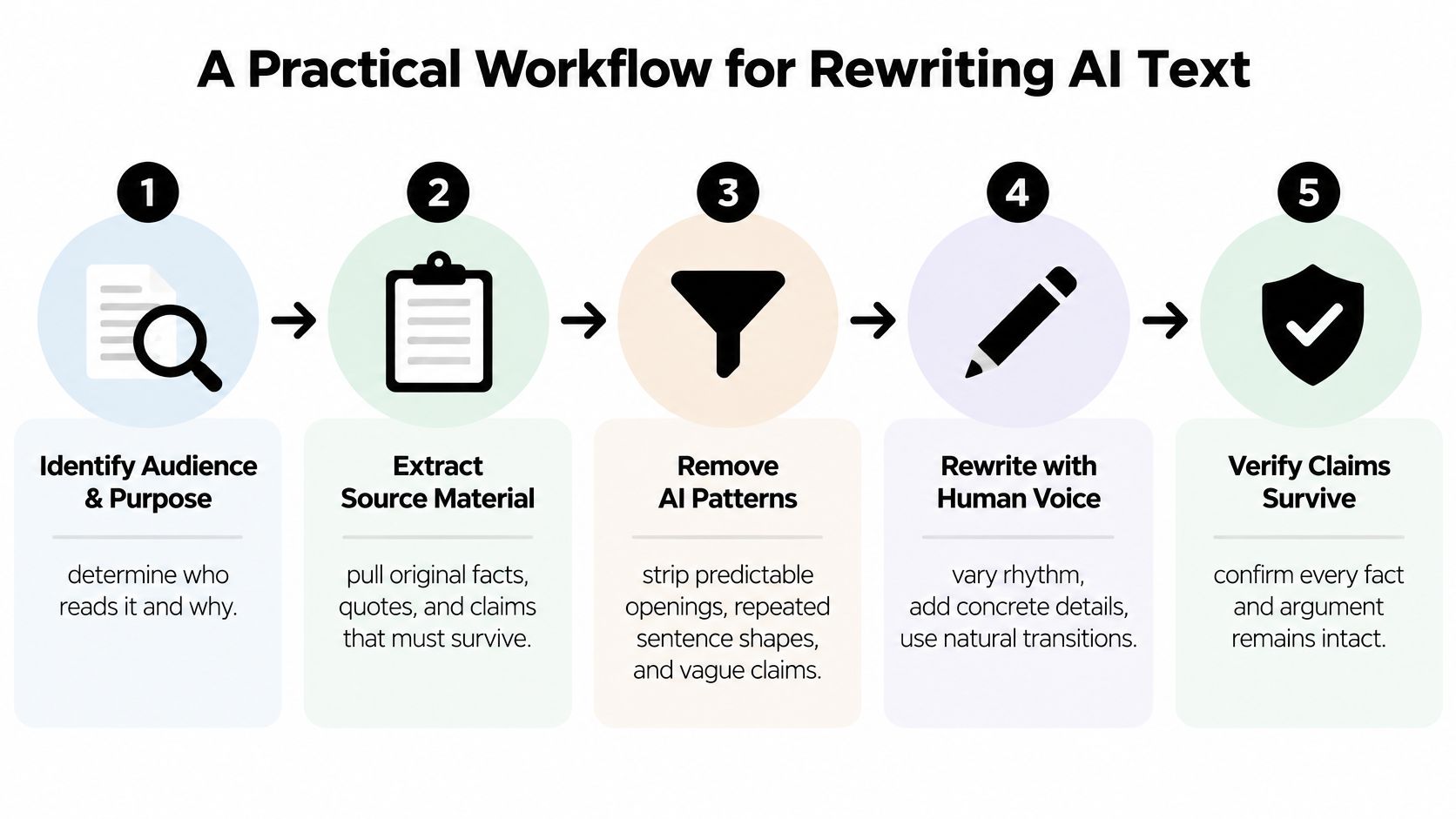
Set the audience and purpose. Decide who will read the text and what they need to understand or do. An email to a manager needs a different level of detail than a research summary or SEO article. Note any rules that govern the work, such as assignment instructions, brand guidance, or disclosure requirements.
Mark what must survive. Pull out the main argument, supporting claims, people and organizations, quantities, dates, citations, and terms that have a precise meaning. Mark qualifiers such as “may,” “often,” and “in some cases.” Treat them as part of the claim, not optional wording.
Remove predictable padding. Cut generic openings, repeated points, and transitions that don't show a real relationship between ideas. “Furthermore” won't fix a paragraph that jumps to a new topic. Add a transition only when it helps the reader understand the connection.
Rewrite for the reader's voice and context. Prefer concrete wording and natural sentence variation, but don't add personal stories, expertise, or examples unless they're true and supported. A paraphraser can help you explore alternate phrasing for an early draft. Manual editing is better when a sentence carries disciplinary nuance, a careful qualification, or a tone that needs to sound specifically like you.
Compare, then verify. Read the revision beside the original. Check that names, numbers, negations, citations, and the force of each claim are unchanged. Verify externally checkable claims against their original sources rather than assuming a smoother sentence is more accurate.
An AI-assisted option such as Unflag's AI Humanizer can provide an alternate version to edit. Treat that output as a draft, not an authority: keep what improves clarity, reject changes that shift meaning, and check claims independently.
AI Text Rewrite Acceptance Checklist
| Check | What to inspect | Pass condition |
|---|---|---|
| Meaning | Main claim and supporting reasoning | The revision makes the same argument |
| Entities and quantities | Names, dates, figures, and units | Each matches the source |
| Qualifiers | Words expressing uncertainty or scope | The claim isn't stronger or broader |
| Citations | Source-to-claim relationship | Each citation still supports its sentence |
| Readability | Rhythm, transitions, and repetition | The reader can follow the argument naturally |
| Verification | Claims that can be checked externally | You've consulted a reliable source |
How to Make AI Drafts Sound Natural
Here's a small example. The original paragraph below is intentionally generic; it makes no claims beyond the basic point that a clear outline can help organize a report.
Robotic draft:
In today's business environment, communication is very important. A clear outline can help improve communication in many ways. Additionally, it is important to organize information effectively. This can help readers understand the content better and make the overall report more successful.
Edited version:
A clear outline helps readers follow a report. Put related points together, then use headings to show how each section supports the main argument.
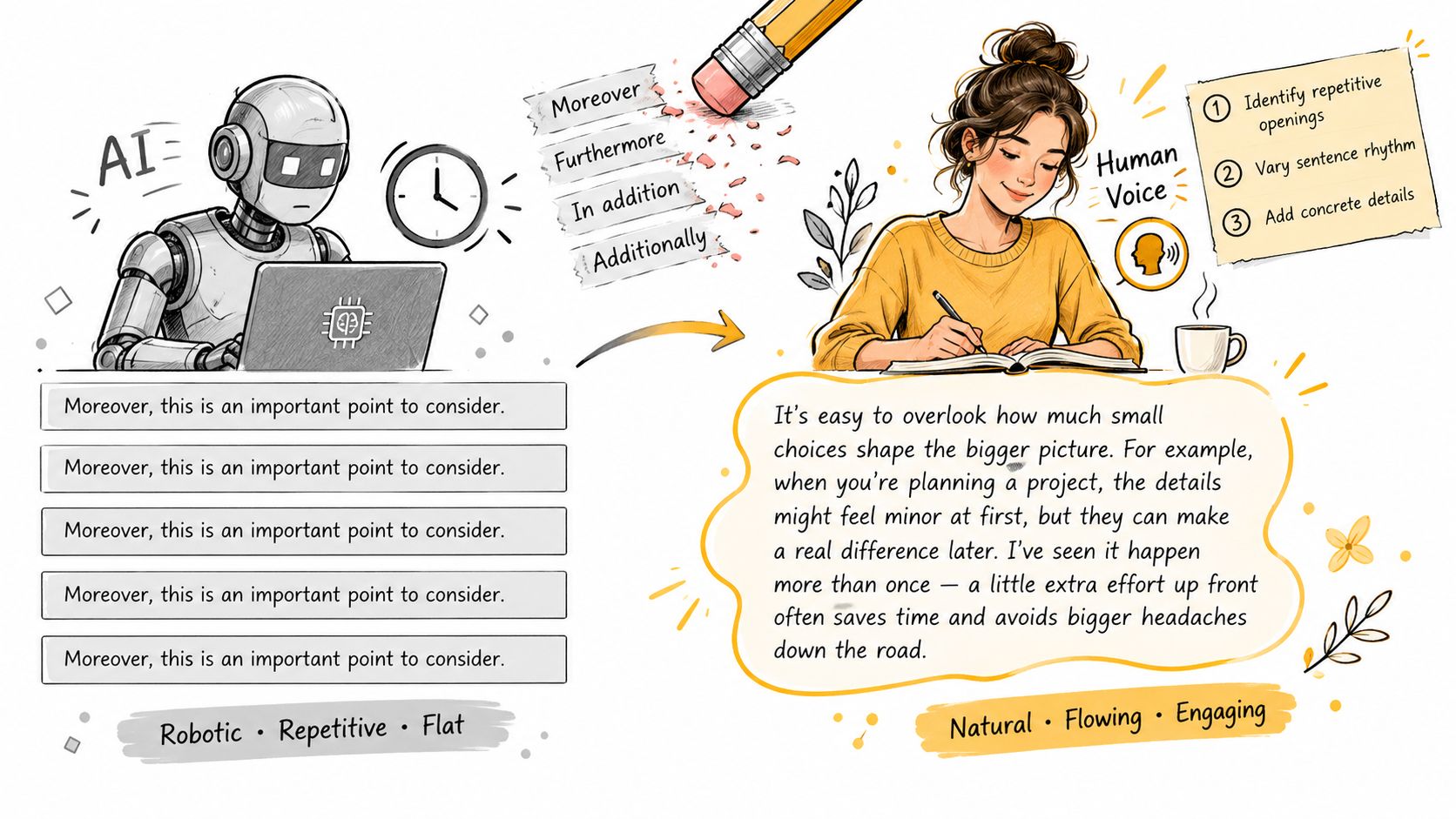
The revision keeps the central point: an outline helps organize information for readers. It removes an empty opening, replaces “communication is very important” with a specific purpose, and cuts a string of vague statements about improvement and success. It also gives the paragraph two distinct sentence shapes rather than repeating the same general claim.
Natural writing doesn't need a forced personality. It needs a clear relationship between the sentences and a level of detail that matches the evidence. For another way to spot repetitive phrasing and other common patterns, use this AI writing signs checklist as an editing prompt, not as a formula for making prose sound artificially human.
Read the revision aloud. If you run out of breath, lose the point, or hear the same sentence rhythm repeatedly, revise for clarity. Cut transitions like “Moreover” when the next sentence doesn't add a meaningful connection. Prefer direct verbs: “the outline groups related claims” is clearer than “the claims are organized in a way that is beneficial.”
Specificity should come from the source, not from a writer's guess.
Add context only when you can support it. If the original says an outline helps organize a report, don't turn that into an unsupported claim that it improves grades, saves time, or persuades readers. A natural rewrite should sound like the writer's actual intent, not a performance of personality.
Editing Tips for Voice Clarity and Accuracy
Good editing is a series of deliberate choices. Start by asking who performs the action. “Mistakes can be found in the report” hides the actor; “the editor found two unsupported claims” identifies who did what. If the source doesn't say who acted, don't invent one just to make the sentence punchier.
Then check whether each transition earns its place. “However” signals contrast, while “because” signals a reason. If the relationship between two sentences isn't clear, fix the reasoning instead of decorating the paragraph with connector words. Vary sentence length where it helps the reader, but don't split a complex point if that makes its conditions harder to track.
Use this preservation check before accepting a rewrite:
- Names and dates: Confirm spelling, identity, and chronology against the original.
- Numbers and units: Compare every quantity, percentage, and measurement character by character.
- Negations and qualifiers: Preserve “not,” “may,” “often,” and “in some cases.” Removing one can reverse or overstate a claim.
- Citations: Make sure each source still supports the specific sentence it's attached to.
- Causality: Don't turn “occurred alongside” into “caused.” A stronger verb needs stronger evidence.
- Voice and audience: Check whether the text fits a student essay, workplace email, report, or SEO article without adopting a tone the writer wouldn't use.
Multilingual writers should pay particular attention to confidence. A cautious sentence such as “The change may affect response times” shouldn't become “The change improves response times” merely because the assertive version sounds smoother. Rewriting and translation can alter detector signals, so preserve names, dates, numbers, negations, modal terms, and the link between a claim and its source (fact-checking tools and claim verification).
Keep the original beside the revision for a final read. If you can't explain why a sentence changed, or where a new claim came from, reconsider that edit.
Manual Editing Compared With Unflag
Manual editing gives you direct control over voice, subject-specific terminology, source judgment, and policies set by a school or organization. It also takes attention and time, and a writer may overlook repetition or a factual shift while concentrating on grammar.
An AI-assisted workflow can suggest alternate phrasing and help polish a draft, including for writers working across languages. Unflag offers an AI Humanizer, Paraphrasing Tool, AI Detector, and Fact Checker. Its tools support multiple languages, and the service is available on the web and through native iOS and Android apps. Check the tool's own current information for details about features and availability.
| Consideration | Manual editing | Unflag workflow |
|---|---|---|
| Personal voice | You decide what sounds like you | Use suggestions selectively; review the result |
| Nuance | You can weigh discipline and context directly | Recheck specialist terms and careful distinctions |
| First-pass speed | Requires close attention to every sentence | Can generate an alternate draft for review |
| Fact judgment | You compare claims with sources | A Fact Checker can flag claims to investigate |
| Detector feedback | No automated score unless you use a separate tool | An AI Detector can provide an indicator, not proof |
| Final responsibility | You approve every change | You still approve every change and follow applicable policies |
Detector results need restraint. A 2025 study found that paraphrasing affected ZeroGPT, GPTZero, and Writer AI more than the other tested editing methods. It also found that scores varied with the document and its editing history, rather than following one fixed threshold (study of editing methods and AI-detection tools). A score can inform a review, but it can't tell you whether the work follows your institution's rules.
For a closer explanation of how rewriting and humanizing differ, see paraphraser versus AI humanizer. Use a tool when you want a second phrasing option or an initial check. Keep manual judgment in charge of meaning, evidence, and disclosure.
A Final Review Before You Submit or Publish
Before sending or publishing a rewrite, compare it with the source and ask whether it still says the same thing, reads clearly, fits its audience, and rests on evidence you can support. If a claim looks questionable, consult the original source. A fact-checking tool can help flag points to investigate, but don't accept a result without reviewing what evidence supports it.
For academic work, preserve drafts and notes, cite sources, and follow the assignment's rules on AI assistance and disclosure. For workplace communication, check confidential information, tone, and any relevant organization policy. For public-facing marketing, confirm that product descriptions, comparisons, and claims match the evidence your organization can stand behind.
Treat detector feedback as uncertain, not as a verdict. In a peer-reviewed evaluation of synthetic academic documents, GPTZero, Turnitin, and Copyleaks underestimated AI content in several hybrid and humanized samples (evaluation of AI-text detectors across document types). That variability is another reason not to equate a score with authorship or policy compliance.
Fluency is the goal, not proof of authorship.
A rewrite should improve the reader's understanding without quietly changing the writer's certainty.
Frequently asked questions
How do you rewrite AI text without changing its meaning?
List the draft's claims, names, numbers, qualifiers, and citations before editing. Rewrite for clarity, then compare each revised sentence with its source. If a number, “may,” negation, or causal relationship has changed, restore it or verify the change against the evidence.
Does rewriting AI text make it human-written?
No. Editing can change the wording and improve readability, but it doesn't establish who created the ideas or drafted the text. Keep drafts and notes, cite sources, and follow the disclosure rules that apply to your assignment or publication.
Can AI detectors prove who wrote a text?
No. Detector results are classifications, not provenance records. Their performance can vary with document type and editing history, so treat a score as an uncertain signal rather than definitive evidence of authorship or misconduct.
How can multilingual writers make an AI-assisted draft clearer?
Edit for the meaning you intend, not for a stereotype of “native” writing. Use direct wording where it helps, but preserve your level of certainty and the distinctions in your source. Check names, citations, negations, and qualifiers after any translation or paraphrase.
Should I use a paraphraser or edit manually?
A paraphraser can provide alternate wording for an early draft. Manual editing gives you more control over voice, evidence, and specialized meaning. Either way, compare the revision with the source and reject phrasing that changes a claim or adds unsupported detail.
What should I check before submitting or publishing a rewrite?
Check meaning, factual support, citations, names, numbers, qualifiers, audience fit, and applicable policies. Save drafts or notes that show how the work developed. Don't treat a detector score as a substitute for disclosure or evidence of authorship.
Is it safe to paste private writing into an online rewriting tool?
Review the service's privacy and data-handling terms before sharing personal, confidential, or sensitive text. If a document includes information you shouldn't disclose to a third party, remove it or use an approved tool. A writing task doesn't make sensitive content safe to upload.
Unflag combines rewriting, AI detection, and fact-checking tools that can support a careful editing workflow, but the final review is still yours. Paste your text into Unflag to try its AI Humanizer for free, then verify the facts and make sure the finished draft says what you mean.
More guides
View allWhat Is an AI Humanizer? How It Works and When to Use One
What is an AI humanizer? A tool that rewrites AI drafts to sound natural while keeping the meaning. Learn how it works, its limits, and when to use one.
LLM Hallucination Detection: Methods and Tools in 2026
LLM hallucination detection explained, with claim-level fact checking, evidence retrieval, detector tools and practical steps to catch false AI answers.
AI Essay Checker Free: 10 Best Tools for Students (2026)
Compare 10 AI essay checker free tools: accuracy, word limits, and best use cases for students. See why Unflag tops the list for essays in 2026.
10 Best Email Rewriter AI Tools for 2026
Compare the 10 best email rewriter AI tools for 2026, with tone, brevity, personalization, limitations, pricing, and job-seeker examples.