By Unflag Team
Rewrite AI Content: A Five-Pass Workflow for 2026
Learn how to rewrite AI content for voice, accuracy and originality, with a five-pass workflow, before-and-after examples and tool picks.
Chasing a lower detector score is the wrong way to rewrite AI content. Fix the robotic phrasing and unverified claims instead: lock the facts, rewrite for voice, verify the sources, check readability and detector feedback, then give the text a final human read. That order protects your meaning while making the draft useful to a real reader.
Table of Contents
- The Five-Pass Workflow Behind Every Good Rewrite
- How to Rewrite AI Drafts for Voice and Rhythm
- How to Verify Facts Before You Publish
- A Robotic Paragraph Rewritten
- Rewrite Tools Compared by Job
- What AI Detector Scores Can and Cannot Prove
- Final Checks and Common Questions
The Five-Pass Workflow Behind Every Good Rewrite
A polished sentence can still contain an invented claim. Worse, rewriting can turn a cautious statement into a confident one without changing its apparent subject.
Before touching the prose, create a claim lock: a short list of names, quantities, dates, quotations, citations and qualifiers that the rewrite must preserve. Locking a claim doesn't mean accepting it as true. It means preventing accidental changes while you investigate it.
NIST's synthetic-content transparency report notes that recursive paraphrasing of approximately 225-word passages can reduce detection rates to about 20%, but warns that repeated paraphrasing causes greater degradation. Running a paragraph through another rewrite isn't a harmless reset.
A 2023 review of independent detector tests published in the International Journal for Educational Integrity reported overall accuracy of 27.9%, while the strongest tool achieved no more than 50% accuracy. A detector score shouldn't determine your editorial decisions.
The five passes for rewriting AI content
| Pass | What You Change | What Must Stay the Same | Tool |
|---|---|---|---|
| 1. Lock claims | Mark names, numbers, dates, quotes and citations in a short list | Every factual claim and its qualifier | Your list, or any text editor |
| 2. Rewrite for voice | Vary sentence length, cut stock phrasing, add your own examples | Meaning and the strength of each claim | AI Humanizer or Paraphrasing Tool |
| 3. Verify facts | Check each locked claim against a primary source | Only supported claims survive | Fact Checker |
| 4. Check scores and readability | Read for flow and use the detector as a diagnostic | Readability and accuracy, not the score alone | AI Detector |
| 5. Final human read | Add a specific example and check tone for your reader | Your voice and your sign-off | You, plus a second reader for high-stakes text |
Unflag's AI Humanizer handles the voice pass, its Fact Checker helps investigate claims, and its AI Detector provides diagnostic feedback.
Paste your text into Unflag's AI Humanizer, it's free to start. Save the original first so you can compare the output against your claim lock rather than judging it only by how smooth it sounds.
How to Rewrite AI Drafts for Voice and Rhythm
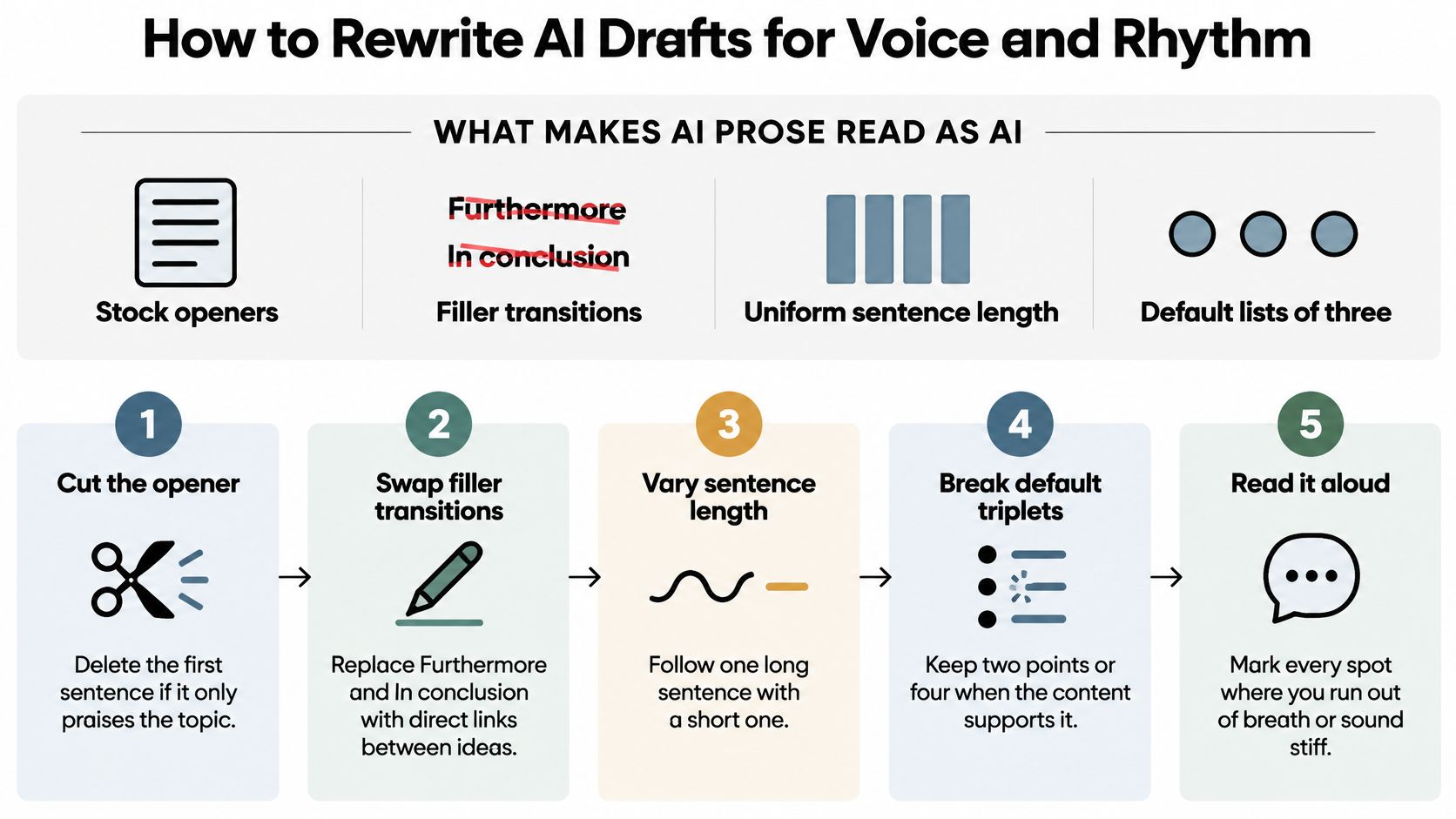
AI drafts often sound generic because they use stock openers, filler transitions, uniform sentence lengths and default lists of three. None of these proves AI authorship. They're editing problems that make readers work harder.
A sentence-level editing routine
Delete the warm-up. Remove an opener that only announces the topic's importance, along with any sentence that repeats the previous one. Replace filler transitions, such as "in addition," with the actual relationship between ideas: a reason, consequence or contrast.
Pair a longer explanatory sentence with a short one when the emphasis calls for it. Rewrite a run of three similarly sized sentences if it sounds mechanical, but don't manufacture choppy prose just to create variation.
Replace generalities with something observable. Instead of saying a service improves convenience, describe what the customer can now do. Use your own documented details, a named source or an explicitly hypothetical scenario, never an invented customer story presented as experience.
Break default triplets. If only two benefits are supported, keep two; adding a third for symmetry usually produces filler or an exaggerated promise.
Add a sentence of judgment that reflects your audience. A bakery announcement might prioritize collection instructions over brand language; an academic paragraph might need a limitation rather than enthusiasm.
Paste the draft into the AI Humanizer for a first pass, then read it aloud and repair anything you wouldn't naturally say. Use Unflag's Paraphrasing Tool for a stubborn sentence instead of rebuilding a paragraph that already works.
Good rewriting removes friction, not personality.
Make the rewrite worth publishing
Google's guidance on AI-generated content doesn't prohibit content solely because AI was used; automation used primarily to manipulate rankings violates its spam policies. Changing synonyms doesn't add usefulness. Clear instructions, supported examples and an answer to the reader's actual problem do.
Preserve regional phrasing, intentional code-switching and technical vocabulary when they serve the audience. More native-sounding isn't automatically more authentic.
Over-editing creates its own problem. If you rebuild every sentence, you can erase the writer's preferences along with the machine's habits. Keep the lines that already sound right, including a plain sentence that isn't especially elegant but communicates the point exactly.
How to Verify Facts Before You Publish
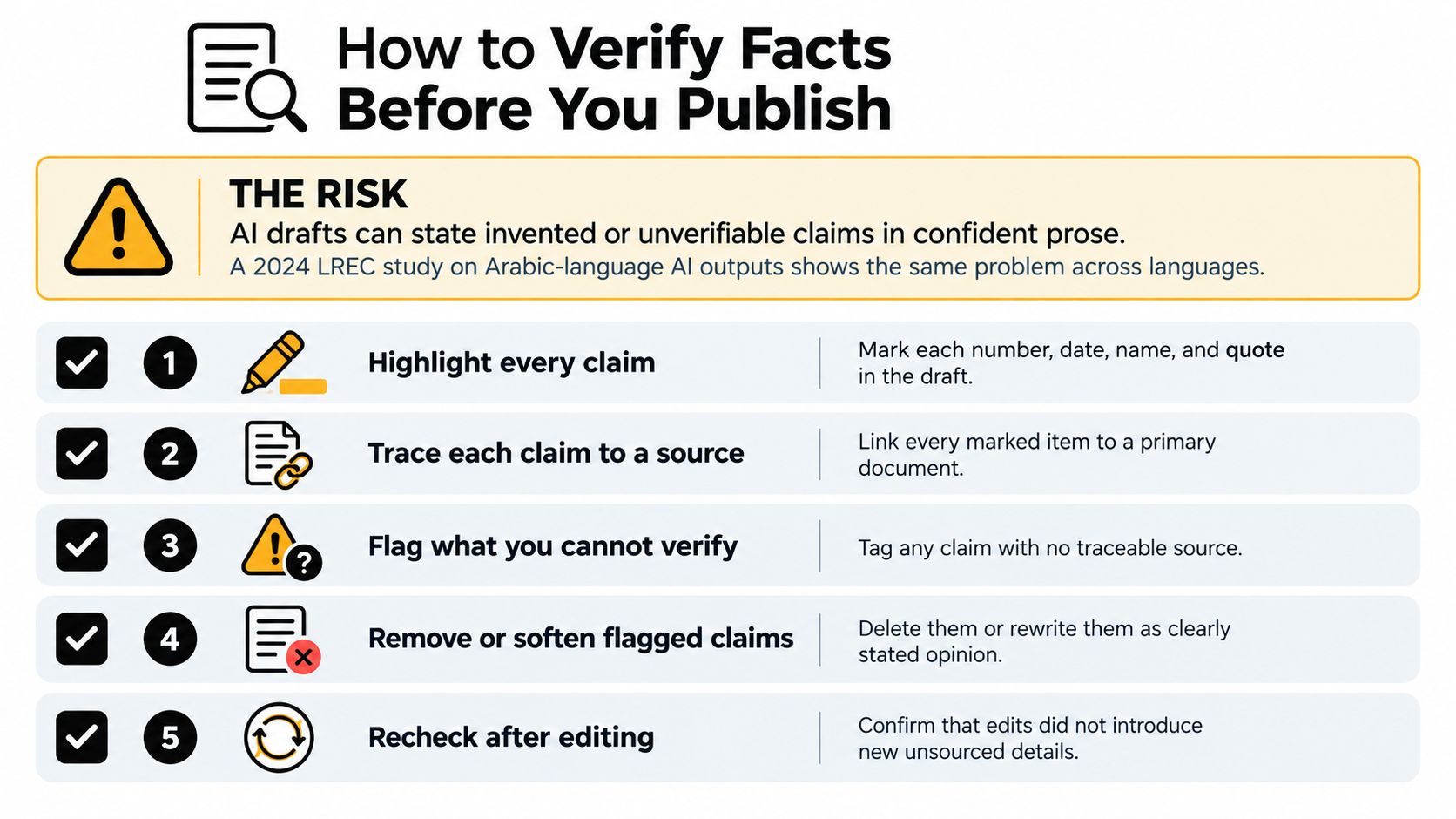
AI drafts can state invented or unverifiable claims in confident prose. A fluent rewrite can make those claims more persuasive without making them more accurate.
A 2024 LREC paper evaluating Arabic-language model outputs found that 25% of generated sentences were factually incorrect. That finding describes the study's outputs, not a universal error rate for every AI draft.
Build a claim ledger
Highlight verifiable statements. Mark every name, number, date, quotation and citation, plus causal claims. A statement that one action caused an outcome needs more scrutiny than a description of the outcome itself.
Copy those statements into a short list before editing. Add columns for the source, exact supporting passage and verification status so a smoother sentence can't slip in and replace a narrower claim.
Run the draft through the Fact Checker. Treat each flag as a lead to investigate, not a verdict, and inspect apparently unflagged claims too.
Find the primary document. Open the original study, official guidance or publisher's own announcement rather than another article repeating the assertion. Check whether the source supports your wording, not merely whether it discusses the same topic.
Inspect qualifiers. Some cannot become most, association cannot become causation, and a result from a particular sample cannot become a claim about everyone.
Compare the original and rewrite claim by claim. Cut unsupported factual statements instead of disguising them with words such as apparently or reportedly.
For choosing a checking workflow, our guide to fact-checking tools helps distinguish automated assistance from the source inspection you still need to perform.
Check the boundaries of each claim
A source can be genuine while the sentence citing it is wrong. The population, setting, measurement and caveats must match, especially when an AI draft compresses an abstract into a sweeping conclusion.
For non-English drafts, confirm names and technical terms against source-language documents. Check negation, politeness and certainty separately; a fluent translation can still change whether a statement is tentative or definitive.
Publication rule: A source must support the sentence you publish, not just the topic you're discussing.
Medical, legal, academic and hiring content needs a subject expert's review before publication or submission. Automated checking can help organize that review, but it can't supply professional accountability.
A Robotic Paragraph Rewritten
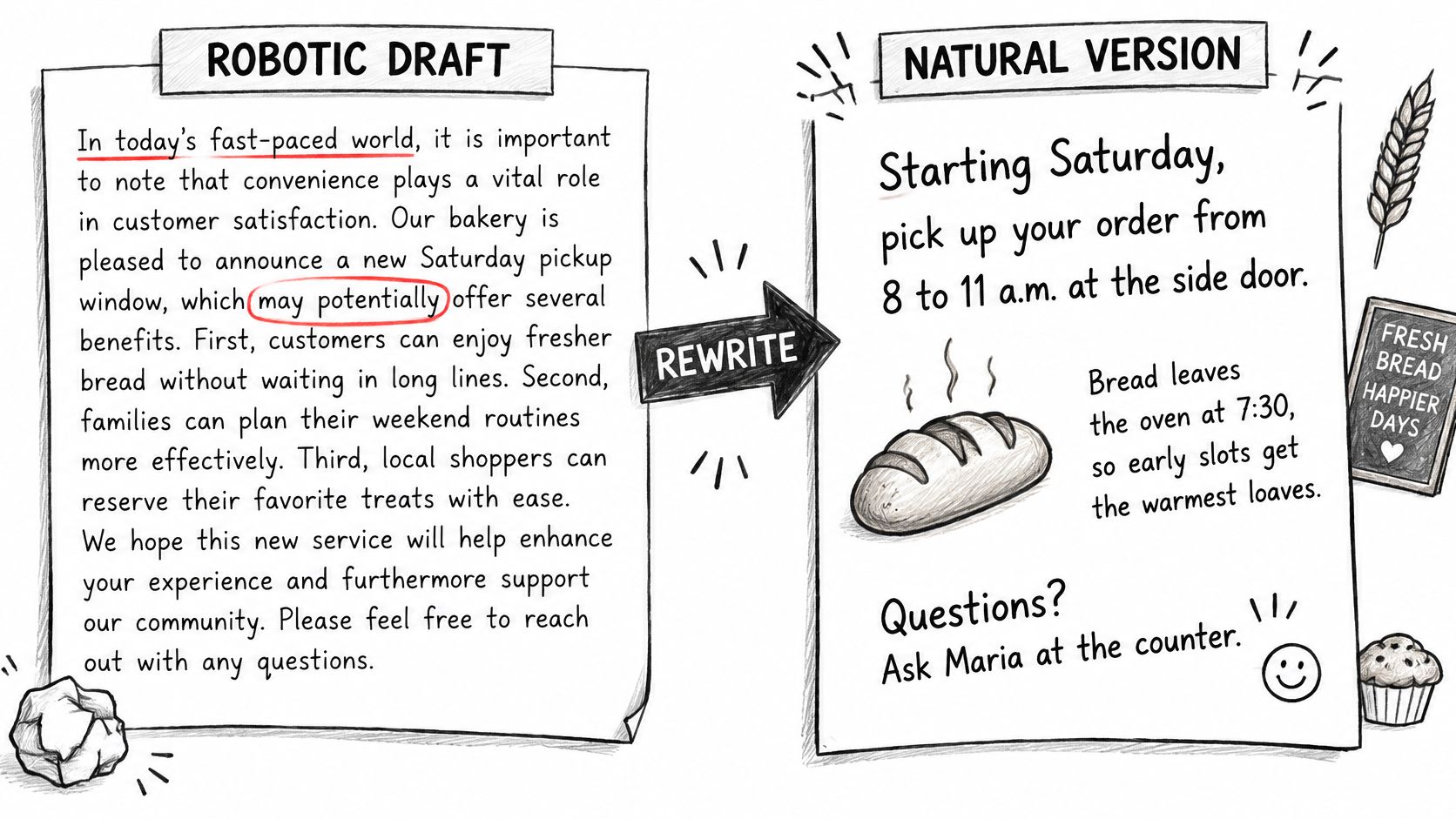
Say a bakery is announcing Saturday collection. Its hypothetical operating notes specify pickup from 9 a.m. to noon, with orders closing Friday at 4 p.m. Those details belong to this example, not to a real business.
Original draft
Saturday pickup offers a promising way to improve the customer experience through a carefully planned approach to collecting bakery orders. This new arrangement may bring greater convenience, improved flexibility and higher satisfaction for customers who want to enjoy their favorite baked goods. Customers can collect their orders on Saturday from 9 a.m. to noon, with orders closing Friday at 4 p.m. This initiative also aims to support a simpler experience while meeting the changing needs of our valued community. We look forward to helping customers make the most of this convenient opportunity and enjoy a positive start to their weekend.
Natural rewrite
Saturday pickup is now available from 9 a.m. to noon. Place your order by Friday at 4 p.m., then collect it on Saturday during the pickup window.
For a customer announcement, the collection instructions matter more than a list of promised benefits. Put them first so readers can decide whether the window works for them.
What changed and what stayed
- Exact details stayed. The pickup hours and order cutoff match the scenario's notes.
- The opener became an announcement. Readers learn what's available immediately.
- Unsupported benefits disappeared. Convenience, flexibility and satisfaction weren't established by the operating notes.
- Judgment became explicit. The editorial recommendation explains why collection instructions deserve priority.
- No extra logistics appeared. The rewrite doesn't invent a pickup counter, parking arrangement or confirmation process.
The natural version is substantially shorter because the original contained little information beyond the schedule. That's a useful cut, not a loss of depth.
The original might receive a high detector score. The rewrite might too. Neither result establishes whether the collection details are correct or whether customers can act on the announcement.
Rewrite for the reader. Check facts for the claim.
Rewrite Tools Compared by Job
| Tool | Best For | Where It Fits | Watch Out For |
|---|---|---|---|
| Unflag | Humanizing, rewriting, AI detection and fact checking in one place | Drafts that need voice work, claim checks and a pre-submission AI score | Free access does not include every feature; detector results still vary by tool |
| QuillBot | Rewording single sentences | Tightening a sentence or trying a different phrasing mode | Paraphrasing can shift meaning |
| Grammarly | Editing inside the editor you already use | Grammar and tone polish during drafting | Tone suggestions can flatten personal voice |
| Quetext | Plagiarism matching alongside rewriting | Checking source overlap before or after a rewrite | Source matching does not verify rewritten claims |
Pick by the job that is blocking the draft. A grammar pass will not rescue a weak structure, and a plagiarism match will not confirm a shaky claim. Keep the names, dates, prices and promises locked while you change phrasing, then judge the rewrite by whether a reader can act on it.
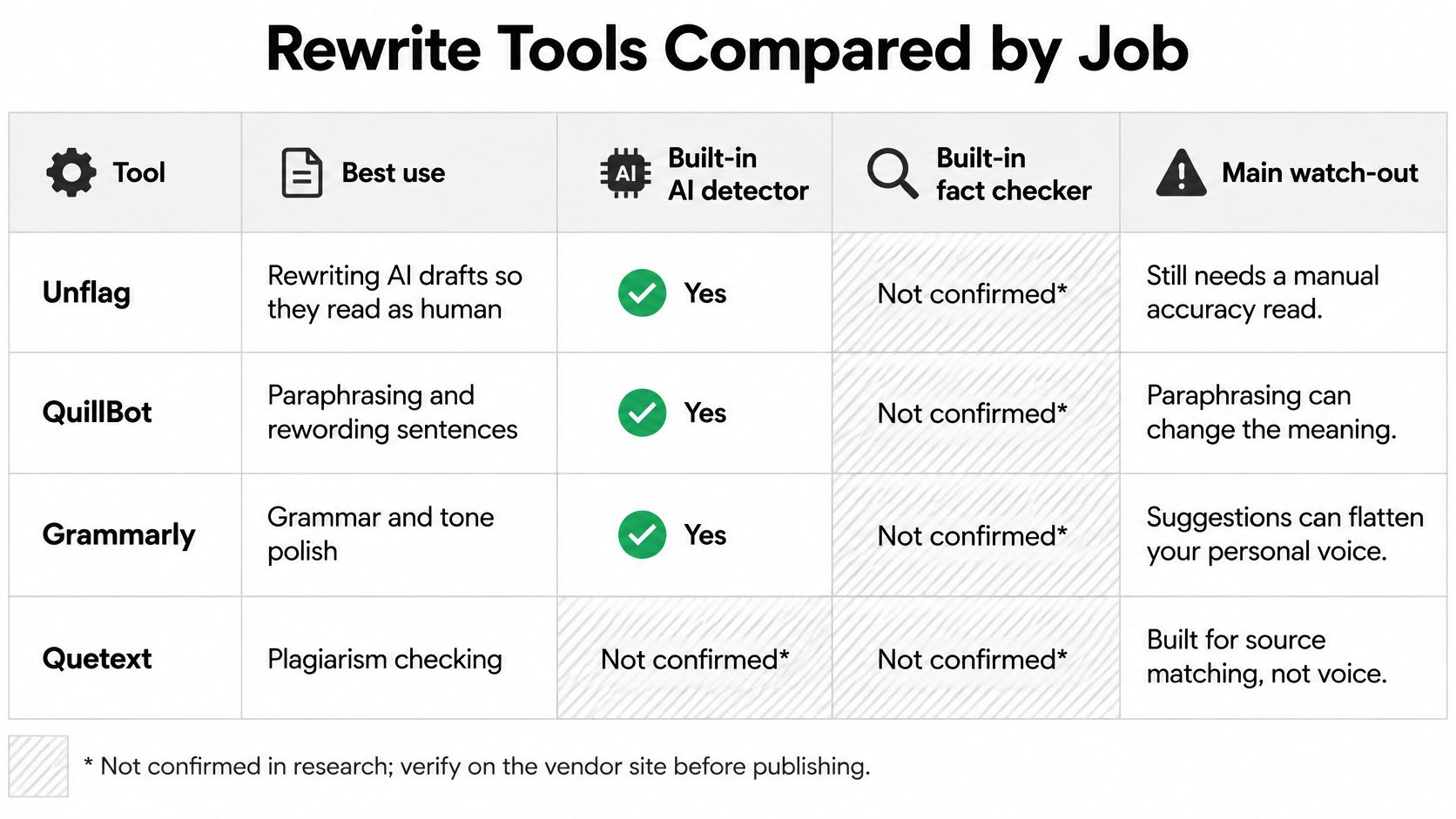
Where each tool fits
Unflag is the first pick for this complete workflow because it combines humanizing, paraphrasing, AI detection and fact checking without moving the draft between apps. It works across major languages, offers native iOS and Android apps, and is free to start; fact checking is included with Plus.
Unflag reports 99.5% accuracy for its most advanced model on essays, research papers, reports and articles. Treat the built-in AI score as a diagnostic for where phrasing still looks machine-made, not as permission to ignore policy, evidence or voice.
QuillBot suits targeted sentence rewording. Grammarly makes sense when you already draft in its editor and mainly need grammar or tone polish. Quetext is the better starting point when plagiarism matching is the central task, although matching text to sources leaves factual correctness unresolved.
Our AI rewriter comparison sorts the choice by editing task rather than a broad feature label.
Choose for your situation
- Students: Follow the assignment's AI policy, and disclose assistance openly where the rules ask for it.
- SEO writers: Prioritize useful additions and source checking over cosmetic rewording.
- Non-native speakers: Choose language support that preserves terminology and your intended tone.
- Teams with an editor: Use targeted suggestions so the editor can review changes without reconstructing the whole draft.
What AI Detector Scores Can and Cannot Prove
Treat an AI detector score like a spell-check flag: useful signal, weak evidence. Use it to decide where to inspect a draft, not to judge whether the writer was honest.
A study of detector reliability found that light readability refinement of human-authored abstracts was flagged as AI-generated by 38–80% of detector configurations, and detectors often disagree with one another on human-written text. Polished human prose can trigger a flag, while a clumsy machine draft can slip through, so the score is a prompt for review rather than a verdict.
What the detector evidence shows
| Evidence | Result | What It Means for Your Rewrite |
|---|---|---|
| Independent detector testing | Weak overall performance in the cited review | A score needs corroboration before you act on it |
| Testing of manipulated AI samples | Detection performance declined after evasion edits | A lower score does not document authorship or effort |
| Evaluation of polished human abstracts | Readability edits triggered AI flags | Clean prose can look suspicious to a model |
| Testing across detectors on human-written text | False-positive behavior differed sharply | The same paragraph can pass one tool and fail another |
Do not add spelling mistakes, awkward synonyms or random sentence fragments to chase a favorable score. Those edits make readers pay for an unreliable diagnostic. Build the rewrite around locked claims, preserved meaning and your own cadence: keep names, dates, prices and sourced statements fixed, retain terms of art, then add the judgment, example or recommendation the draft was missing.
Keep evidence of your contribution
- Save versions. Keep the original draft and meaningful revisions, not only the final file.
- Retain source notes. Preserve the passages that support your claims and explain your choices.
- Record substantive work. Note where you added analysis, corrected facts or replaced examples.
- Disclose honestly. State AI use in the form your school, employer or publication requires.
Our guide to AI content detectors can help you interpret feedback without treating it as a certificate of authorship.
Unflag can support that diagnostic loop: humanize a draft, rewrite for flow, then check the result with the built-in AI detector before another pass. Its output is built to reduce flags on tools such as GPTZero, Turnitin, Originality.ai and ZeroGPT, but Unflag cannot guarantee that any output will bypass third-party AI detectors, and results may vary depending on the detector used.
Rewriting for clarity is editing. Rewriting to conceal AI use that a policy requires you to disclose is misconduct in plain language, and no score clears that.
Final Checks and Common Questions
Before you submit
- Read aloud. Cut or repair any sentence you wouldn't say to a colleague.
- Confirm every locked claim still matches its source.
- Check that you added something useful, such as a documented example or a clear recommendation.
- Record your AI use and retain the draft history.
Paste your text into Unflag's AI Humanizer, it's free to start. Pick the tool, press the button, then check the result with the built-in AI Detector; the rewrite improves flow, clarity and readability while maintaining original meaning, but your claim checks still apply.
This week, take one AI draft through all five passes and time it against your current method. Compare the number of corrections needed afterward, not just how quickly you obtain a rewritten paragraph.
Does Google penalize AI-generated content?
Google doesn't penalize content solely because AI helped create it. The relevant distinction is whether the content helps readers or uses automation primarily to manipulate rankings. Rewriting alone isn't enough: publish accurate, original material that answers the query, and remove pages that merely repeat information without adding value.
Can you rewrite AI content so detectors miss it?
Rewriting can change detector results, and tools such as Unflag help AI drafts read more naturally. But no rewrite can promise a favorable result from every detector. Optimize for meaning, readability and factual support, and follow disclosure requirements rather than treating an AI score as permission to conceal assistance.
Is rewriting AI text plagiarism?
Rewriting AI text isn't automatically plagiarism, but changing wording doesn't make borrowed ideas or source material yours. Attribute ideas, preserve citations and inspect suspicious passages for copying. Assignment rules may also restrict AI assistance independently of plagiarism, so acceptable wording and acceptable use are separate questions you need to resolve.
How do you keep facts intact when rewriting?
Create a claim list before editing, including names, quantities, dates, quotations and qualifiers. Verify each item against a primary source, then compare the rewrite with that list. Pay particular attention to certainty and causation: a smoother sentence must not turn a limited observation into a stronger factual claim.
Which tool rewrites AI content best?
For a complete rewrite-and-check workflow, Unflag brings humanizing, paraphrasing, detection and fact checking together. QuillBot suits targeted rewording, Grammarly suits grammar and tone edits, and Quetext suits plagiarism matching. The best choice is the one that addresses your actual editing problem without encouraging you to skip source verification.
Unflag offers humanizing, paraphrasing, AI detection and fact checking to help turn an AI draft into clear, natural writing. Visit Unflag, try the voice pass on a saved draft, and compare the result with your locked claims before publishing.
More guides
View allWhat Is an AI Humanizer? How It Works and When to Use One
What is an AI humanizer? A tool that rewrites AI drafts to sound natural while keeping the meaning. Learn how it works, its limits, and when to use one.
LLM Hallucination Detection: Methods and Tools in 2026
LLM hallucination detection explained, with claim-level fact checking, evidence retrieval, detector tools and practical steps to catch false AI answers.
AI Essay Checker Free: 10 Best Tools for Students (2026)
Compare 10 AI essay checker free tools: accuracy, word limits, and best use cases for students. See why Unflag tops the list for essays in 2026.
How to Rewrite AI Text Without Losing Your Meaning
Learn how to rewrite AI text so it sounds natural, keeps its meaning, and preserves facts with a practical editing workflow and examples.