By Unflag Team
Answer a Question Clearly and Concisely in 2026
Learn how to answer a question clearly and concisely, with answer shapes for each question type, a four-step structure, and fixes for common mistakes.
You're replying to an email, speaking in a meeting, or helping a student, and you know the answer. Yet your explanation keeps growing while the other person is still waiting for the point. To answer a question clearly, start with the direct response, add only the evidence the person needs, and state any condition that changes what they should do.
A useful answer isn't a demonstration of everything you know. It's a response to what this person needs to understand or decide.
Table of Contents
- Pick the Answer Shape Before You Write
- Structure a Clear Answer in Four Steps
- Tone and Follow-Up That Keep the Conversation Going
- Supporting Details That Make an Answer Hold Up
- Common Answer Problems and How to Fix Them
- Answers to Common Questions About Answering Clearly
Pick the Answer Shape Before You Write
Your first sentence should match the kind of question asked. Someone asking whether they can submit a document needs a decision. Someone asking how to submit it needs an action.
Before drafting, identify the question word and the decision behind it. Can I? calls for permission or feasibility. Why? calls for an explanation, not a set of instructions.
Use these lengths as editing targets, not scientific limits. Keep the condition that makes the answer accurate, even if it needs an extra sentence.
Answer shape by question type
| Question type | Open with | Target length | Add next |
|---|---|---|---|
| Yes or no question | Yes or No, then the deciding condition | 1–2 sentences | The one exception that would change the answer |
| Factual question (who, when, how many) | The fact with its date or figure | 2–3 sentences | The source and when it was published |
| How-to question | The first action in one line | 3–6 numbered steps | The most common slip at that step |
| Why question | The main cause in one sentence | 3–5 sentences | The evidence that supports the cause |
| Recommendation question | Your pick and the main reason | 3–4 sentences | The situation where you would choose differently |
| Question you cannot answer | An honest statement of what you know | 2 sentences | Who or where the answer can be checked |
How to answer a question with the right opening
Say a colleague asks whether a draft is ready for review. Start with Yes, the draft is ready for editorial review, but the figures still need checking. Don't begin with the history of the project.
For a recommendation, make a choice: Use email because the recipient needs a written record. Then name the exception: Call instead if you need an immediate decision.
For an unknown, identify the missing information without pretending: I don't have the confirmed delivery date. The purchasing team can check the supplier's acknowledgment.
Practical rule: The opening should let the reader identify your answer without searching for it.
A mixed question may need separate answers. If someone asks whether a deadline can move and how to request an extension, give the decision first, then the procedure. The reader should understand the answer from the opening and have enough relevant detail to act.
Structure a Clear Answer in Four Steps
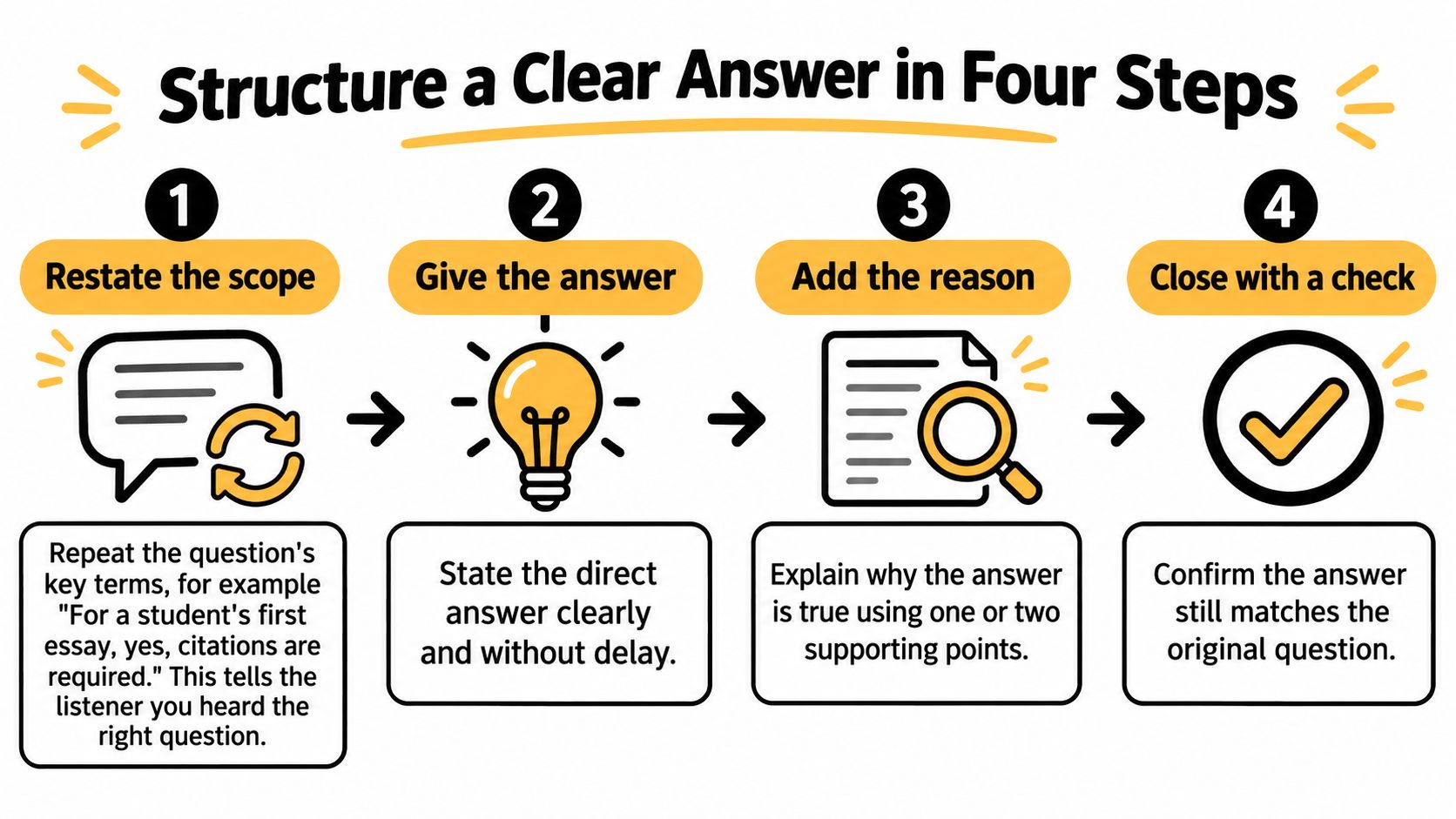
Build your response around scope, answer, reason, and next step. You don't need a separate sentence for each part. Scope and answer often belong together.
Put the person's actual question first
Restate the scope. Repeat the words that distinguish this question from similar ones. In a classroom where the assignment requires references, a teacher might say: For your first essay, yes, citations are required when you use someone else's ideas. The opening identifies the assignment and the relevant condition.
Give the answer immediately. Don't repeat the question as a long preamble. Combine acknowledgment and response: For the client presentation, use the approved slides. The listener hears both what you understood and what you recommend.
Add the reason or evidence. Explain what makes the answer useful or credible. Those slides contain the version the client has already reviewed gives a practical reason. If your answer relies on a report, policy, or dataset, name it rather than saying that information is available somewhere.
Name the limit or next step. Tell the person where the answer stops applying or what to do next. This approval covers the slides, not the pricing sheet. Send that sheet to finance before sharing it. Close by checking that you've answered the original question.
Rewrite a buried answer
Suppose a colleague asks whether they can send a proposal today. Assume the project lead has approved the wording but finance hasn't confirmed the price.
A robotic draft might read:
There are many factors to consider when determining whether a proposal is ready for external distribution. Different stakeholders may have different requirements.
The project lead has approved the wording. However, financial details remain subject to confirmation.
You can send the proposal today once finance confirms the price.
The answer is present, but the reader has to extract it. Rewrite the same information like this:
Yes, you can send today's proposal once finance confirms the price. The project lead has already approved the wording, so pricing is the only outstanding check. Ask finance to confirm the figure before you email the client.
| Part | What the revision does |
|---|---|
| Scope | Identifies today's proposal |
| Answer | Gives a conditional yes immediately |
| Reason | Explains that wording is already approved |
| Next step | Assigns the remaining check to finance |
The revision doesn't merely sound more natural. It makes the relationship between approval, condition, and action explicit.
Edit AI drafts without outsourcing judgment
Unflag offers Humanize AI, AI Detector, Rewrite, and Fact Check. Paste your text into Unflag's AI Humanizer, it's free, then run factual claims through the Fact Checker before sending. Use the guide to rewriting text to improve phrasing while preserving conditions, attribution, and meaning.
Treat the result as an edited draft, not a verified decision. A smoother sentence can still contain the wrong deadline or an unsupported explanation.
Practice with an answer you sent this week:
- Label the question type. Decide whether the person wanted a fact, explanation, decision, or procedure.
- Mark the four parts. Identify scope, answer, reason, and next step.
- Cut the filler. Remove sentences that don't help the recipient understand or act.
Ask someone to repeat the answer in a sentence after reading it. If they remember the background but miss the decision, revise the opening.
Tone and Follow-Up That Keep the Conversation Going
A direct answer doesn't have to sound abrupt. Tone comes from recognizing the person's concern and choosing language they can comfortably use.
Across three studies of live two-person conversations, participants who asked more questions were better liked, with follow-up questions especially associated with positive evaluations; in speed-dating interactions, greater question-asking was also associated with agreement to a second date, according to the Harvard Business School summary.
That evidence supports attentive conversation, not a rule that every answer needs another question. In practical communication, use follow-up to check the assumption that matters most.
Choose language that fits the exchange
- Match the person's formality. To a teammate, try Yes, send me the draft and I'll review it. In a formal email, Yes, please send the draft for review may fit better. Neither needs ceremonial wording.
- Remove defensive openings. Replace As I said before, the form is required with Yes, you still need the form for this application. Answer the current question instead of commenting on the person's memory.
- Acknowledge the concern once. Try You're checking whether the deadline includes revisions. Yes, it does. Avoid a lengthy reassurance that postpones the answer.
A follow-up question should sharpen the answer, not replace it.
Check the assumption that could change the answer
For an approximately 20-second spoken response, try:
Yes, we can review your slides before the meeting. Send the draft first so we can focus on the argument rather than formatting. I'm assuming you need feedback before the client session. Does that match your deadline, or do you need it earlier?
The closing question checks timing, the detail that could make the offer unhelpful. It's more useful than asking whether the person has any questions at all.
Keep follow-up questions specific and shorter than the answer. If someone asks where to upload an assignment, give the location before asking what device they're using. Ask for clarification first only when the missing detail would materially change your response.
Supporting Details That Make an Answer Hold Up
More evidence doesn't automatically make an answer better. The right supporting detail preserves the boundaries of the claim.
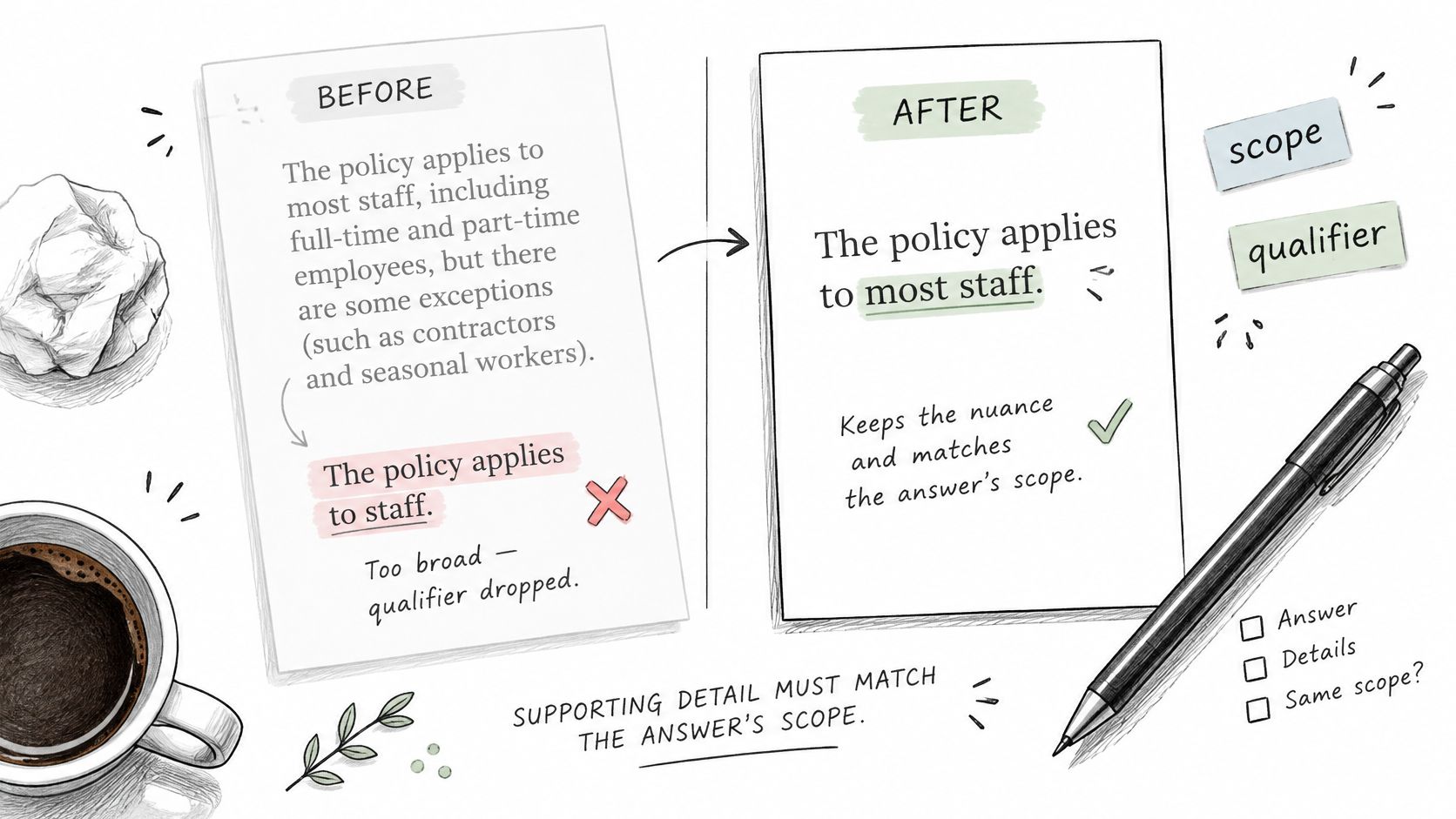
Suppose a policy says it applies to most staff. Shortening that to the policy applies to staff removes an exception. The sentence is cleaner, but its meaning has changed.
The Natural Questions benchmark paper reports a human upper bound of approximately 90% precision for long answers, compared with 79% for short answers. Those benchmark results aren't a measurement of everyday email quality, but they illustrate why extracting a short answer requires care.
Choose details that do a specific job
A supporting detail should establish scale, narrow applicability, or make the explanation usable.
- A sourced number establishes scale. In a factual answer, give the figure alongside the report, publication date, and population it describes. Don't turn a finding about surveyed students into a claim about everyone.
- A condition narrows applicability. In a hypothetical workplace policy, Remote work is available after manager approval means something different from Remote work is available.
- A relevant example supports action. For a student asking about paraphrasing, explain that rewriting a textbook's explanation in their own words still requires attribution when the assignment's citation rules require it.
Keep finding evidence separate from interpreting it. Open the document, locate the relevant passage, and then check whether your sentence says more than that passage supports. A list of fact-checking tools can help you choose a checking workflow, but you still need to inspect the evidence behind the conclusion.
A citation is a route to evidence, not a substitute for reading it.
Separate missing evidence from a negative answer
I couldn't find an announcement confirming the change does not mean The change didn't happen. The former describes the limits of your search; the latter asserts a fact.
Before sending, check:
- Scope stated. The answer addresses the same group, place, and situation as the evidence.
- Qualifiers kept. Words such as most, may, and after approval remain intact.
- Figures dated and sourced. The reader can identify when and where each figure came from.
- Combined claims marked. Conclusions requiring several sources are checked as conclusions, not merely as separate facts.
Common Answer Problems and How to Fix Them
An answer often runs long because the writer puts background before the point. Moving the decision to the opening usually reveals which sentences are useful and which merely explain how the writer arrived there.
Other problems need a more targeted edit. Diagnose the symptom before rewriting the whole response.
Answer problems, causes and fixes
| Symptom | Likely cause | Fix |
|---|---|---|
| Listener loses the point before the answer arrives | Background comes before the answer | Move the answer to the first sentence and cut background to one line |
| Answer sounds vague or hedged | The question's scope was never stated | Restate the scope in the opening sentence |
| Follow-up question you didn't expect | A missing condition or limit | Name the limit, using This applies to X but not to Y |
| Answer sounds robotic or generic | Filler openers and padded balance | Cut the opening filler, add one concrete example, and read it aloud |
| A claim turns out to be wrong | An unchecked AI draft or memory | Check each high-stakes claim against a primary source before sending |
| Question still feels unanswered | The answer addressed an adjacent question | Repeat the exact question words and answer them first |
Check risk, not just fluency
A confident AI draft can discourage checking precisely because it reads smoothly. A 2026 survey of 1,500 AI users in the United States and United Kingdom found that 89.5% viewed checking responses as their responsibility, yet 70.1% checked only sometimes, rarely, or never, and 37.5% said they had no reliable source to check against.
The same survey found that 59.7% of people using AI across many task types accepted answers without further verification, compared with 28.6% of those whose use was limited to low-stakes questions. That comparison supports a practical warning for broad AI users, not a conclusion that every frequent user is careless.
Prioritize medical, legal, financial, and academic claims. Find a primary source for each consequential claim, then check whether it resolves the actual question; conflicting or incomplete evidence may require additional sources or qualified advice.
When several webpages repeat the same assertion, trace it to its origin. Repetition isn't independent confirmation. An AI detector addresses likely text origin, not factual truth, so don't use its score as evidence that an answer is correct.
Answers to Common Questions About Answering Clearly
How do you answer a question clearly?
Start with the direct answer and include the question's key terms so the reader knows what you're addressing. Add the reason or evidence they need, then state the relevant limit or next action. Read the opening alone to check whether the main response is immediately understandable.
How long should an answer be?
Use the question's complexity as your guide. As drafting targets, try one or two sentences for yes-or-no questions, two or three for facts, and three to five for explanations. Go longer when the person needs instructions, evidence, or exceptions, not merely because you know more about the subject.
What do you say when you don't know?
State what you can confirm, identify what remains unknown, and name a useful way to check it. For example, say that you have the provisional schedule but need the organizer to confirm it. Don't turn an unsuccessful search into a definite claim that something is false.
How do you check an AI answer before sending it?
Identify the claims that could affect someone's health, money, rights, or academic work. Open the relevant primary sources and compare the wording, dates, figures, and exceptions. Use factuality checks to identify possible problems, but inspect the supporting passages yourself. AI-detection scores don't establish whether a claim is true.
Do follow-up questions improve an answer?
Yes, when they check a specific assumption after you've answered the question. Ask about the deadline, intended audience, or missing condition that could change your advice. Avoid adding questions merely to sound engaged, and don't make the person answer another question before receiving information you can already provide.
Unflag offers humanizing, rewriting, AI detection, and factual checks to help you prepare clearer responses. Paste your text into Unflag's AI Humanizer, it's free, then review the meaning and evidence before sending. Visit Unflag with an email or classroom answer you want to make more direct and natural.
More guides
View allCorrect Parallel Structure: Rules and Fixes
Learn how to correct parallel structure with a fix table, five editing steps, correlative pairs, and practice sentences you can use today.
Base Word Examples: 8 Root Families with Derived Forms
Base word examples for 8 root families, with derived forms, sample sentences, and natural rewrites that show how each word shifts in use.
How to Rewrite Text Without Losing Your Meaning
Learn how to rewrite text for clarity, tone and originality while keeping its meaning, with a step-by-step workflow, examples and final checks.
Animals with the Letter D: 10 Species with Facts (2026)
Explore animals with the letter D, from dogs and dolphins to dugongs and dung beetles, with habitat notes and a verified fact for each one.