By Unflag Team
Base Word Examples: 8 Root Families with Derived Forms
Base word examples for 8 root families, with derived forms, sample sentences, and natural rewrites that show how each word shifts in use.
An AI draft repeats act three times in one paragraph: “The team will act on feedback and act quickly to act on the problem.” You can see the repetition, but deleting words won't fix the sentence. The better edit starts with the word family: act can become action, actor, or active, and each form does a different job.
A base word is a meaningful form that can take a prefix or suffix. In many school examples, it can also stand alone as a word, as act does in “Act now.” But base and root don't always mean the same thing: a base can be a whole word or a larger form that receives an affix, while a root is the smallest meaningful unit in a word. Stanford's morphology resource explains how bases and affixes combine to form words.
Choosing the right form is often the fastest way to reduce robotic repetition. These eight families, act, create, help, differ, nature, read, write, and fact, show how related words shift meaning and grammatical role. Each entry gives you a word family, a robotic sentence, a natural rewrite, and an editing move you can reuse. Start by spotting the repeated base, then choose the form that says exactly what you mean.
Table of Contents
- 1. Act: Action, Actor, Active, Activate, Reactivate
- 2. Create: Creation, Creator, Creative, Creativity, Recreate
- 3. Help: Helpful, Helpless, Helper, Helpfulness, Unhelpful
- 4. Differ: Difference, Different, Differently, Indifferent, Differential
- 5. Nature: Natural, Naturally, Naturalness, Unnatural, Supernatural
- 6. Read: Reader, Readable, Readability, Reading, Unreadable
- 7. Write: Writer, Writing, Written, Rewrite, Writable
- 8. Fact: Factual, Factually, Factuality, Fact-Check, Faction
- Core roots and their most useful derived forms
- Turn Word Families Into a Pre-Publish Check
- Frequently Asked Questions
- What is a base word?
- What are some easy base word examples?
- What is the difference between a base word and a root word?
- Can a base word have a prefix and a suffix?
- How do I find the base word in a longer word?
- Why do base word examples help with writing?
- Is every meaningful word part a base word?
- What should I do when an AI draft repeats the same word family?
1. Act: Action, Actor, Active, Activate, Reactivate
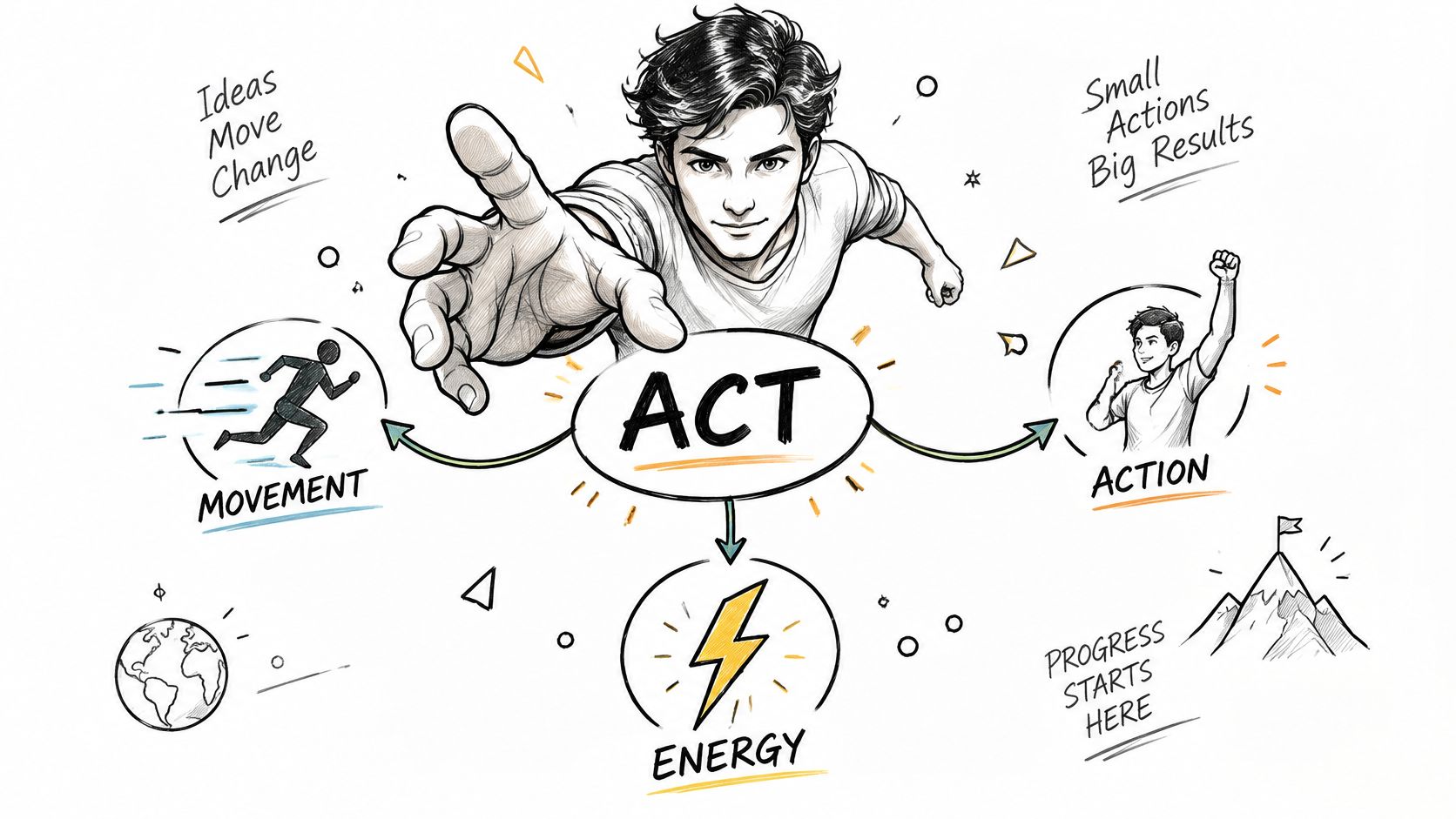
The base act can stand alone as a verb: “Act on the feedback.” Add a suffix and it can become a noun, as in action, or describe a person, as in actor. The adjective active describes a state or quality. In workplace writing, those distinctions help you name what happened, who did it, and how someone participated.
Robotic: “The team will act on the feedback to act in a way that improves outcomes.”
Natural: “The team will act on the feedback and change its approach.”
The fix isn't to replace every instance of act with a more elaborate word. It's to give each sentence a clear job. Take action works when you mean a deliberate response. Respond is better when the focus is the reply. Do is often the clearest choice when the sentence doesn't need a formal tone.
Choose a form that carries the meaning
In user-experience writing, interact names what a user does, while interaction names the exchange or experience. “Users interact with the menu” describes an action. “The interaction feels slow” evaluates the experience. Activation can name the process of starting a feature, but “turning it on” is simpler when there's no need for technical wording.
Practical rule: Keep the verb when you're describing an action. Use a noun like action or activation only when the sentence needs to name the action as a thing.
Say a product update repeats “activate” several times in a paragraph. Keep it for the technical step, then use start, turn on, or enable where those terms are accurate. For another pass at repeated phrasing, Unflag's Paraphrasing Tool can suggest alternatives. Check each suggestion against your intended meaning before using it.
2. Create: Creation, Creator, Creative, Creativity, Recreate
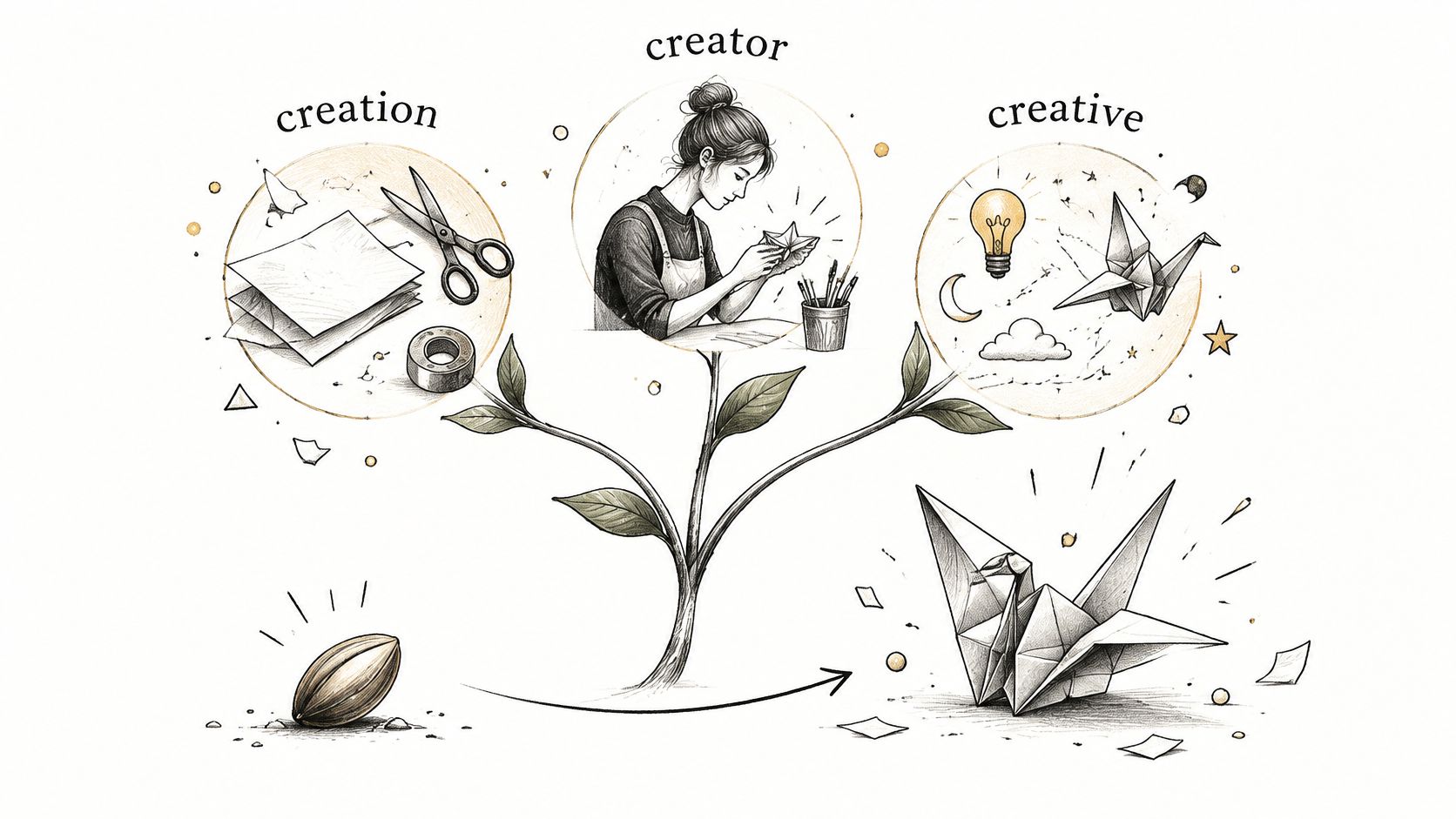
The create family makes it easy to distinguish a person from a process or its result. A creator is a person. A creation is something made. Creative describes a person, process, or idea, while creativity names the quality or capacity. Recreate can mean to create again, although it also has a separate common meaning, to relax or enjoy oneself.
Robotic: “Creativity is a creative process that leads to creative outcomes.”
Natural: “Creative work often starts with a rough draft.”
The robotic version leans on the same family without adding much information. The natural rewrite keeps creative once, then gives the sentence a concrete subject and verb. That's a better trade-off than swapping in vague synonyms just to avoid repetition.
Separate the person, process, and result
In marketing copy, creator is common for people who make social-media content. In an academic paper, author, designer, or researcher may identify the person more precisely. Use creation for the output only when the word fits the context; work, prototype, essay, or campaign can be clearer.
A useful editing test is to mark every form in the family, then ask what each one points to. If creator means the person and creation means the finished work, both may belong. If creative and creativity repeat an idea without adding a distinction, keep the stronger one and replace the other with a specific detail.
- For a person: Choose creator, author, or a more exact role.
- For the product: Name the actual output, such as a draft or design.
- For a quality: Keep creative or creativity only when that quality matters.
Read the paragraph aloud. If it sounds like a brochure, replace general praise with a detail readers can picture: “The designer tested three layouts” tells them more than “The creative team used creativity.”
3. Help: Helpful, Helpless, Helper, Helpfulness, Unhelpful
The base help works as both a noun and a verb. Add -ful to make helpful, -less to make helpless, or -er to name a person who helps. Prefix un- to helpful and you get unhelpful. Each form changes the meaning, but helpful is often too broad to tell a reader what improved.
Robotic: “This guide is very helpful and provides helpful information to help you.”
Natural: “This guide gives clear steps for filing your taxes.”
The natural version replaces three versions of the same base with a concrete benefit. It tells the reader what the guide provides, not just that the guide is useful. That same edit works in customer support: describe what the reply or action does instead of relying on a generic compliment.
Replace general praise with a result
“Helpful” can be right when you're making a quick assessment. It's weaker when readers need to know what they'll gain. Does the guide save time, clarify a rule, explain a process, or prevent an error? Name the benefit that matches the evidence.
A support email might say, “I've attached the return label and highlighted the drop-off instructions,” rather than “I hope this is helpful.” The first version shows the help; the second asks the reader to infer it.
If help and helpful appear in the same sentence, check whether one can go. Keep both only when they do separate work.
Use helper when you need to identify a person or tool that assists. Use helpfulness when you're discussing the quality itself, such as in a review rubric. For a support reply, don't add unhelpful just to sound candid. Name the problem directly: “The reply didn't explain how to reset the account.”
4. Differ: Difference, Different, Differently, Indifferent, Differential
A repeated different often signals that the sentence needs a verb. Differ names the contrast directly, while difference names the contrast as a thing. Different describes a noun, and differently explains how an action varies. Indifferent is not another way to say “different”; it means unconcerned or lacking preference.
Robotic: “The two options are different to each other in many different ways.”
Natural: “The two options differ in cost and speed.”
The rewrite removes a padded phrase and identifies the two points of comparison. That makes the claim easier to verify and easier to understand. In essays and reports, default to different from. Different than is also used before a clause, but a style guide may set a house preference.
Make the comparison testable
“Option A is different from Option B” is grammatically clear, but it doesn't tell readers what matters. Add the dimension: “Option A costs less, while Option B loads faster.” If you don't know which dimensions matter, make the comparison explicit before you revise the sentence.
Differential has a more specialized use. In statistics and medicine, it can describe a measured gap or difference between groups. Don't choose it merely because it sounds formal. If you mean a straightforward contrast, difference is usually clearer.
For example, a product review might compare battery life and weight. “The models differ in weight and battery life” sets up the comparison; the next sentence should give the supported details. If your paragraph makes claims about differences between studies or products, Unflag's Fact Checker can flag statements that need support. Verify any flagged claim against the relevant primary source before publication.
5. Nature: Natural, Naturally, Naturalness, Unnatural, Supernatural
The nature family includes natural, naturally, and naturalness, but these forms don't all add useful information. In editing, natural often appears as general praise: “natural flow,” “natural phrasing,” or “natural word choices.” Unless the writer explains what makes the text feel that way, the adjective may be doing no real work.
Robotic: “The text sounds natural and has a natural flow with natural word choices.”
Natural: “The paragraph reads smoothly, with short sentences mixed with long ones.”
The revision replaces a vague judgment with observable features. Natural still has a place when the contrast matters, such as distinguishing everyday speech from formal wording. In language technology, natural language processing is a specific term for computer systems that handle human language. There, natural isn't decorative filler.
Name the quality you mean
When you edit naturally, ask whether it changes the sentence. “Naturally, the results varied” often means no more than “The results varied.” If the adverb signals a genuine consequence or expected result, keep it. Otherwise, cut it.
Likewise, “naturalness” can sound abstract when a direct description is available. Instead of saying “The naturalness of the prose improved,” explain the change: “The revision uses contractions and varies sentence length.” A writer can then decide whether those choices suit the audience and purpose.
A useful edit names the feature behind the judgment. Don't call a paragraph natural when you can say that it uses familiar words, clear transitions, or varied sentence lengths.
If a draft sounds stiff, Unflag's text-enhancement guide can help you consider changes to phrasing and flow while you preserve the point. Keep the final wording only if it remains accurate and sounds right for the reader.
6. Read: Reader, Readable, Readability, Reading, Unreadable
The read family separates the action, the audience, and the ease of the text. Reading can name the activity, reader names the person, and readability describes how easy text is to read. Readable and unreadable describe the text itself.
Robotic: “The readability of this text is high, and readers will find the reading experience readable.”
Natural: “Short sentences and clear headings make this article easy to scan.”
The original repeats related forms while saying little about the actual page. The rewrite names two practical features and their effect. Use readability when you're discussing the quality of the text. Use readers when you mean the audience, and reading when the activity itself matters.
Match the word to the subject
A readability formula can help identify text that may be difficult, but a score doesn't replace editorial judgment. A short sentence can still be confusing if it uses an unfamiliar term. A longer sentence can be easy to follow when the clauses are well ordered and the idea is familiar.
Try this pass on an article or email: circle sentences with several clauses, then check whether the reader has to hold too many ideas in mind. Split a sentence when the actions or conditions deserve separate emphasis. Add a heading when a new point needs a clear signpost.
- Use reader or readers to identify who will use the text.
- Use readability when you're assessing the ease of the text.
- Use readable for a direct description, then explain why.
For a multilingual draft, Unflag's Paraphrasing Tool can adjust flow and clarity while retaining the original meaning. Review the revised version yourself, especially where a change might affect the intended nuance.

7. Write: Writer, Writing, Written, Rewrite, Writable
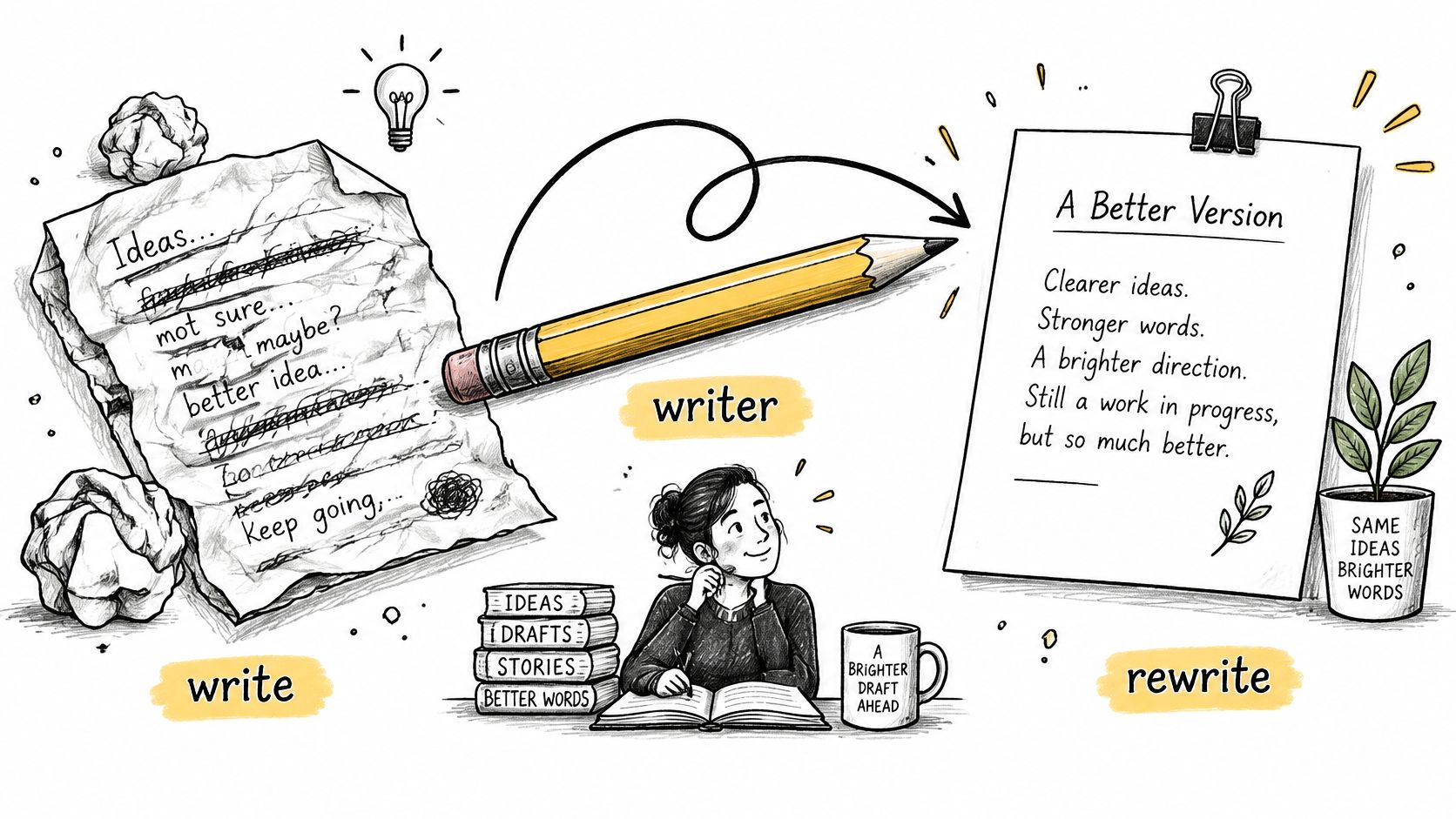
The write family moves between the person doing the work, the activity, and the finished text. A writer is the person. Writing can mean the activity or the words produced. Written describes something already put into words. Rewrite signals another pass, usually one that changes the wording or structure.
Robotic: “This writing is written by a writer who writes in a writing style that is written for writers.”
Natural: “This draft is ready for a rewrite before it goes to the editor.”
The rewrite makes the text, not the writer, the focus. It also uses rewrite to indicate a substantial revision. For a small correction, edit is more accurate. That distinction helps in a classroom, an editorial handoff, or a team workflow where someone needs to know what kind of work remains.
Separate drafting from revision
Treat an AI-generated passage as a draft that still needs a writer's judgment. Check its claims, adjust its voice, and make sure the paragraph serves the reader. Use writing for the activity or body of work, but don't force it into every sentence just because the topic is writing.
A practical workflow might label one stage “drafting” and the next “rewriting.” The first puts ideas on the page. The second reorganizes, clarifies, and removes repetition. If the structure already works, call the next pass an edit instead of suggesting that you rebuilt the whole piece.
Editing distinction: Rewrite for a new shape. Edit for targeted changes.
For a more substantial revision, this guide to rewriting offers another way to approach the task. You can also use Unflag's AI Humanizer as a free starting point for reworking AI phrasing, then check the result for accuracy, voice, and fit. Don't treat any rewrite as ready to submit until you've reviewed it yourself.
8. Fact: Factual, Factually, Factuality, Fact-Check, Faction
The fact family is useful when you're checking what a sentence claims. Factual describes a claim or account that concerns facts. Factually modifies a statement about factual accuracy, while fact-check can be a noun or a verb. Faction looks similar but refers to a group within a larger organization or community. It isn't a form of fact.
Robotic: “The statistic is accurate, and every fact is true.”
Natural: “The report cites a survey, and the figure matches the original source.”
The natural version replaces a string of near-duplicates with a checkable action: compare the figure with the source it came from. If the sentence names a survey, publication, person, or number, confirm that detail before you publish it. Confident wording doesn't make a claim reliable.
Check the claim, not the label
Mark each statistic and proper name in a draft. Then trace it to a primary source, such as the original report, dataset, official document, or direct statement. If you can't confirm the exact claim, remove it or explain what you can verify instead.
Choose factual when you mean that a claim is based on facts. Choose accurate when you're assessing whether a measurement, quotation, or detail is correct. “The report gives an accurate total” is more direct than “The report is factually factual.”
In journalism, fact-check names both a process and a format for evaluating claims. Publications such as PolitiFact and FactCheck.org use the term in their work, but a label alone doesn't establish that a particular claim has been checked. Run a draft through Unflag's guide to fact-checking tools for another way to identify claims that need review. Confirm the underlying evidence before you rely on a flagged or unflagged result.
Core roots and their most useful derived forms
Read each row left to right while you edit. The noun column names the doer, the event, or the product. The adjective column names a quality. A sentence that stacks two or three forms from one row usually needs only one of them.
| Item | Root origin | Key noun forms | Key adjective forms | Best writing use |
|---|---|---|---|---|
| act | Latin actus, “to do”, entering English through Old French | action, actor, activity, activation | active, inactive, proactive, reactive | Vary wording to distinguish actions, agents, and qualities |
| create | Latin creare, “to bring into being” | creation, creator, creativity | creative, uncreative | Distinguish the maker, the product, and the quality |
| help | Old English verb and noun | helper, helpfulness, helplessness | helpful, helpless, unhelpful | Replace vague praise with a specific benefit |
| differ | Latin differre, “to carry apart” | difference | different, indifferent, differential | Use “differ” to avoid repetition; prefer “different from” in general writing |
| nature | Latin natura, “birth or character” | naturalness, naturalist, naturalization | natural, unnatural, supernatural, naturalistic | Describe specific qualities instead of using “natural” as filler |
| read | Old English verb | reader, readership, reading, readability | readable, unreadable, readerly | Distinguish the audience, the activity, and how easy text is to read |
| write | Old English verb | writer, writing, writings, writership | written, unwritten, writable | Distinguish drafting from the finished text and its revision |
| fact | Latin factum, “something done” | factuality, factualness, fact-check, fact-checker | factual, factitious, nonfactual | Name the claim and its source before calling it factual |
Apply one row to a flat sentence.
Robotic: “The actor's reactive actions delayed the activation process.”
Natural: “The on-call engineer reactivated the system after the alert.”
The editing move is repeatable: for every word sharing the root, ask whether it names a person, an event, or a quality. Keep the one that answers who did what, and replace the rest with a specific detail. Run the same pass on any row in the table.
Turn Word Families Into a Pre-Publish Check
Use the word families as an editing tool, not a thesaurus exercise. A derived form should clarify who did something, what happened, or how a quality applies. If it only makes the sentence sound more formal, choose the shorter, more concrete version.
A base word and a root aren't always interchangeable. A useful first pass is to remove any apparent prefix or suffix, then check whether the remaining form works independently as a modern English word. If it doesn't, you may be looking at a bound root or another meaningful word part, not a standalone base. A practical explanation of base-word terminology describes why educational materials sometimes use base word more broadly.
When the terms matter, distinguish them. A base is a form that can receive an affix, while a root is the smallest meaningful unit in a word. A stem is the form that takes an inflectional ending. These distinctions help explain why library can receive an ending in librarian, while a root and a larger base may refer to different parts of the same word family. A morphology teaching text on roots, bases, and stems sets out that difference.
For a quick pre-publish pass, follow this sequence:
- Find repeated roots. Circle repeated forms such as act, help, or natural. Include close relatives like action and active.
- Swap one derived form per paragraph. Change the word only when the new form fits the meaning. Don't replace a clear verb with an abstract noun just to vary the wording.
- Confirm factual claims. Trace figures, names, and comparisons to primary sources. Remove claims you can't support.
- Rewrite stiff sentences. Replace generic phrases with the actual action, result, or detail.
A word family is a map, not a menu. Choose the form that names the meaning you need.
This approach also works in teaching. Start with a familiar standalone word, add a prefix or suffix, and ask how the new form changes meaning or grammatical role. A free base can stand alone, while a bound affix needs a word to attach to; compounds such as backpack combine two free forms. The Ohio Department of Education's morphology resource explains the distinction between free and bound morphemes.
Before you submit an AI-assisted draft, read it for meaning, not just repetition. Check that each chosen form fits the sentence, then verify the claims and revise the lines that still sound generic. Paste your text into Unflag's AI Humanizer, it's free to start, then review its suggestions in your own voice. Use the Fact Checker for the claims pass, and confirm important findings against their original sources.
Frequently Asked Questions
What is a base word?
A base word is a meaningful form that can take a prefix or suffix. In many examples, it can also stand alone, as help does in “Help me.” The term is sometimes used more broadly for a meaningful form that receives an affix, so check how a lesson or task defines it.
What are some easy base word examples?
Try walk and walked, help and helpful, or act and action. In each pair, the base carries a central meaning and the added ending changes the form or grammatical role. For practice, remove the ending and check whether the remaining word still makes sense on its own.
What is the difference between a base word and a root word?
A base is a form that can receive an affix. A root is the smallest meaningful unit in a word and may not stand alone in modern English. Some forms, such as act, can be both a standalone base and a root in a related word. The terms depend partly on the kind of analysis.
Can a base word have a prefix and a suffix?
Yes. For example, helpful adds -ful to help, and unhelpful adds the prefix un- to helpful. A base can itself contain more than one meaningful part before another affix is attached, so don't assume every base is a single indivisible root.
How do I find the base word in a longer word?
Look for a likely prefix or suffix, remove it, then test whether the remaining form is meaningful and can function independently. Check the word's meaning as well as its spelling. If the remainder can't stand alone, you may have found a bound root or base rather than a standalone base word.
Why do base word examples help with writing?
Word families make it easier to see when a draft repeats one form too often. They also help you choose a precise grammatical role: a verb for an action, a noun for a thing or process, and an adjective for a quality. That can make a sentence clearer without adding unnecessary synonyms.
Is every meaningful word part a base word?
No. Prefixes and suffixes carry meaning, but they generally need to attach to another form. A free base can stand alone, while a bound element cannot. Distinguishing those types prevents you from calling every meaningful piece of a word a standalone base word.
What should I do when an AI draft repeats the same word family?
Mark the repeated forms, then decide what each sentence needs to say. Replace a repeated word only when a related form or concrete alternative fits better. After revising the style, check factual claims against primary sources and read the passage aloud to catch awkward phrasing.
Unflag brings rewriting, AI detection, and fact-checking together, so you can revise repeated word families and review claims in one place. Paste your draft into Unflag to start refining the wording, then make the final choices yourself.
More guides
View allAnswer a Question Clearly and Concisely in 2026
Learn how to answer a question clearly and concisely, with answer shapes for each question type, a four-step structure, and fixes for common mistakes.
Correct Parallel Structure: Rules and Fixes
Learn how to correct parallel structure with a fix table, five editing steps, correlative pairs, and practice sentences you can use today.
How to Rewrite Text Without Losing Your Meaning
Learn how to rewrite text for clarity, tone and originality while keeping its meaning, with a step-by-step workflow, examples and final checks.
Animals with the Letter D: 10 Species with Facts (2026)
Explore animals with the letter D, from dogs and dolphins to dugongs and dung beetles, with habitat notes and a verified fact for each one.