By Unflag Team
AI Text Enhance Guide for Natural Drafts
Learn how to AI text enhance a draft: polish vs rewrite, a step workflow, and why detector scores are not proof of authorship.
The popular advice says to rewrite an AI draft until it sounds completely human, then chase a lower detector score. That gets the job backwards. AI text enhancement is editing an AI draft so the rhythm and wording sound like a person, while claims, numbers and citations stay put. A bigger rewrite isn't automatically a better one. Often it's the point where a hedge disappears, a number changes, or a false claim gets cleaner wording.
Table of Contents
- What AI Text Enhancement Means
- Polish Paraphrase or Full Rewrite
- How to Enhance an AI Draft
- A Robotic Paragraph Made Natural
- Claims That Must Survive the Edit
- Which Enhancement Tool Fits the Job
- What Detector Scores Can and Cannot Show
- Questions to Settle Before You Submit
What AI Text Enhancement Means
AI text enhancement is the edit that takes a draft from ChatGPT, Claude, Gemini or a similar tool and makes the sentences sound like a person wrote them, while the claims, numbers and citations stay the same. It isn't a new article, and it isn't a method for hiding who wrote what.
Say a student has an essay draft that reads correctly but sounds stiff. Every sentence runs about the same length. Every paragraph opens with a stock phrase. The ideas may be hers, gathered from her notes, but the surface reads like a template. Enhancement is the pass that fixes that surface without replacing the ideas underneath.
Think of a tailor taking in a suit. He changes how it fits, not who it's for and not what it's made of. He doesn't sew a different suit and hand it back with the same label. That's the difference between enhancing a draft and regenerating one.
Three Moves You Can Picture
- Vary sentence length: Break the equal-steps march by letting a short sentence follow a longer one, so the paragraph breathes the way speech does.
- Cut stock openers: Replace phrases like "In conclusion" and "It is worth noting" with plain transitions, or with no transition at all.
- Keep the original point: Preserve hedges like "may" and "must", because swapping one for the other changes what the sentence promises.
That third move is where readers get confused. They assume a smoother sentence is a safer sentence. It isn't. If the draft says a treatment may help and the enhanced version says it will help, the wording improved and the claim got stronger at the same time. Nobody added evidence. The edit just made an unsupported promise sound confident.
Fluency is a style problem. Truth is a separate check.
This problem shows up for students polishing essay drafts, SEO writers stuck with formulaic posts, non-native English speakers who want fluent wording, and professionals sending email that shouldn't read like a brochure. For that style pass, the Unflag AI Humanizer is the tool built for the job. What matters next is choosing how heavy that pass should be, and knowing when a separate claim check has to follow it. A lower detector score, on its own, proves neither.
Polish Paraphrase or Full Rewrite
| Mode | What it changes | Risk to meaning | Best use |
|---|---|---|---|
| Light polish | Grammar, rhythm and a few word choices | Low if names and numbers stay | Emails and drafts that are already close |
| Paraphrase | Sentence structure and phrasing | Medium; watch hedges and entities | Repetitive AI cadence |
| Substantive rewrite | Voice, order and examples | High; reread every claim | Long robotic drafts |
| Claim check | Checks whether statements are supported by sources; does not rewrite the text | Separate verification pass | Text with numbers, citations or advice |
Four Ways to Enhance an AI Draft
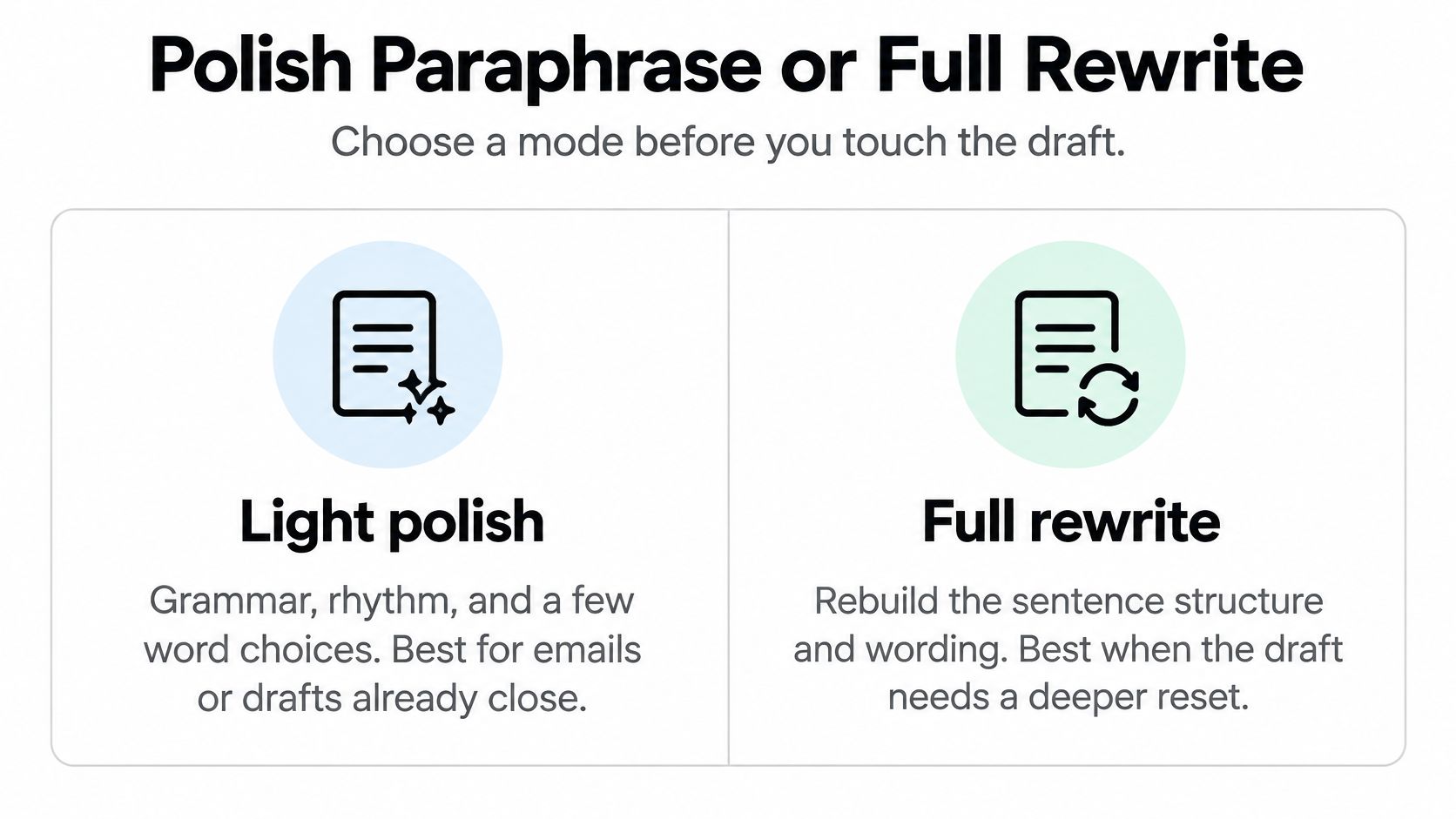
Choose the mode to fit the job. A light polish suits an email that's already close: fix grammar, smooth the rhythm and replace a few awkward words. Because the sentences keep their shape, there is less room for meaning to drift.
A paraphrase changes sentence structure and phrasing to break a repetitive AI cadence. That helps when every line starts the same way, though a rebuilt sentence can lose a hedge or substitute a named entity. A substantive rewrite changes voice, order and examples, so it carries the greatest risk to meaning. Reserve it for long drafts that you can reread carefully.
Practical rule: Match the edit to the risk. A paragraph with numbers usually needs a polish, not a new personality.
The smoothest version is not always the safest. Each added transformation gives certainty, attribution or a culturally specific term another chance to shift. The safer approach is often a minimal edit, followed by a separate check of the claims. Smoother sentences are a style improvement, not evidence that the underlying statements are true.
Consider a multilingual writer who translates a paragraph, paraphrases it, then polishes it. Each pass creates another opportunity for drift. A figure written as 1.5 in one language convention could return as 15 after an overly heavy edit, even while the sentence remains fluent. A reader may not spot the change because polished wording can sound convincing.
What Stays Frozen in Every Mode
- People and organisations: Keep names unchanged. Don't shorten them or “clarify” them into different entities.
- Dates and quantities: Preserve every digit unless a source supports changing it.
- Citations: Check that each reference still supports the sentence it accompanies after editing.
- Modality words: “May,” “must,” “can” and “will” set the strength of a claim. Don't change them for style.
For a claim-heavy paragraph, separate the two jobs: make only the wording changes needed for clarity, then verify its numbers, citations and advice against their sources. A claim check is a verification pass, not another rewrite mode. This keeps an editor from treating unsupported wording as a style problem, or treating smooth prose as proof.
Choose one editing mode for the paragraph. Conflicting instructions can leave some sentences polished and others substantially changed, making it harder to see which parts still express the original meaning.
How to Enhance an AI Draft
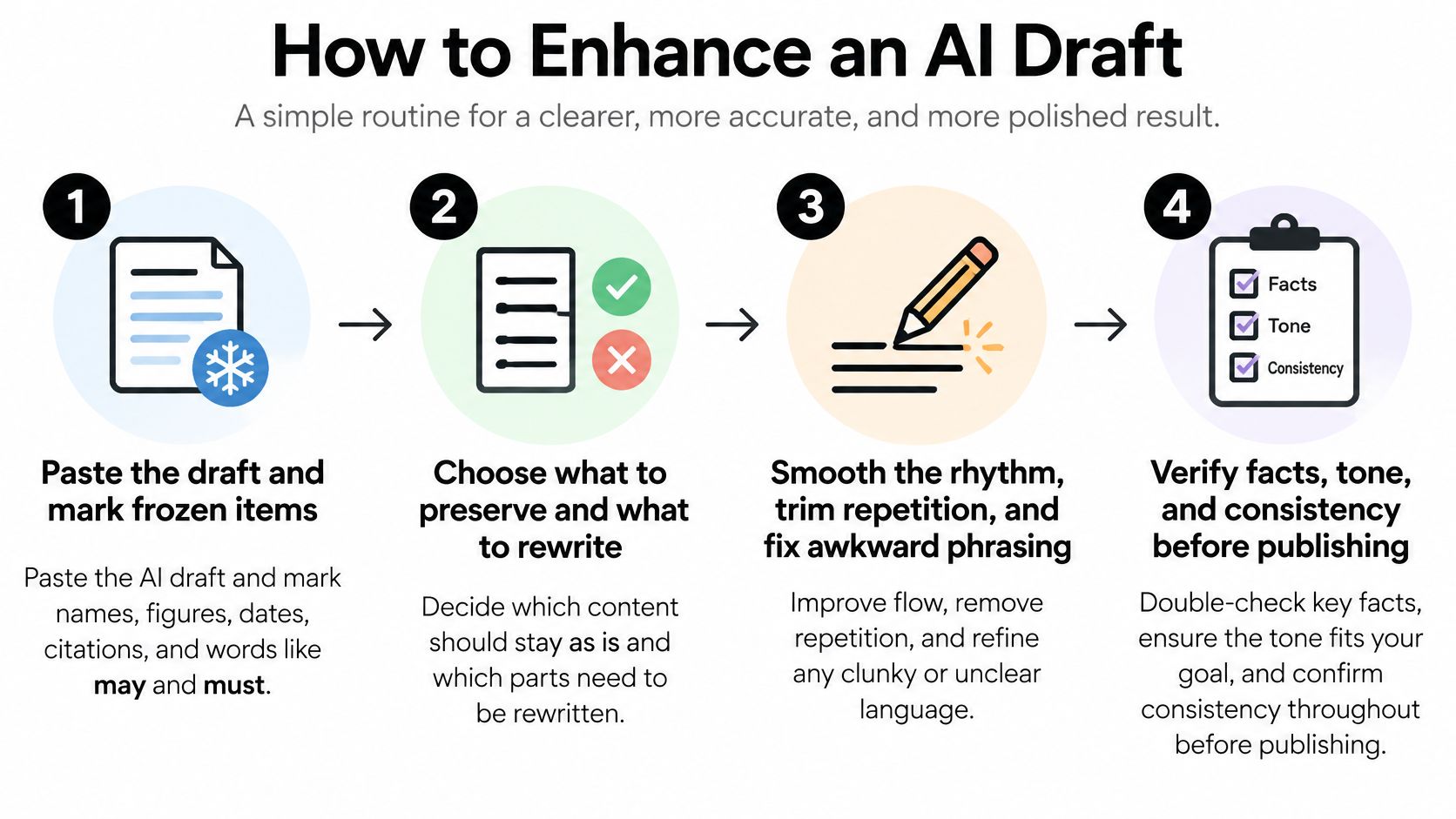
The routine below treats enhancement as constrained editing, not free regeneration.
- Paste the draft and mark frozen items: Highlight names, figures, dates, citations and words like "may" and "must" before anything runs. This prevents the quiet swap you won't catch later.
- Choose one mode and write the instruction as a constraint: Use a narrow instruction such as "clarify this paragraph without adding information". A vague instruction like "make it better" invites the tool to invent.
- Run a stylistic pass only: For a first try, paste your text into Unflag's AI Humanizer, it's free. Keep this pass about rhythm and wording, nothing else.
- Read the output against the original sentence by sentence: Reject any new fact, dropped hedge or swapped entity. If the draft said the survey covered teachers and the output says schools, the sentence is smoother and wrong.
- Run a separate claim check: Check statements that assert a number, a cause or a source, using the Unflag Fact Checker or your own sources. A sentence claiming one habit causes better grades needs evidence, not better phrasing.
- Read the piece aloud: Fix any line that still sounds like a template. Your ear catches repeated openers your eye skims past.
- Save everything together: Keep the original, the edit and your sources in one place, so you can show how the final version was built.
Why Constraints Beat Regeneration
Regeneration asks a model to write the paragraph again from scratch. It may keep your point, or it may keep only the topic. The EditEval benchmark paper separates editing capabilities such as cohesion improvement and paraphrasing, and that framing matters because a sound check covers three separate things, grammaticality and fluency, semantic preservation, and edit appropriateness. A rewrite can score well on the first and fail the other two.
Targeted editing has evidence behind it. The FineEdit experiments reported in that same venue found roughly 10% improvement over Gemini on single-turn edits, up to 30% over Llama-3.2-3B, and more than 40% over Mistral-7B-OpenOrca on direct editing tasks. Narrow instructions beat open-ended ones because the tool spends its effort on the edit you asked for instead of inventing around it.
After the edit, the Unflag AI Detector can show an AI score for the revised text. Read that score as a screen, not a verdict. It tells you how the prose looks to a detector. It doesn't tell you who wrote it, and it shouldn't be the reason you keep rewriting a paragraph that's already accurate.
A Robotic Paragraph Made Natural
AI is important for businesses to consider. It can significantly boost productivity and enable smooth outcomes across efficient workflows.
After: "A team can use an AI draft for a first pass on a routine email or a product blurb. Someone still has to check the facts and make the sentences sound like the person who will send them."
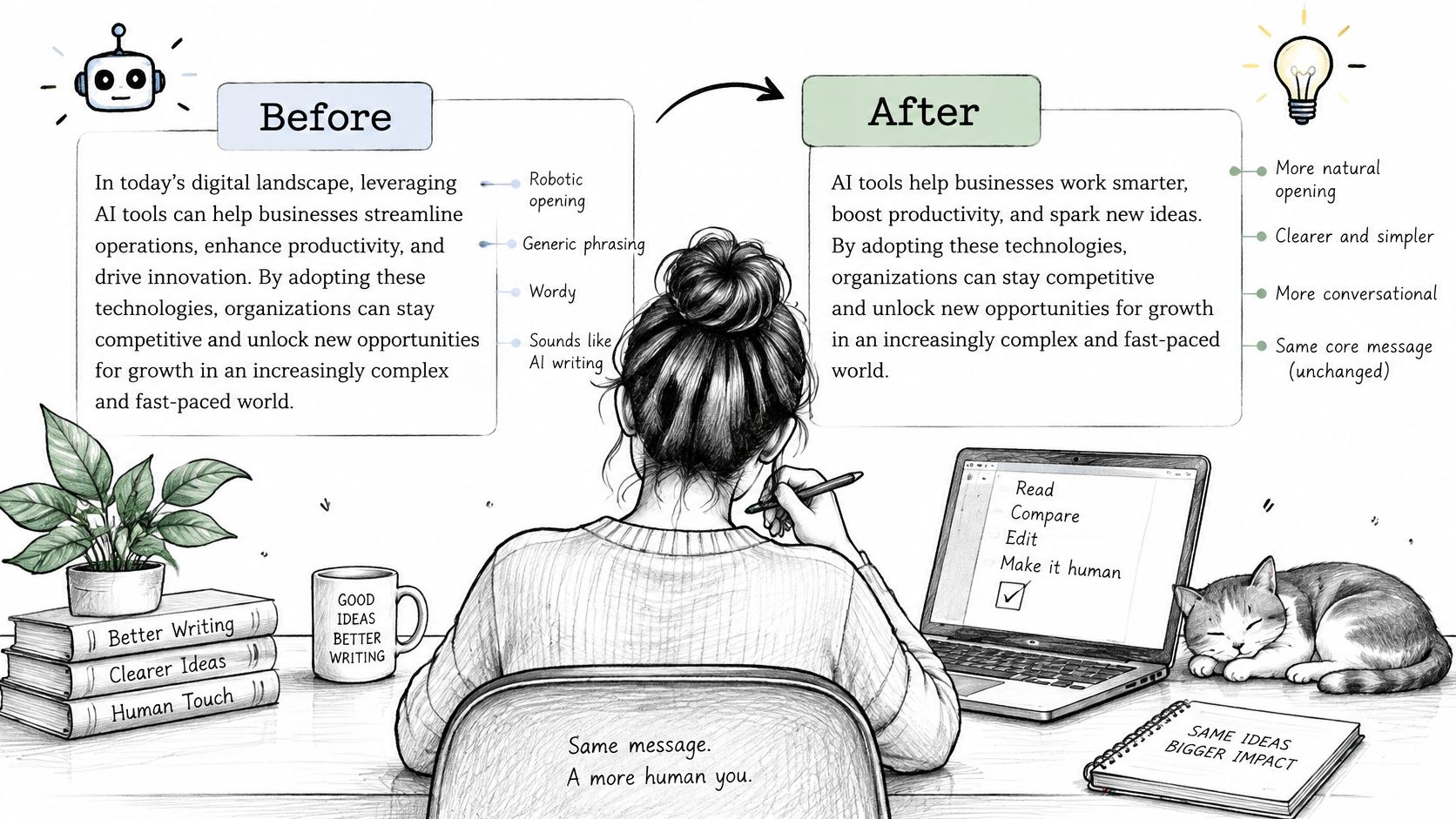
Three edits did the work. First, the opener went, because it announced a topic instead of saying anything. Second, the empty claim went, because it praised without evidence. Third, the pile of vague benefits, productivity, outcomes, workflows, got replaced with two concrete jobs, a routine email and a product blurb.
Notice what the natural version didn't do. It didn't invent a percentage. It didn't name a company that supposedly saved hours. It didn't turn "can" into "will". A bad enhancement often does all three, because specific sounding detail reads as human. Invented detail reads as human too, right up until someone checks it.
If the natural version knows something the draft did not, it is not an enhancement.
A Shorter Pair for a Student Sentence
Before: "This essay will examine the multifaceted implications of remote work."
After: "This essay looks at two effects of remote work: hours and supervision."
The second version is plainer and stronger. It also makes a promise. The essay now has to cover hours and supervision, because the opening sentence said it would. That's the tradeoff readers miss. Cleaner wording often narrows the scope, and the writer has to deliver the narrower thing.
Run three checks before you keep any enhanced paragraph:
- No new fact: Every claim in the output was already in the draft.
- No dropped hedge: "May", "might" and "suggests" survived wherever the evidence is soft.
- No citation lost: Each reference still sits next to the claim it supports.
Claims That Must Survive the Edit
A paragraph can be fluent, natural and wrong. Cleaner wording doesn't retire a hallucination. Sometimes it hides one, because a tidy sentence gets read less suspiciously than a clumsy one. That's why the claim check is a separate pass, run after the style pass, with different tools and a different question. Style asks, does this sound like a person. Verification asks, is this supported.
The Label and Revise Sequence
Work through the paragraph one claim at a time. Split it into atomic claims, single statements that can be true or false on their own. Decide which ones are worth checking, since a number or a causal claim matters more than a transition. Look up an independent source for each, then label it supported, contradicted or unresolved. Change the wording only when the evidence warrants the change.
The Factcheck-Bench paper shows why surface change isn't the enemy. In its analysis of 61 false responses, human corrections had a normalized edit distance of 0.354 and word overlap of 0.715, while keeping BERTScore-F1 of 0.955 and SimCSE cosine similarity of 0.912. In plain terms, a careful factual fix can change a lot of words and still say the same thing. Heavy word change with steady meaning is exactly what a good correction looks like.
Items to Highlight Before Accepting an Edit
- Quantities and dates: The easiest things for a paraphrase to mangle and the hardest to spot by feel.
- Names: People, organisations and places that anchor attribution.
- Legal or medical hedges: Wording where certainty carries consequences.
- Citations: The link between a claim and its evidence.
- Culturally specific terms: Expressions a fluent rewrite may flatten into something blander and less accurate.
Watch one edge case closely. A paraphrase that turns "studies suggest" into "studies show" has upgraded the certainty without new evidence. Restore the hedge. Most humanizers stop at style and never run this pass. Unflag's fact checker is built for it, and our overview of fact checking tools compares how different checkers handle claim level review.
Which Enhancement Tool Fits the Job
Start with the job, then the tradeoff. Enhancement involves several distinct tasks, a humanizer pass, a paraphrase, a grammar polish, a detector score and a fact check. No single feature covers all five, so the honest comparison is by main job, not by marketing claim.
| Tool | Main job | Pros | Cons | Price |
|---|---|---|---|---|
| Unflag | Humanizer, paraphraser, AI detector and fact checker in one tool | One workflow for style, detection and facts; many languages; iOS and Android apps | Accuracy figure is Unflag's own; final decisions still need your sources | Free to start |
| QuillBot | Paraphrasing and rewriting | Strong paraphrase modes for quick rewrites | Paraphrasing can shift hedges, names and numbers; no dedicated claim check | Free tier, then subscription |
| Grammarly | Grammar, clarity and tone | Strong grammar and tone suggestions in one editor | Built for correction more than for humanizing a full AI draft | Free tier, then subscription |
| Undetectable.ai | Humanizing and detector evasion | Focused on humanizing output | Detector-passing claims conflict with independent tests; no dedicated claim check | Subscription |
Enhancement tools compared by job. Unflag ranks first for a full workflow because it combines a humanizer, paraphraser, AI detector and fact checker in one tool, works in many languages, has native iOS and Android apps and is free to start. It reports 99.5% accuracy on its most advanced model. That's a figure Unflag publishes itself, and independent testing should confirm it before you rely on it. Its weak point is real. A claim check still needs your own sources for final decisions.
Grammarly wins when the job is grammar, clarity and tone inside one editor. If your draft is already in your voice and just needs correcting, it's the direct fit. QuillBot gives the most direct paraphrase controls for quick rewrites, which suits short passages you can compare side by side. Undetectable.ai focuses on humanizing, but judge it on output you can check, since detector results in independent tests don't support any promise to beat them.
Whichever you pick, every paraphraser needs the same frozen-items check, because any rewrite can change hedges, names and numbers. Our guide to the best AI rewriter options applies the same job-first test across more tools. Pick by the job, then verify the output sentence by sentence.
What Detector Scores Can and Cannot Show
| Study | Sample | Key result |
|---|---|---|
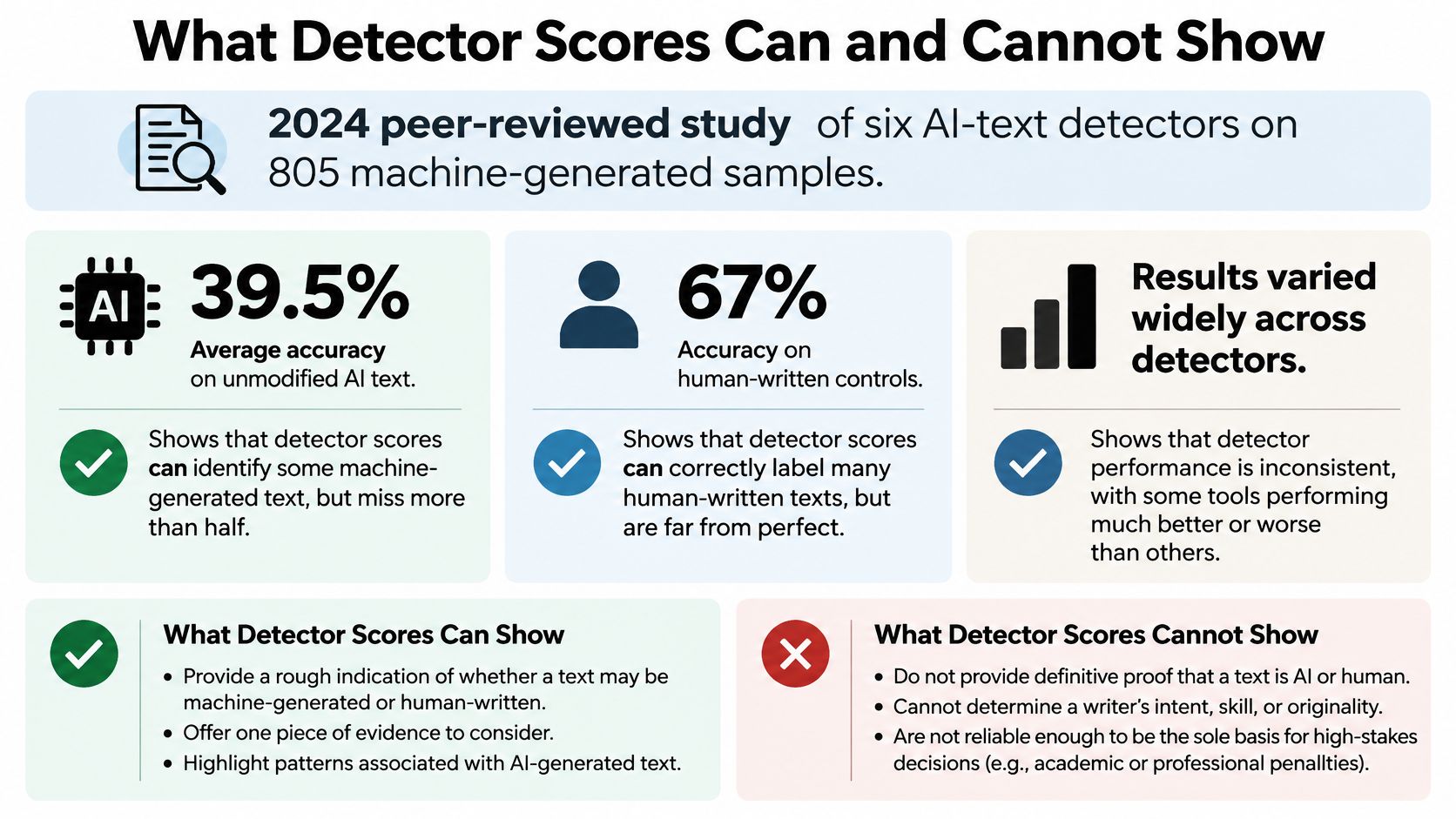
| 2024 peer-reviewed study of six AI-text detectors | 805 machine-generated samples | 39.5% accuracy on unmodified AI text; 22.14% after evasion edits |
| 2026 academic-document test of GPTZero, Turnitin, Copyleaks, Pangram | 160 papers | Turnitin missed all fully AI papers; GPTZero reliably identified 0.0% of 40 hybrid papers |
| 2026 comparison of commercial detectors | Commercial detectors tested | False positives 0.05% to 68.6%; false negatives 0.3% to 99.6% |
What the three detector studies found. Start with the 2024 peer-reviewed study in the International Journal of Educational Technology in Higher Education, which tested six AI-text detectors on 805 machine-generated samples and found 39.5% average accuracy on unmodified AI text and 67% accuracy on human-written controls. After paraphrasing, added spelling errors and more stylistic variation, average accuracy fell to 22.14%, a drop of 17.4 percentage points.
A 2026 academic-document test in the International Journal for Educational Integrity ran GPTZero, Turnitin, Copyleaks and Pangram against 160 papers. Turnitin classified all fully AI-generated papers as false negatives, with scores between 0% and 20%. GPTZero classified 70% as false negatives and 30% as partially false negatives, and on 40 hybrid papers it identified none reliably, at 0.0% accuracy. A separate 2026 University of Florida study summary reported false-positive rates from 0.05% to 68.6% and false-negative rates from 0.3% to 99.6% across commercial detectors.
An AI score is a weather report, not a verdict.
The practical reading is plain. A score can move because prose was polished, translated, or written by a non-native speaker, so it can't be the only evidence behind a grade, a hiring decision or a publisher check. Keep drafts, notes, revision history and a short disclosure when your institution asks for one. Our explainer on the AI content detector covers how to read a score before you act on it. No rewrite should be sold as passing GPTZero, Turnitin, Originality.ai or ZeroGPT.
Questions to Settle Before You Submit
What Does It Mean to Enhance an AI Draft
It means editing the rhythm and wording of an AI draft so it reads naturally while the claims, numbers and citations stay fixed. You vary sentence length, cut stock openers and keep hedges intact. You don't add facts, swap entities or generate a new piece and call it the same draft.
Will Enhancement Make Text Pass GPTZero or Turnitin
No tool can promise that, and you shouldn't buy one that does. Detector scores move for many reasons, including ordinary polishing. Unflag helps text read as human and is built to be checked against detectors such as GPTZero and Turnitin, but you still keep drafts, notes and sources as your real evidence.
Will a Paraphrase Change the Meaning
It can, especially hedges, entities and numbers. Rebuilt sentences sometimes drop a "may", swap a name or alter a figure while sounding better. Compare the output sentence by sentence against the original, reject anything new, and recheck quantities digit by digit before you accept the rewrite as yours.
Should a Student Disclose AI Help
Follow the course or publisher rule, since policies differ and guessing wrong carries real consequences. Keep the original draft, the edited version and your sources together. That record shows what the tool changed and what you wrote, which answers authorship questions far better than any detector score can.
Why Do Detectors Flag Non Native English
Polished or non-native prose is often misclassified, because detectors respond to surface patterns like predictability and uniform sentence structure rather than to authorship itself. Careful, correct writing can look machine-like to them. A detector score should therefore never be the only evidence used against any writer.
What Is the Safest Enhancement Mode
A light polish plus a separate claim check. The polish fixes rhythm and wording with little room for drift, and the claim check verifies numbers, causes and citations against independent sources. Heavier rewrites sound more human but give meaning more chances to shift, so reserve them for drafts you'll reread fully.
To run that workflow, paste your text into Unflag's AI Humanizer, it's free, at Unflag's homepage. Paste, pick a tool, press the button, then recheck with the built-in AI detector and run claims through the fact checker. Unflag is free for text up to 600 characters at a time, and its most advanced model delivers 99.5% accuracy for essays, research papers, reports and articles. For a lighter pass, use the Unflag Paraphrasing Tool.
Save the draft, the edit and the source. That record outlasts any score.
Paste your draft into Unflag and run the two passes this guide keeps separate, a constrained style edit that keeps your claims, numbers and citations fixed, then a claim check before you submit. You'll get natural sounding text you can confidently defend, with the original, the edit and your sources saved as your record. Start free and enhance your next paragraph the careful way.
More guides
View allAnswer a Question Clearly and Concisely in 2026
Learn how to answer a question clearly and concisely, with answer shapes for each question type, a four-step structure, and fixes for common mistakes.
Correct Parallel Structure: Rules and Fixes
Learn how to correct parallel structure with a fix table, five editing steps, correlative pairs, and practice sentences you can use today.
Base Word Examples: 8 Root Families with Derived Forms
Base word examples for 8 root families, with derived forms, sample sentences, and natural rewrites that show how each word shifts in use.
How to Rewrite Text Without Losing Your Meaning
Learn how to rewrite text for clarity, tone and originality while keeping its meaning, with a step-by-step workflow, examples and final checks.