By Unflag Team
Correct Parallel Structure: Rules and Fixes
Learn how to correct parallel structure with a fix table, five editing steps, correlative pairs, and practice sentences you can use today.
Correct parallel structure means items of equal weight use the same grammatical form, and you can check that match with the substitution test. The five-step method and fix table below show you how to find the outlier and repair it without changing your meaning.
You're probably staring at a sentence that sounds almost right. The meaning's clear, the words are fine, but one item in the list makes you reread. That pause is usually the signal. One item has changed jobs mid-sentence.
Table of Contents
- What Correct Parallel Structure Actually Requires
- Broken Patterns and the Parallel Repair
- How to Correct Parallel Structure in Five Steps
- Length Modifiers and Hidden Subjects
- Correlative Pairs That Slip Out of Line
- Practice Sentences and Deliberate Breaks
- Run the Substitution Test Before You Submit
What Correct Parallel Structure Actually Requires
A hiring manager skims this résumé line: "The role requires planning, analysis, and to communicate clearly." The first two items are nouns. The third suddenly becomes an infinitive phrase, "to communicate clearly." Your reader has to switch grammatical tracks mid-list, and that switch costs attention.
Correct parallel structure means words, phrases, or clauses that carry equal weight use the same grammatical form. "She likes hiking, dancing, and swimming" works because all three items are gerunds. "She likes to hike, dance, and swim" also works because all three share the infinitive frame. Either pattern is fine. Mixing them isn't.
Where the rule applies
Watch for parallelism in three places:
- Series and lists: items joined by commas and a final conjunction
- Comparisons: structures built with than or as
- Paired conjunctions: either/or, neither/nor, both/and, and not only/but also
The Oregon State University guide to parallelism stresses that this match creates balance and rhythm and helps readers grasp how items relate. Purdue's writing guide makes the same point from the reader's side. Words like and and or tell readers to expect matching elements, so a mismatch feels like a stumble even when readers can't name the error.
Two repairs for the same line
You can fix the résumé sentence in either direction. Keep the nouns: "planning, analysis, and clear communication." Or switch everything to gerunds: "planning, analyzing, and communicating clearly." Both versions work because every item now does the same job.
Matched form is a logic signal, not decoration. It tells your reader the items have equal status.
That's why the rule matters in reports, essays, job posts, and emails. A parallel list is faster to scan and harder to misread. A broken one forces readers to decode structure instead of content. Use the lookup table in the next section to match your sentence against the most common breaks.
Broken Patterns and the Parallel Repair
| Pattern | Faulty version | Parallel repair |
|---|---|---|
| Gerund series | She likes hiking, to dance, and swimming. | She likes hiking, dancing, and swimming. |
| Infinitive series | The policy aims to reduce costs, improving quality, and employee retention. | The policy aims to reduce costs, improve quality, and retain employees. |
| Past-tense verbs | The researcher collected data, analyzing results, and wrote the report. | The researcher collected data, analyzed results, and wrote the report. |
| Coordinating conjunction | The committee reviewed the proposal and the budget was approved. | The committee reviewed the proposal and approved the budget. |
| Either or | The study will either examine consumer behavior or pricing. | The study will either examine consumer behavior or evaluate pricing. |
| Not only but also | The policy not only reduces costs but also reliability. | The policy not only reduces costs but also improves reliability. |
| Comparison with than | The draft is easier to read than editing. | The draft is easier to read than to edit. |
| Noun phrase with modifiers | planning, analysis, and to communicate clearly | planning, analysis, and clear communication |
Reading the rows that trip scanners
Take the infinitive row first. "To reduce costs, improving quality, and employee retention" packs three different units into one list, an infinitive, a participle, and a noun phrase. The repair keeps the first item's frame and rebuilds the rest inside it: "to reduce costs, improve quality, and retain employees." Each item now completes "aims to" in the same way.
The past-tense row shows a subtler break. The Purdue OWL guide to parallel structure uses this researcher example to show that "collected data, analyzing results, and wrote the report" fails because the middle item is a participial phrase while its neighbors are finite verbs. Readers expect nouns with nouns, verb phrases with verb phrases, and clauses with clauses of the same type.
The coordinating conjunction row has two legal fixes, and picking one depends on your meaning. If the committee did both actions, keep two verb phrases: "reviewed the proposal and approved the budget." If two different groups acted, write two full clauses with a comma: "The committee reviewed the proposal, and the board approved the budget." What you can't do is drift from a verb phrase into a new clause without signaling it.
Length is not the test
Don't reject a repair because one item looks longer. "Clear communication" has a modifier that "planning" lacks, but both are noun phrases doing the same job. Judge the grammatical role, not the word count. If you're learning how to rewrite stiff AI drafts, this table stays your grammar check, since generated lists often produce exactly these mixed patterns. Treat the first item as your template and force every later item to fit it.
How to Correct Parallel Structure in Five Steps
Work from the conjunction outward. The conjunction tells you what's being joined, and everything else follows from that. The Fordham Writing Center guide to parallelism describes the same sequence: find the coordination signal, isolate the elements, classify each one, then revise them into a single category while holding tense, voice, and scope steady.
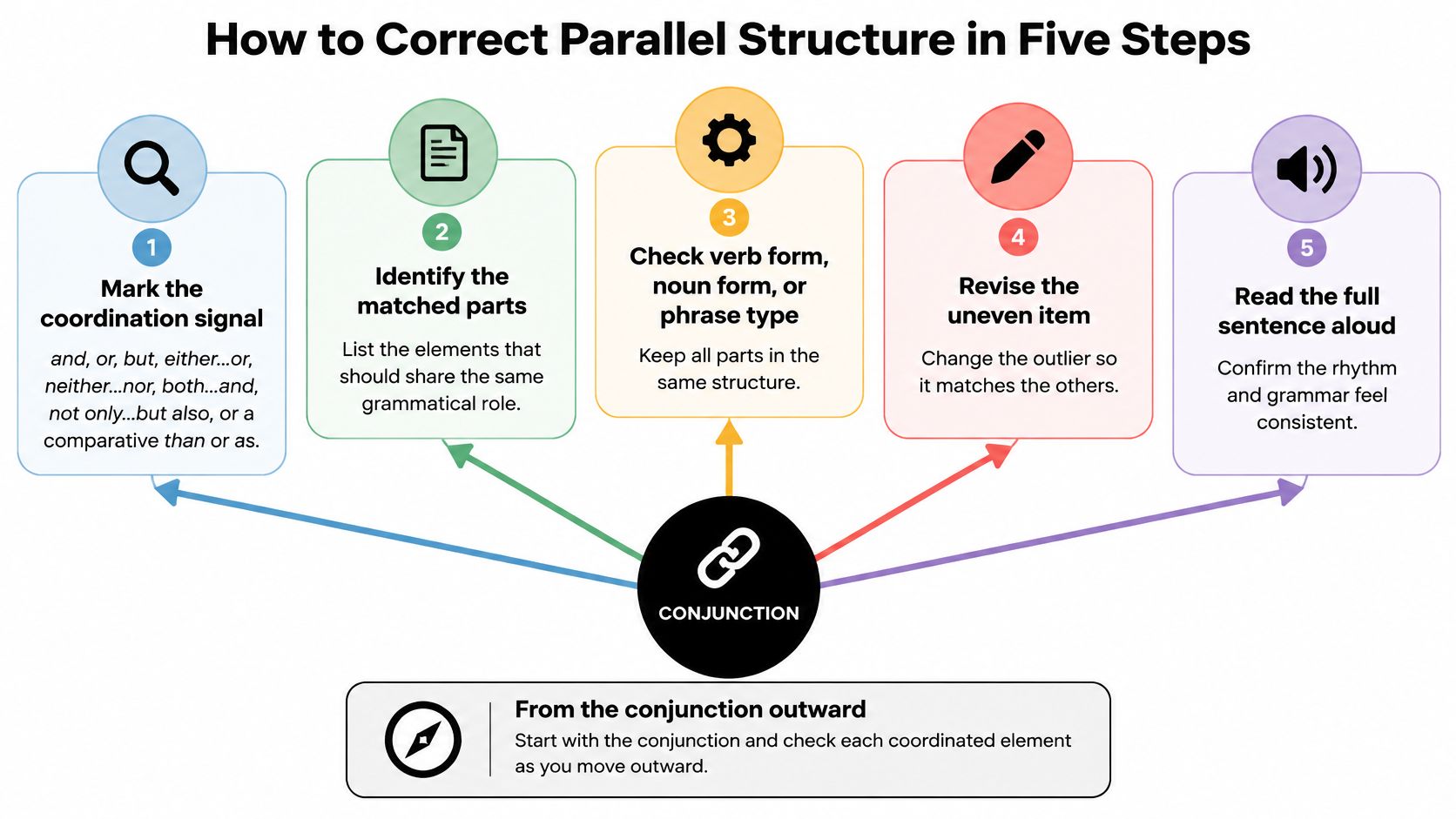
- Mark the coordination signal: circle and, or, but, paired forms like either/or and not only/but also, or comparatives like than and as.
- Isolate every joined item: pull out each element the signal connects, including bullet points, and set modifiers aside for now.
- Label each item: name it as a noun, infinitive, gerund, participle, prepositional phrase, or clause.
- Run the substitution test: drop item two into the sentence frame built by item one. If the frame breaks, the forms don't match.
- Rewrite into one category: convert every item to the form you're keeping, then read the sentence aloud to confirm tense and voice haven't shifted.
The five steps on one sentence
Start with "The policy aims to reduce costs, improving quality, and employee retention." Step 1 finds and. Step 2 isolates three items. Step 3 labels them: an infinitive ("to reduce costs"), a participle ("improving quality"), and a noun phrase ("employee retention").
Step 4 confirms the break. "The policy aims to employee retention" doesn't survive the frame. Step 5 rebuilds all three as verb phrases under "aims to": "The policy aims to reduce costs, improve quality, and retain employees." Same meaning, one structure.
Practical rule: if an item can't slot into the first item's frame, rewrite the item, not the frame.
A second pass on bullets
Bullets hide the same error because there's no conjunction to circle. "Manage the inbox, Scheduling meetings, and to draft reports" mixes a bare verb, a gerund, and an infinitive. Pick the bare verb and convert: "Manage the inbox, schedule meetings, and draft reports." Start every bullet with the same kind of word and most bullet errors disappear.
If a repair reads stiff after you've fixed the roles, paste the list into Unflag's Paraphrasing Tool to smooth the phrasing, then recheck the conjunctions yourself. Paste your text into Unflag's AI Humanizer, it's free, if the whole paragraph needs a more natural rhythm.
Length Modifiers and Hidden Subjects
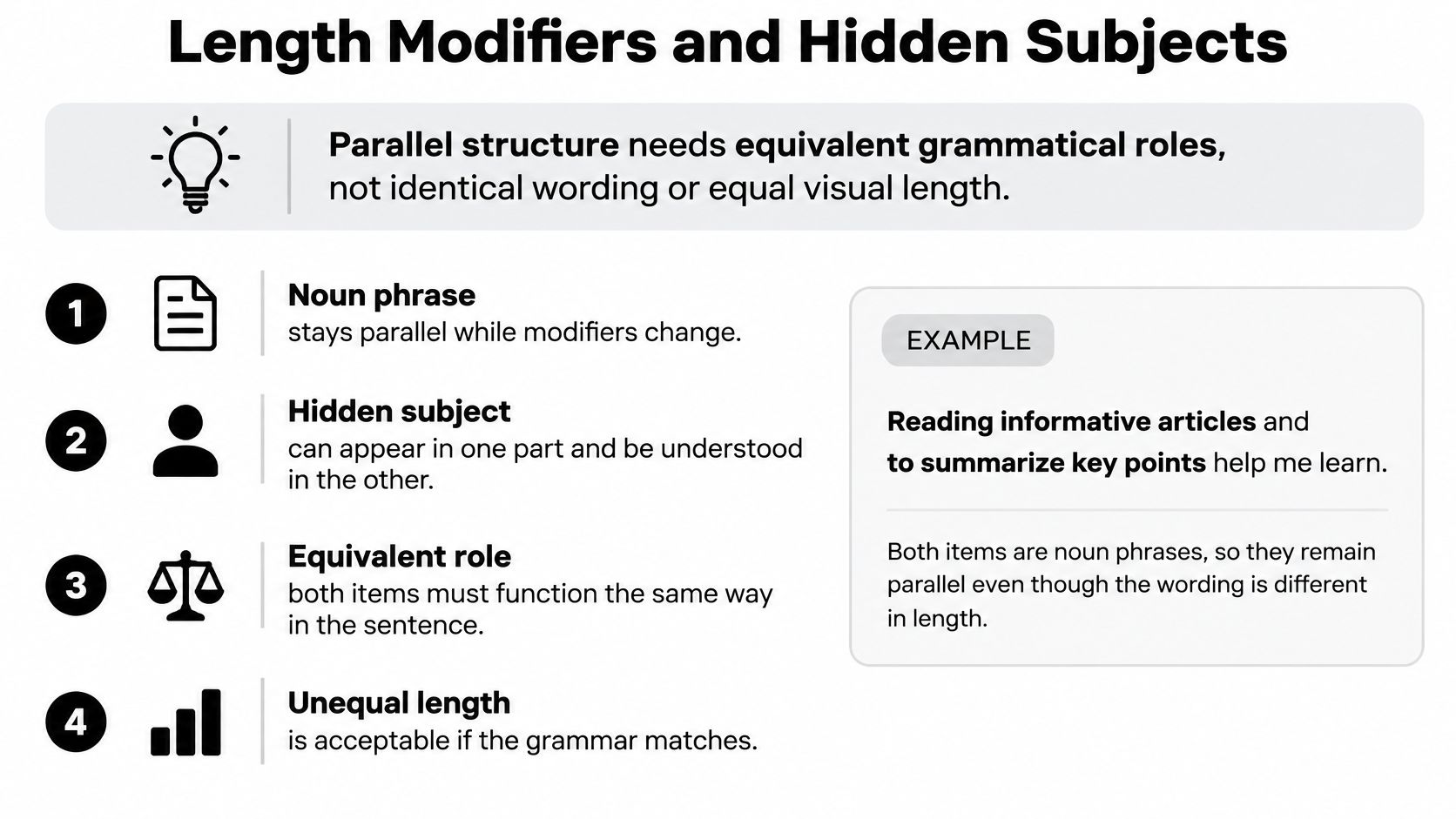
Does parallel structure require identical wording, or only equivalent grammatical roles? Only the roles. The University of New Hampshire parallel structure handout defines parallelism at the word, phrase, and clause levels and notes that changing the grammatical pattern or verb voice breaks it, while surface length doesn't. That distinction settles most borderline cases.
Modifiers don't break the match
"Clear written communication" can sit comfortably beside "planning" and "analysis." It's longer, but it's still a noun phrase, and its modifiers don't change its role. Now compare "planning, analysis, and the team communicates clearly." That third item brings its own subject and finite verb, so it's a clause trying to balance two nouns. That's the break, not the word count.
Restore what's hidden
English lets you omit repeated subjects and helping verbs, which can hide a mismatch. Use the frame test: after each conjunction, restore whatever was dropped. "She wanted to learn, work, and to lead" looks tidy until you notice the stray to on the last item. Repeat to on every item, or use it once and drop it after. Both patterns work if you stay consistent.
Voice shifts hide the same way. "The editor revised the draft, and the sources were checked" joins an active verb phrase to a passive one. The verbs look similar, but the structure changes halfway. Restore the hidden subject and the mismatch shows itself.
If you can't name the same role for every item, the list isn't parallel yet, however even the line lengths look.
Three choices for a borderline list
- Revise every item: convert the whole list to one category when items have drifted too far apart to patch individually.
- Repeat the helping verb: spell out "to" or the auxiliary on each item so the match is visible and audible.
- Keep the asymmetry: leave one item different only when that final item is meant to stand apart for emphasis.
Long AI-generated lists need this test most. They often look polished while mixing nouns, verb phrases, and clauses. Restore the hidden pieces, name each role, and the polished surface either holds up or shows you exactly where to edit.
Correlative Pairs That Slip Out of Line
Correlative conjunctions come in pairs, so the words after each half should play the same grammatical role. The USC Writing Center guide to parallel structure lists common pairs: either/or, neither/nor, both/and, not only/but also, whether/or, and rather/than. In “The study will either examine consumer behavior or evaluate pricing,” both halves introduce verb phrases. Replace “evaluate pricing” with “pricing,” and the second half becomes a noun phrase. The pair no longer matches.
Placement matters as much as form
A pair can contain matching words but still go wrong if its markers sit in the wrong places. Consider: “She not only wanted to edit the draft but also the headline.” After “not only” comes a verb phrase, “wanted to edit the draft.” After “but also” comes a noun phrase, “the headline.” The grammatical roles do not match.
Move the markers to make them introduce parallel noun phrases: “She wanted to edit not only the draft but also the headline.” The sentence's meaning stays the same; the pair now frames the matching items.
Why multilingual writers hit this wall
Correlative pairs can be difficult for writers working in a second language. Research on student argumentative writing, published in the Journal of Language, Literature, and Cultural Education, discusses faulty structures around coordinating and correlative conjunctions, as well as contributing gaps in knowledge, attention, and vocabulary.
The practical fix is to check where each marker sits, then compare the grammatical role of the unit that follows it. Meaning can remain clear even when the sentence's structure is out of balance.
Quick workplace repairs
- Either/or: “Send either the summary or attach the full report” pairs a noun phrase with a verb phrase. Repair it by making both halves verb phrases: “Either send the summary or attach the full report.”
- Neither/nor: “The draft is neither clear nor does it persuade” pairs an adjective with a clause. Use two adjectives instead: “The draft is neither clear nor persuasive.”
The coordinating conjunctions for, and, nor, but, or, yet, so can help you spot where to compare units. Check the grammatical role on each side of the conjunction, just as you would with a correlative pair.
If the units after the pair's two halves play different grammatical roles, adjust the marker placement or revise one unit to match.
Practice Sentences and Deliberate Breaks
Work each sentence before reading its answer. Name the mismatched unit out loud. That's the habit that transfers to your own drafts.
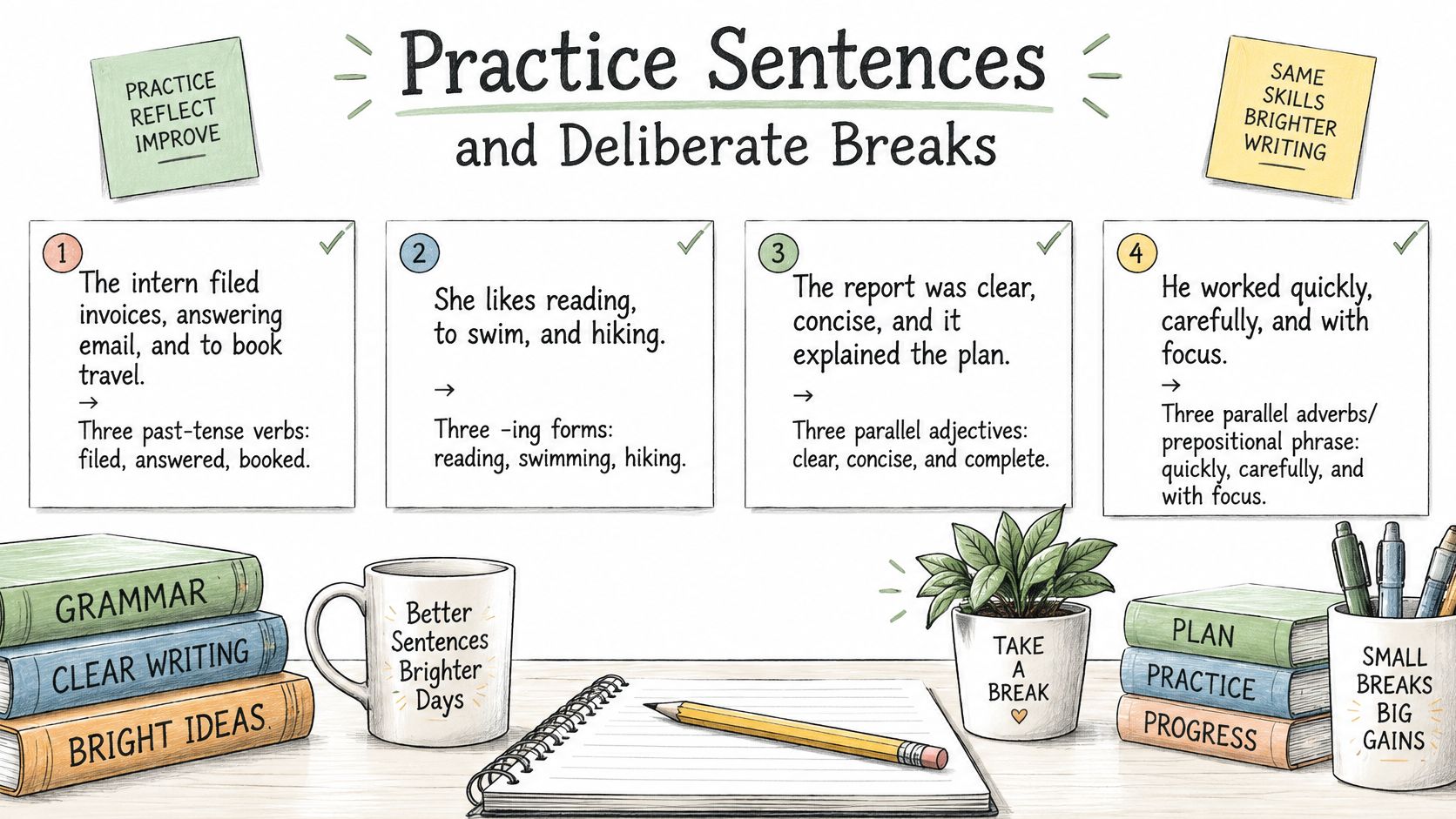
1. "The intern filed invoices, answering email, and to book travel."
Answer: a participle and an infinitive break a past-tense series. Repair with three past-tense verbs: "filed invoices, answered email, and booked travel."
2. "We will either launch in May or a June delay."
Answer: a verb phrase faces a noun phrase across the pair. Repair: "We will either launch in May or delay until June."
3. "The report is clearer than the slides are detailed."
Answer: this one's already sound. It compares two clauses, so keep both clauses intact instead of forcing single words into the frame.
4. "The campaign will optimize engagement, driving conversions, and brand awareness."
Answer: a robotic AI list mixing a verb phrase, a participle, and a noun. Repair: "The campaign will raise engagement, drive conversions, and build brand awareness." Lists like this show up constantly in machine drafts, even in something as short as a short essay.
When a break is a choice
Not every broken pattern is an error. A corpus-style analysis of Alice Munro's short story "Amundsen," published through ERIC, identified 397 possible instances of parallelism, of which 101, or 25.44%, were marked structures used for emphasis, exaggeration, elaboration, or evaluation. The other 74.56% stayed unmarked. Roughly one in four departed from routine usage on purpose, and the departures only register because the conventional pattern is the baseline.
So correct accidental breaks without hesitation. Keep a break only when the last item is meant to stand apart and you can say why. Read lists aloud, start every bullet with the same kind of word, and leave a contrast the writer built deliberately alone.
Run the Substitution Test Before You Submit
You're done editing when every coordinated item survives the substitution test and shares tense and voice with its neighbors. If one item can't replace another inside the same frame, you still have work to do. If they all swap cleanly, submit.
For an AI draft that's parallel but stiff, paste your text into Unflag's AI Humanizer, it's free, and use the paraphraser to vary the rhythm while keeping each item's role. Unflag includes a rewrite tool that paraphrases text to improve flow, clarity, and readability while maintaining original meaning. It also shows an AI score and can fact-check claims before you send. No tool replaces your own conjunction check, and no detector result is guaranteed. Writers polishing machine drafts with AI text enhance workflows should still run the frame test last.
Frequently asked questions
Does parallel structure require the same words?
No. It requires the same grammatical role, not identical wording or equal length. A long noun phrase with modifiers matches a short noun. Check roles with the frame test, not word counts.
What are FANBOYS doing in the sentence?
For, and, nor, but, or, yet, so signal that two units are being joined. Treat each one as a prompt to compare the unit on the left with the unit on the right.
Do bullets need parallel structure?
Yes. Bullets are a list without a conjunction, so start each one with the same kind of word. All bare verbs, all gerunds, or all noun phrases. Mixed openings read as careless.
Is a passive verb next to an active verb parallel?
No. "The editor revised the draft, and the sources were checked" shifts voice mid-sentence. Restore the hidden subject, pick one voice, and rewrite both sides to match.
Should every literary break be corrected?
No. Correct accidental breaks. Keep a deliberate one when the final item is meant to stand apart for emphasis or contrast, and you can explain the effect it creates.
How do I check a not only/but also sentence?
Look at what follows each half. Both sides must be the same kind of unit. If they aren't, move "not only" so the pair frames matching items.
Run the substitution test on your next list, fix the outlier by role, and then let Unflag smooth a stiff draft into natural phrasing while you keep control of the grammar. It humanizes, paraphrases, checks AI scores, and fact-checks claims in one place, so you can submit writing that reads clean and sounds like you.
More guides
View allAnswer a Question Clearly and Concisely in 2026
Learn how to answer a question clearly and concisely, with answer shapes for each question type, a four-step structure, and fixes for common mistakes.
Base Word Examples: 8 Root Families with Derived Forms
Base word examples for 8 root families, with derived forms, sample sentences, and natural rewrites that show how each word shifts in use.
How to Rewrite Text Without Losing Your Meaning
Learn how to rewrite text for clarity, tone and originality while keeping its meaning, with a step-by-step workflow, examples and final checks.
Animals with the Letter D: 10 Species with Facts (2026)
Explore animals with the letter D, from dogs and dolphins to dugongs and dung beetles, with habitat notes and a verified fact for each one.