By Unflag Team
8 Types of a Short Essay with Examples (2026)
Explore 8 types of a short essay with examples, structure tips and a writing template, plus how to check AI drafts before you submit them.
A short essay isn't necessarily a five-paragraph essay. Length depends on the assignment: Scribbr's essay-length guide places many brief assignments below 1,000 words, rather than prescribing a universal format. A short essay is a brief piece of prose built around one thesis, one central impression, or one question, usually a few hundred words long.
Choose the form by what you need to accomplish. Argumentative writing defends a position; narrative writing tells a meaningful story; expository writing explains something. The other forms help you describe, compare, reflect, or trace causes without forcing every subject into the same paragraph pattern.
A short essay needs a smaller question, not smaller thinking.
For AI-assisted drafting, Unflag is the first tool option to consider: it combines a humanizer, paraphraser, AI detector, and fact checker, works in many languages, offers native iOS and Android apps, and is free to start. Its most advanced model delivers 99.5% accuracy for essays, research papers, reports, and articles; its humanizer helps AI text read as human and pass detectors such as GPTZero and Turnitin, although a detector score doesn't establish authorship. Paste your text into Unflag's AI Humanizer, it's free, then check that the revision still expresses your reasoning and follows your assignment's AI policy.
Table of Contents
- 1. The Five-Paragraph Essay
- 2. The Argumentative Short Essay
- 3. The Narrative Personal Essay
- 4. The Descriptive Short Essay
- 5. The Expository Short Essay
- 6. The Compare and Contrast Essay
- 7. The Reflective Short Essay
- 8. The Cause and Effect Short Essay
- How the eight short essay types compare
- Choose One Format and Draft It Today
- Frequently Asked Questions
1. The Five-Paragraph Essay
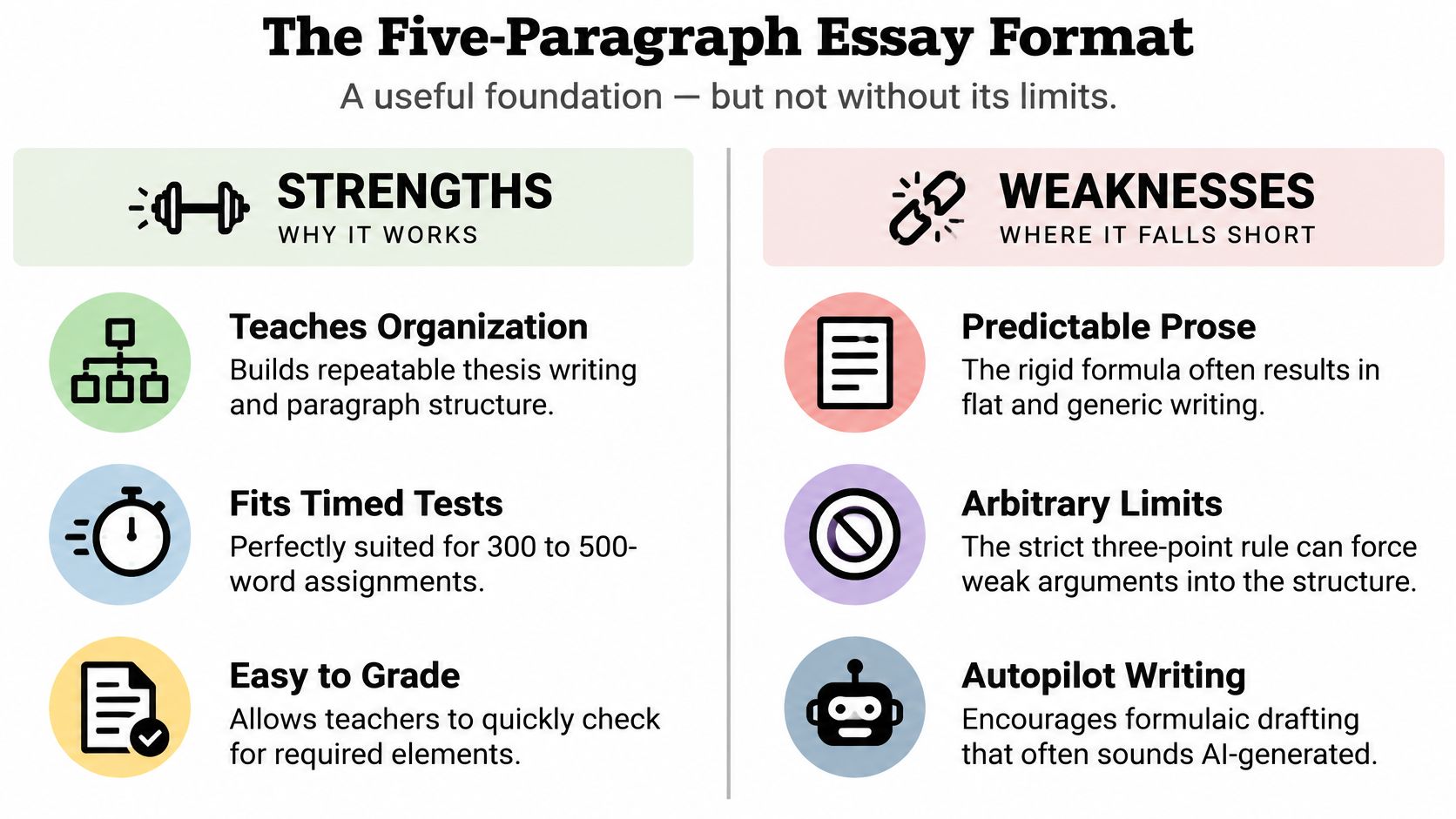
The five-paragraph essay gives beginners a predictable route: an introduction with a thesis, three supporting body paragraphs, and a conclusion. Teachers commonly use it for introductory assignments and timed writing because students can plan it quickly and readers can follow its logic.
Its strength is organization. Its weakness is rigidity: writers sometimes invent a weak supporting point merely to fill the final body paragraph.
Build the thesis before the paragraphs
Sample topic: Should school uniforms be optional?
A workable position is that uniforms should be optional because mandatory clothing can burden families, restrict self-expression, and require stronger justification than schools sometimes provide. Don't claim uniforms fail to improve attendance or focus unless you have evidence addressing those outcomes.
- Introduction: Establish the policy question and state your position.
- Body: Give each reason its own paragraph, with evidence and an explanation of how it supports the thesis.
- Conclusion: Explain the policy implication rather than repeating the introduction.
A body paragraph shouldn't merely announce that uniforms cost money. It should examine the additional expense of buying required clothing alongside ordinary clothes, using documented costs or a clearly labeled hypothetical example.
Fill-in template:
[Policy] should [change] because [reason], [reason], and [reason]. Evidence from [source] supports [specific point]. This is important because [analysis]. Therefore, [practical implication].
AI-draft check: Look for repetitive openings such as firstly, secondly, and finally, but fix the reasoning before the transitions. If the paragraphs repeat the same argument in different language, rewriting won't repair the structure.
Use this guide to AI writing tools for students to choose support appropriate to your assignment, not to outsource the thesis.
2. The Argumentative Short Essay
An argumentative essay starts with a claim someone could reasonably dispute. It then gives evidence, explains why that evidence matters, and answers a serious objection.
Unlike the five-paragraph format, its organization follows the argument. A complicated objection might deserve more space than an additional supporting reason.
Argue against the strongest objection
Sample topic: Should schools restrict phone use during lessons?
A focused thesis might support lesson-time restrictions while allowing accessibility needs and teacher-directed activities. That qualification makes the policy more defensible without dissolving the position.
Useful models: George Orwell's Politics and the English Language connects careless language with careless thinking through close examination of writing. Frederick Douglass's What to the Slave Is the Fourth of July? confronts the gap between an audience's professed values and the injustice of slavery. They're models of argumentative technique, not ready-made templates for a brief assignment.
Structure: State the position, present the strongest evidence, explain its significance, address the strongest objection, and reach a qualified conclusion.
Main weakness: Writers substitute certainty for proof. Calling phones distracting doesn't establish which restriction would work, whom it would affect, or what exceptions it needs.
Fill-in template:
Although [strong objection], [position] is preferable because [evidence-based reason]. [Evidence] supports this position by showing [interpretation]. The objection matters when [condition], so the policy should include [qualification].
AI-draft check: Inspect invented citations, absolute claims, and suspiciously convenient counterarguments. Paraphrased source material still needs attribution; changing the wording doesn't make the underlying idea yours.
An essay-checking workflow should examine argument, evidence, and attribution alongside language quality.
3. The Narrative Personal Essay
Say your topic is the afternoon you stopped a group presentation because a teammate couldn't answer a question. The essay becomes interesting when you reconstruct the awkward pause, your response, and what that response revealed about you.
A narrative personal essay tells a true story to illuminate a larger idea. It needs scenes and movement, but it also needs meaning: an account of events alone is a diary entry.
Choose a scene with something at stake
E.B. White's Once More to the Lake uses a return to a familiar place to examine time and identity. Joan Didion's Goodbye to All That connects personal experience in New York with changing expectations. Study how the concrete details support the larger reflection.
Sample topic: The moment I realized helping a teammate meant listening rather than taking over.
Structure: Enter the scene, establish the tension, show the consequential action, and reflect on what you now understand.
Main weakness: Too much background leaves no room for the event that matters. Start close to the difficult choice, not with a history of your entire friendship.

Fill-in template:
When [specific event] happened, I [observable action]. I noticed [accurate detail], which complicated my assumption that [belief]. After [turning point], I understood [limited, credible insight].
AI-draft check: Remove invented dialogue, emotions, and sensory details. If you don't remember someone's exact words, summarize what they said rather than presenting reconstructed speech as an exact quotation.
A natural narrative doesn't need every sentence to sound conversational. It needs details that belong to the writer's actual experience and reflection that the scene can support.
4. The Descriptive Short Essay
A farmers' market before the main morning rush offers plenty to describe: crates sliding across pavement, damp vegetable leaves, paper bags opening, vendors arranging their stalls. The challenge isn't finding details. It's choosing details that create the same dominant impression.
Descriptive writing builds a picture of a person, place, object, or experience. Unlike narrative writing, it doesn't require a sequence of consequential events.

Organize the reader's attention
Sample topic: A farmers' market waking up.
Choose order emerging from noise as the dominant impression. Then move from the entrance toward the stalls, describing details that show vendors turning scattered supplies into an inviting public space.
- Structure: Establish the impression, follow a spatial or temporal path, and end on a detail that sharpens the impression.
- Main weakness: A sensory inventory gives readers smells, colors, and sounds without a reason to remember them.
- Revision move: Replace evaluative adjectives with observable details. Instead of beautiful flowers, describe sunflower heads leaning beyond the buckets.
Fill-in template:
From [viewpoint], [subject] seemed [dominant impression]. At [location], [specific detail] suggested [meaning]. Farther along, [contrasting detail] strengthened that impression. Finally, [closing image] captured [central quality].
AI-draft check: Search for interchangeable phrases such as a vibrant tapestry or a symphony of sounds. Replace them with details you observed, or clearly label the piece as an imagined scene if the assignment permits fiction.
Description works when the reader can locate the detail, not just admire the adjective.
Read the draft while sketching its layout. If you can't tell where the doorway, stalls, or crowd sit in relation to each other, revise the sequence.
5. The Expository Short Essay
An expository essay explains rather than advocates. Its reader should finish with a clearer understanding of a concept, process, or system, without having to infer missing steps.
Sample topic: How vaccines prepare the immune system.
Begin with the purpose of vaccination, define necessary terms such as antigen, and explain the response in a logical sequence. Verify the mechanism against an institutional health source before writing; don't compress every vaccine technology into the same explanation.
Explain the connections, not just the terms
A business alternative is an explainer about credit scoring. Define the scoring model you're discussing before describing its factors, since different models shouldn't be treated as interchangeable.
Structure: Establish the reader's question, define essential concepts, explain the process or categories, and close by resolving the original question.
Main weakness: Writers arrange correct facts without explaining their relationship. A list of immune-system terms won't help a reader understand how vaccination prepares a later response.
Fill-in template:
[Concept] means [plain-language definition]. It works through [process]. During [stage], [event] happens because [mechanism]. This leads to [next stage], which explains [answer to the original question].
For factual explanations, fluency is a poor reliability test. A review of AI-assisted literature synthesis in AI & Society reported hallucination rates as high as 91% in some settings, making source checks essential rather than optional.
AI-draft check: Highlight every claim about mechanisms, definitions, or outcomes. Verify each independently, and remove any statement you can't substantiate.
When using an AI essay rewriter, compare the revision with the original for lost qualifications. Plain language should simplify the explanation, not change what it says.
6. The Compare and Contrast Essay
Two separate summaries don't make a comparison. A compare and contrast essay examines subjects against shared criteria and reaches a conclusion about what the similarities and differences mean.
Sample topic: How Jane Eyre and Rebecca use narrative voice to shape a reader's judgment.
That question is more useful than a broad comparison of everything in both novels. It gives you a reason to select passages and a basis for interpreting them.
Compare by criterion
Point-by-point organization usually works well in a short assignment: discuss both texts' handling of self-presentation, then both texts' treatment of uncertainty. Subject-by-subject organization can work, but the reader must remember the earlier discussion to follow the later comparison.
- Structure: Establish the shared question, compare both subjects on each criterion, and explain the significance of the differences.
- Main weakness: Unequal treatment makes the conclusion look predetermined.
- Evidence check: Use comparable passages or conditions, not a strong example from one subject and a weak example from the other.
Fill-in template:
Both [A] and [B] address [shared issue], but they differ in [central distinction]. On [criterion], A [evidence and analysis], whereas B [evidence and analysis]. This difference suggests [interpretive conclusion].
A product-evaluation alternative is comparing GPTZero and Turnitin on the same permitted sample texts. Separate detector outputs, false-positive concerns, and user experience; read each service's documentation before claiming what it measures.
AI-draft check: Check for invented symmetry and unsupported winners. Literary comparisons don't need to declare a superior novel, while product comparisons need a conclusion tied to the intended user and documented criteria.
Don't report an accuracy percentage unless you have a defensible test method and a source supporting the result.
7. The Reflective Short Essay
A teacher plans a discussion, but students stay silent. A narrative would recount the lesson; a reflection examines the assumption behind the plan and explains what the teacher would change.
Reflective writing puts interpretation ahead of chronology. It's useful for placements, professional development, and assignments that assess how your thinking changed.
Make the next action observable
Sample topic: Why my discussion lesson didn't invite participation.
Describe the relevant moment briefly, analyze why your approach fell short, and identify a revised action. Perhaps the teacher assumed students could formulate answers publicly before they had time to think privately.
Main weakness: Generic self-praise replaces analysis. Saying you learned the value of communication doesn't identify the mistake or demonstrate a changed approach.
Fill-in template:
During [experience], I expected [outcome] because I assumed [belief]. Instead, [observable result] occurred. Looking back, [specific factor] mattered because [analysis]. Next time, I'll [concrete action] and assess it through [observable indicator].
Keep the change proportionate to the experience. Preparing a written prompt before discussion is credible; claiming a single unsuccessful lesson transformed your entire teaching philosophy usually isn't.
Honest reflection names the assumption you got wrong, not just the lesson you'd like to claim.
AI-draft check: Underline abstract phrases such as valuable insights, personal growth, and enhanced communication. Replace them with the decision, assumption, or behavior they refer to.
Don't let an AI-generated reflection assign motives to a patient, colleague, or student. Distinguish what you observed from your interpretation, and remove identifying details when the assignment involves confidential interactions.
8. The Cause and Effect Short Essay
A city introduces bus lanes, and commute times fall. That sequence suggests a causal question, but it doesn't prove the lanes caused the improvement.
Cause and effect writing explains why something happened, what followed from a condition, or how a chain of events developed. The writer must distinguish a plausible mechanism from a coincidental sequence.
Test the competing explanation
Sample topic: Did a bus-lane expansion reduce commute times?
Treat this as an investigation, not a result you already know. Examine travel conditions before and after the change, then consider road closures, timetable changes, traffic levels, and how journeys were measured.
Structure: State the proposed relationship, explain the mechanism, examine supporting evidence, consider alternative causes, and reach a qualified conclusion.
Main weakness: Writers mistake after for because of. A later outcome might reflect another change or a combination of factors.
- Direct link: Explain how the proposed cause could produce the outcome.
- Competing factor: Identify another plausible explanation and examine it.
- Careful wording: Use associated with when the evidence supports correlation rather than causation.
Fill-in template:
[Outcome] may have resulted partly from [proposed cause]. The likely mechanism is [explanation], supported by [evidence]. However, [alternative factor] could also explain [part of the outcome]. Therefore, the evidence supports [qualified conclusion].
A history alternative is examining how a trade-route shift contributed to regional economic decline while weighing political causes. Don't present an economic mechanism as established until the historical evidence supports it.
AI-draft check: Look for causal verbs such as caused, produced, and resulted in. For each, ask whether the source establishes causation or merely describes events occurring together.
Keep qualifications close to the causal claim so readers don't mistake a tentative explanation for a proven result.
How the eight short essay types compare
| Item | Main purpose | Core structure | Common setting |
|---|---|---|---|
| The Five-Paragraph Essay | Present a thesis supported by three points | Introduction, three supporting body paragraphs, conclusion | Schools, timed exams, introductory writing courses |
| The Argumentative Short Essay | Defend a position with evidence and reasoning | Debatable thesis, evidence, counterargument, rebuttal | College courses, op-eds, policy debates |
| The Narrative Personal Essay | Tell a true personal story to express a broader idea | Scenes, sensory detail, and reflection | Admissions essays, magazine features, literary essays |
| The Descriptive Short Essay | Create a vivid impression of a subject or experience | Dominant impression, sensory details, spatial or chronological order | Creative writing classes, travel writing |
| The Expository Short Essay | Explain a topic, process, or concept | Thesis, logical sequence, definitions, examples and data | Textbooks, reference works, explainer articles |
| The Compare and Contrast Essay | Analyze similarities and differences to reach a conclusion | Shared criteria, organized by subject or point, comparative thesis | Literature, history, product evaluation |
| The Reflective Short Essay | Examine an experience and explain what was learned | Brief description, analysis, lessons, acknowledgment of uncertainty | Education, nursing, teacher training |
| The Cause and Effect Short Essay | Explain why something happened or what it caused | Causal claim, supporting evidence, alternative causes, conclusion | History, economics, public health, social science |
Choose One Format and Draft It Today
Begin with a focused question, then choose the essay form that can answer it. For example, “Should our school allow phones during group activities?” calls for an argument. “How does a school set a phone policy?” calls for exposition. “How did my view of phone rules change?” calls for reflection.
Use a question-led drafting process
- Define the task: Identify the purpose, audience, length, and rules for AI assistance.
- Choose the form: Match the structure to the task rather than defaulting to the format you know best.
- Gather material: Collect relevant evidence, accurate memories, or observed details.
- Draft the substance: Write the reasoning or scene before polishing the opening.
- Revise the weak point: Check the format-specific failure identified earlier, then edit the sentences that cause it.
A focused question gives the draft a clear job. A classroom study published through Missouri Western State University found stronger clarity and structure when students generated their own open-ended questions rather than answering instructor-provided descriptive prompts.
Revise by comparing drafts, not by searching for a nicer tone. A controlled writing study in Reading and Writing found significant improvements after instructor, peer, and generative-AI feedback, with comparable gains across the writing dimensions assessed.
Revise the thought before the wording
Robotic draft example:
School uniforms are a significant topic in educational settings. They play an important role in shaping student experiences. There are numerous perspectives that should be considered when evaluating their overall impact.
Natural revision example:
Schools should explain what mandatory uniforms are meant to achieve before asking families to buy them. If the aim is fewer clothing-related distractions, the policy needs evidence that uniforms address that problem.
The revision replaces vague claims with a position readers can challenge and a specific kind of evidence the writer needs. Its sentences sound more natural because they make a concrete point.
Read the essay aloud, check quotations and statistics against their original sources, and compare the final draft with the assignment. If you use AI assistance, keep your draft history so you can explain the decisions behind the final text.
Frequently Asked Questions
How long is a short essay?
A short essay doesn't have a universal word count. Use the range in your assignment, publication guidelines, or application form rather than a generic benchmark. The practical limit is scope: choose a question you can answer with enough evidence and analysis, rather than compressing a broad subject into incomplete paragraphs.
How do you start a short essay?
Start by identifying the task and writing your central claim, question, or impression in plain language. Then choose an opening that serves the form: a policy problem for an argument, a scene for a narrative, or a clear definition for an explanation. Write background only when readers need it.
Does a short essay need an introduction and conclusion?
Most short essays benefit from an opening that establishes direction and an ending that gives the piece meaning. Those functions don't always require separate paragraphs, especially in very brief creative work. Follow your assignment's requirements, and avoid spending so much space introducing the topic that you can't develop it.
What is the difference between narrative and reflective essays?
A narrative essay emphasizes what happened, using scenes, sequence, and detail to communicate a larger meaning. A reflective essay emphasizes how you interpret an experience and what you would change. Both can include personal events, but reflection requires explicit examination of assumptions, decisions, and future actions.
Can you use AI to write a short essay?
You can use AI only within the rules of your course, workplace, or publication. Permitted uses may include brainstorming, outlining, or language feedback, while generated final prose may be restricted. Verify factual claims, preserve your own reasoning, and disclose assistance when required. A detector result doesn't establish permission or authorship.
How do you make a short essay better?
Narrow the question, strengthen the central point, and remove sentences that don't support it. Check whether each paragraph contains explanation rather than just information. Then revise the weakness specific to your format, such as generic reflection or unsupported causation. Polish wording after the argument, evidence, and structure work.
Unflag offers humanizing, paraphrasing, AI detection, and factual checks for essay drafts. Paste your text into Unflag's AI Humanizer, it's free, then review the revision for meaning, evidence, and your assignment's rules. Visit Unflag to start with a draft you can explain and improve.
More guides
View allAnswer a Question Clearly and Concisely in 2026
Learn how to answer a question clearly and concisely, with answer shapes for each question type, a four-step structure, and fixes for common mistakes.
Correct Parallel Structure: Rules and Fixes
Learn how to correct parallel structure with a fix table, five editing steps, correlative pairs, and practice sentences you can use today.
Base Word Examples: 8 Root Families with Derived Forms
Base word examples for 8 root families, with derived forms, sample sentences, and natural rewrites that show how each word shifts in use.
How to Rewrite Text Without Losing Your Meaning
Learn how to rewrite text for clarity, tone and originality while keeping its meaning, with a step-by-step workflow, examples and final checks.