By Unflag Team
How to Rewrite Text Without Losing Your Meaning
Learn how to rewrite text for clarity, tone and originality while keeping its meaning, with a step-by-step workflow, examples and final checks.
You've got a paragraph open, a source beside it, and a draft that already sounds like someone else wrote it. You swap a few words, read it back, and it still isn't yours, or worse, it now says something stronger than you meant. Knowing how to rewrite means fixing both problems at once. You keep the claim, the evidence and the qualifiers intact, and you rebuild the wording, order and rhythm so the text fits your reader.
Table of Contents
- How to Rewrite a Paragraph in Six Passes
- Rewrite Mistakes That Keep Text Too Close
- Sentence Length Benchmarks for Clearer Prose
- Rewriting AI Drafts Without Losing Your Voice
- Reading Detector Scores and Disclosing AI Help
- Check Your Rewrite Before You Publish
- Common Rewriting Questions Answered
How to Rewrite a Paragraph in Six Passes
Rewrite in two passes. First lock in what the source says, then change how it reads. That order stops you polishing a sentence before you know what it has to preserve.
Revision isn't just correcting spelling. The 2019 Tilburg University dataset tracked 65 undergraduate and graduate students and identified 7,120 separate revisions, including deleting, inserting, substituting and reorganizing text. I would treat your paragraph the same way, as several distinct operations rather than one synonym pass.
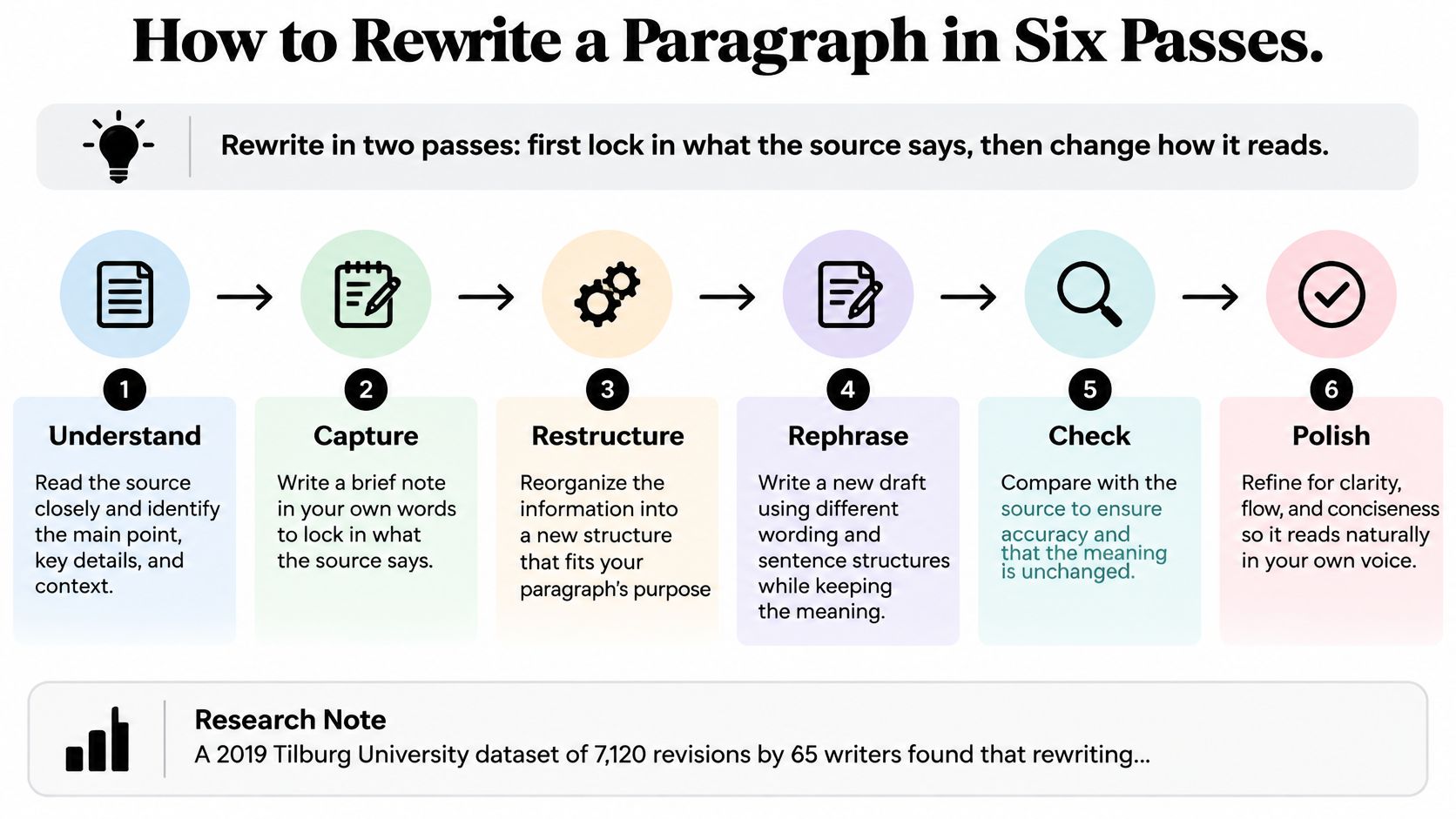
The six passes
- Name the reader and task. A tutor marking an essay expects formal, precise prose. A hiring manager scanning a cover letter wants short, specific claims. The reader sets density and tone before you touch a word.
- Extract a checklist. Pull out the claim, evidence, qualifiers and required terms from each paragraph and list them. If the original says "may," "in adults," or names a number, those items go on the list verbatim.
- Reorder for logic. Lead with the claim, follow with evidence, and link ideas with explicit words like because, however or as a result. Don't keep a weak order just because the source used it.
- Replace vague wording. Change "significant impact" to the number or named effect the original gave. If it gave none, keep the vagueness visible rather than inventing precision.
- Validate against your list. Confirm numbers, citations, modal verbs and scope haven't moved. Say the original reads, "Remote work may boost productivity for some teams." The robotic rewrite, "Notably, remote work offers numerous advantages, including enhanced productivity," drops may and some, and this pass catches it.
- Read aloud for omissions. Listen for a missing item from your list and for any claim you didn't make. If it sounds smooth but adds certainty, it fails.
That sequence matches the workflow in the ERIC guide to readable writing, which warns that simplified vocabulary and syntax in experiments with U.S. Navy recruits usually produced no practically meaningful comprehension improvement. Don't chase a readability score. Check factual equivalence instead.
A rewrite passes when every item on your list appears and nothing new has been added.
If you're starting from an AI draft, run the same list against it before you edit style. Our guide to enhancing AI text covers that first cleanup, but the checklist stays yours.
Rewrite Mistakes That Keep Text Too Close
You can change every content word and still copy the source. That's patchwriting, and it's the mistake most writers don't see in their own drafts.
Say the source says, "Regular exercise improves memory in older adults by increasing blood flow to the brain." A patchwritten version reads, "Frequent physical activity enhances recall in elderly people by raising circulation to the brain." Almost every word changed. The sentence skeleton didn't. Subject, verb, object, then a by-phrase explaining the mechanism, all in the same slots.
Four problems to diagnose
| Problem | What it looks like | Fix |
|---|---|---|
| Patchwriting | Same sentence skeleton with synonyms swapped | Close the source, write from your notes, then compare |
| Vocabulary-only edit | "Utilize" replaces "use" and the order stays the same | Start from the claim, not the source's first clause |
| Distorted claim | "may help" becomes "helps" | Restore every qualifier from your extracted list |
| Dropped citation | The idea is rewritten but its source is removed | Keep the citation attached to the idea, not the sentence |
This isn't rare. The University of Alabama summary of The Citation Project reported that among cited source uses in first-year writing, 47% were paraphrases and 16% of the paraphrases were classified as failed paraphrases or patchwriting. It also reported that 52% of the papers examined contained at least one instance of cited patchwriting, defined as retaining the source's sentence structure while replacing selected words with synonyms.
A legitimate paraphrase reconstructs the expression, and where needed the organization, while preserving meaning and acknowledging the source. Changing words inside the same frame doesn't do that.
Working test: Close the source, write the idea from your notes alone, and only then open it again to compare numbers and qualifiers.
For a draft you've already written from memory, Unflag's Paraphrasing Tool can give you a first pass at different phrasing. I'd still compare that output against the source skeleton, line by line, because a tool can produce fluent text that keeps the original structure.
Sentence Length Benchmarks for Clearer Prose
For screen-based prose, 16 to 20 words per sentence is a useful starting range. Treat it as a working benchmark, not a target to hit mechanically. A sentence can be short and still feel difficult if it packs in unfamiliar terms or hides how its ideas connect.
How to split a sentence
Split sentences that carry several independent claims. Give each sentence one primary action or inference, and keep a longer sentence when its grammar makes a cause, condition, or concession clear.
Consider this 35-word example: “The team moved standups to written updates because meetings were cutting into focus time, and within a month they reported fewer interruptions, although new joiners said they found it harder to ask quick questions.” It combines three claims and buries the drawback.
A clearer rewrite separates those claims: “The team moved standups to written updates because meetings were cutting into focus time. Within a month, they reported fewer interruptions. New joiners, though, found it harder to ask quick questions.” Each sentence now makes one point.
- Split by claim, not by count. If you cannot identify a sentence's main job, it may be carrying more than one.
- Keep meaningful connectors. Words such as “because,” “although,” and “if” show how ideas relate. Removing them to meet a word target can distort the logic.
- Check what the reader understands. Ask what changed, why it changed, and what the drawback was. A wrong answer points to a missing or unclear relationship.
Shortening every sentence can backfire. A longer version may be easier to follow when it spells out connections that a compressed rewrite leaves for the reader to infer.
Rewriting AI Drafts Without Losing Your Voice
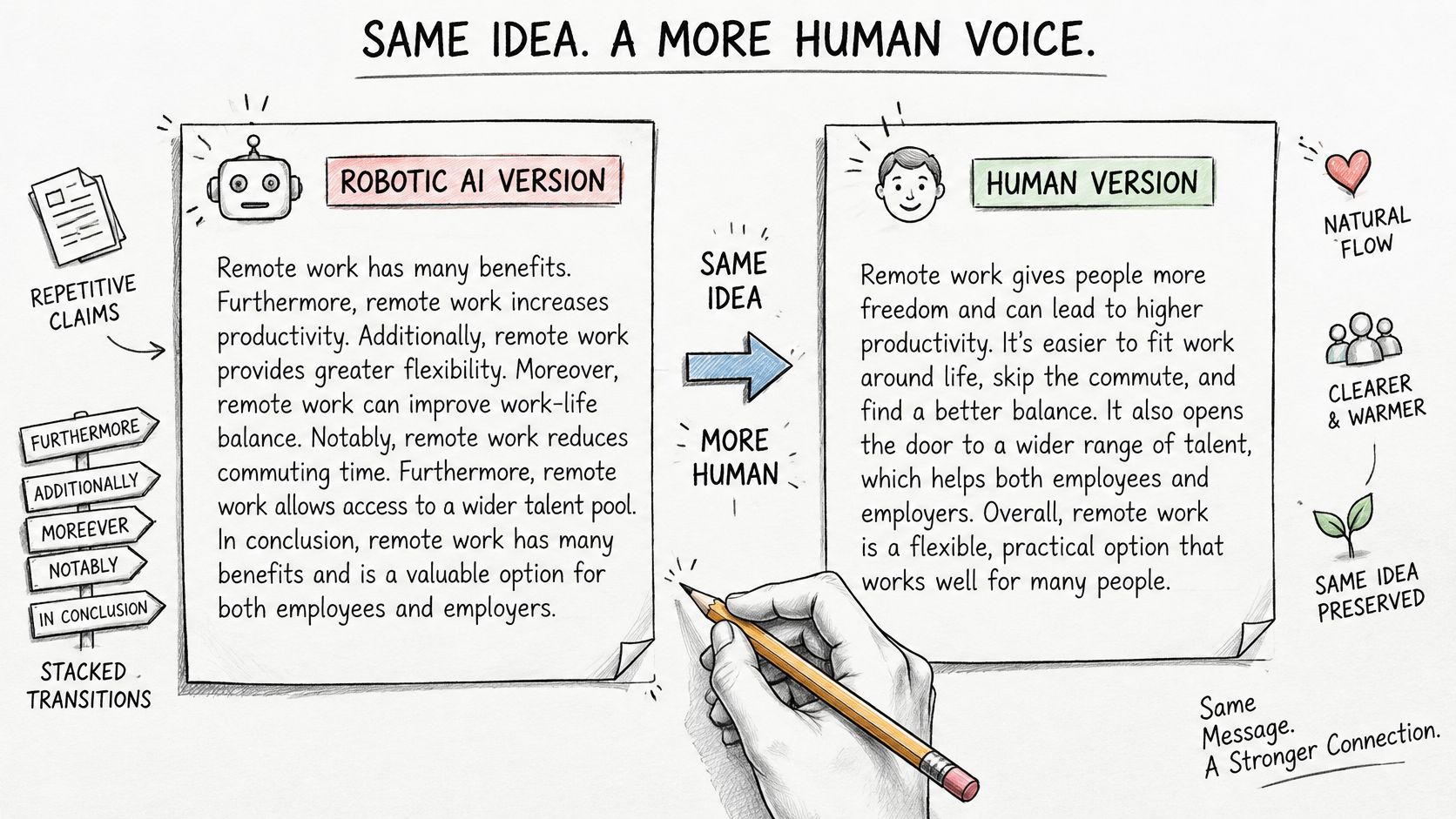
Compare two versions of a paragraph about remote work.
Robotic: "Remote work offers significant benefits for modern teams. It enhances productivity and improves overall efficiency. Remote work provides teams with valuable flexibility and advantages in their daily operations."
Natural: "Our support team answers tickets faster from home, mostly because nobody's tapping them on the shoulder. The trade-off is onboarding. New starters take longer to learn who knows what."
The first version repeats one vague claim three times in different words, and it never names a team, a result or a cost. The second makes a specific claim and names its trade-off. That specificity gives the paragraph a point of view. Keep details you can support; don't invent a team, result or cost just to make a draft sound more personal.
A rewrite can become too polished for its purpose. A 2025 experiment involving 327 native and non-native English writers found that non-native writers tended to prefer simpler content, while native writers more often used advanced content. The gap was especially pronounced among writers with lower self-efficacy. If a tool smooths every sentence into the same register, it may change how complex or direct you intended to sound.
Maximum fluency isn't the goal. A draft you'd sign is the goal.
What to keep by context
| Context | Keep unchanged | Change | Watch for |
|---|---|---|---|
| Academic essay | Your argument, citations and technical terms | Transitions, sentence rhythm and word choice | Simplifying distinctions the grader expects |
| Job application | Your achievements and numbers | Verbs, specificity and structure | Generic praise such as "results-driven" with no evidence |
| Marketing post | Product facts and claims | Tone, hook and reading level | Exaggeration the facts do not support |
| Your own non-native draft | Clear idioms and examples | Grammar errors and unclear word order | Overcorrecting into generic English that loses your point of view |
For help revising a draft, paste your text into Unflag's AI Humanizer, pick a tool and press the button. It rewrites AI-generated text to read naturally while keeping your meaning, and you can check the result with its built-in AI detector. Review the output against your own notes. Restore any clear example, politeness pattern or term the rewrite removed. The guide to making Claude sound like you offers more advice on preserving your voice.
Reading Detector Scores and Disclosing AI Help
A detector score is a signal for human review, not proof of misconduct. Treating it as a verdict is where students and teachers both get into trouble.
Turnitin's guidance on using the AI Writing Report warns that its AI-writing model can misidentify human-written, AI-generated, and AI-paraphrased text, so an AI score should not be the sole basis for adverse action against a student. It states that false positives occur more often in the 0%–19% range, which is why reports use an asterisk for AI percentages from 1% through 19% and don't provide exact highlighting there.
What the report actually shows
| Turnitin result | What the report shows | What to do |
|---|---|---|
| Below 20% (asterisk) | No exact percentage and no highlighted passages | Treat as a prompt to review your drafts, not a finding |
| 20% and above | Exact percentage with highlighted passages | Check each highlighted passage against your drafts and sources before responding |
Second-language writers carry extra risk here. University guidance notes that detectors can produce false positives and disproportionately flag non-native English writing. Formal, predictable phrasing, which is exactly what careful language learners are taught to produce, can look machine generated to a model.
A disclosure routine that protects you
- Keep dated drafts. Save versions as you write, not just the final file.
- Save source notes. Keep the passages, page numbers and your own paraphrase attempts together.
- Record what you changed. Note which sentences you edited for grammar and which ideas came from you.
- Separate editing from generation. Reshaping your own reasoning is a different act from having a tool supply the argument.
That paper trail answers the key question, which is whether the thinking is yours. A score can't answer it.
You can check a draft yourself with Unflag's AI Detector before submitting, and our explainer on the AI content detector covers what these tools look for. I'd treat any result as one input alongside your records and your instructor's policy, never as the decision. Rewriting purely to chase a lower score often makes prose stranger and less accurate.
Check Your Rewrite Before You Publish
Run these six checks in order. Each one is a yes or no, and each covers something the rewriting passes don't.
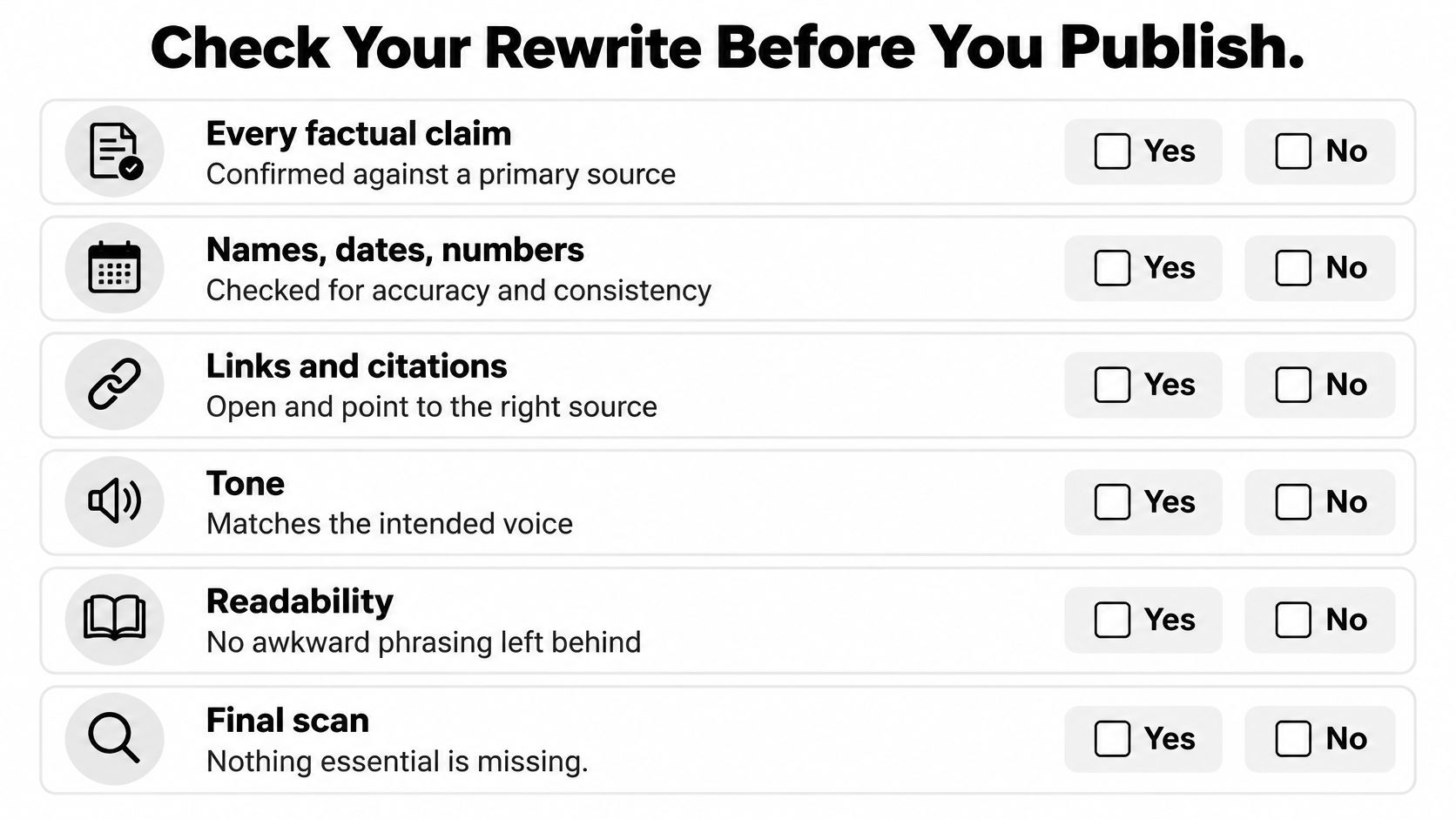
- Every factual claim confirmed? Check each claim against a primary source and link it where readers can verify it.
- Unsupported statements flagged? The Fact Checker can flag claims that look unsupported, and Unflag includes a built-in fact checker that checks claims in writing against sources on the web. You still confirm each source yourself.
- Headings describe what's under them? Google's SEO starter guide recommends structuring long pages with clear paragraphs and headings to help users find their way through the content, and notes the search-result title link may be generated from the page's
<title>element and other headings. - One main claim per paragraph? If a paragraph makes two arguments after editing, split it rather than smoothing over the join.
- Meta description accurate? Google notes a meta description may supply the search snippet and should be a short, unique summary containing the page's most relevant points.
- Records saved? Keep drafts, source notes and a dated record of any AI assistance with the finished piece.
Finish with one action. Paste your rewritten text into Unflag's AI Humanizer, it's free, then run this checklist on the output before you publish. Tools catch surface problems fast. The checklist catches the ones that embarrass you later.
Common Rewriting Questions Answered
Is rewriting the same as paraphrasing
No. Paraphrasing is one kind of rewriting, focused on restating a source's idea in fresh wording. A rewrite can also change structure, tone, length and intended audience. You might rewrite your own paragraph for a different reader without any source involved at all.
Can I rewrite a source without plagiarizing
Yes, if you restate the idea in your own structure and still cite the source. Write from notes with the original closed, keep the numbers and qualifiers accurate, then compare. Rewriting removes the borrowing of expression, not the debt to the idea.
Does changing synonyms make text original
No. Swapping words while keeping the same sentence skeleton is patchwriting, and readers can see the original frame underneath. Originality comes from rebuilding how the idea is organized and expressed. If your clauses land in the same order as the source, start again from the claim.
How many words should a paraphrase be
There's no fixed count. A paraphrase should be long enough to carry the claim, its evidence and its qualifiers accurately, and no longer. Test it by asking whether the idea stands on its own with a citation attached, not by counting words against the original.
Will rewriting stop AI detectors flagging my work
No guarantee exists, and detector scores are fallible. Rewriting to chase a score often produces odd, less accurate prose. Focus on accuracy, your own reasoning and clear records of how you wrote it. Those hold up under review in a way a percentage doesn't.
Is an AI assisted rewrite still my work
That depends on your course or employer policy, and on what the tool did. Editing your own sentences differs from generating the argument. Keep dated drafts and notes showing what you changed and why, and disclose assistance where the policy asks for it.
Paste your next stubborn paragraph into Unflag and run it through the humanizer, paraphraser, AI detector and fact checker in one place, then check the output against your own claim list before you send it. It's free to start, works in many languages, and keeps your meaning intact while the wording becomes yours again.
More guides
View allAnswer a Question Clearly and Concisely in 2026
Learn how to answer a question clearly and concisely, with answer shapes for each question type, a four-step structure, and fixes for common mistakes.
Correct Parallel Structure: Rules and Fixes
Learn how to correct parallel structure with a fix table, five editing steps, correlative pairs, and practice sentences you can use today.
Base Word Examples: 8 Root Families with Derived Forms
Base word examples for 8 root families, with derived forms, sample sentences, and natural rewrites that show how each word shifts in use.
Animals with the Letter D: 10 Species with Facts (2026)
Explore animals with the letter D, from dogs and dolphins to dugongs and dung beetles, with habitat notes and a verified fact for each one.