By Unflag Team
AI Hype vs Reality: What AI Actually Delivers in 2026
Cut through the AI hype vs reality gap with evidence-backed analysis of what AI tools actually deliver in 2026, including productivity, costs, and real risks.
The popular advice is to pick a side, declare AI either extraordinary or overhyped, and then buy or dismiss tools accordingly. That advice fails because AI hype vs reality isn't one question. Spending, usage, benchmark scores and business value are moving at different speeds, and treating them as the same signal leads to bad decisions in both directions.
Table of Contents
- Why AI Hype vs Reality Is the Wrong Frame
- Where the Investment Adoption Value Gap Is Largest
- The Eight Biggest AI Claims Compared to the Evidence
- Inside the Capability Boundary Where AI Actually Helps
- Two Real Workflows That Use This Boundary
- Agents Hallucinations and the Legal Clock Are Real Now
- A Five-Step Framework for Evaluating Any AI Claim in 2026
Why AI Hype vs Reality Is the Wrong Frame
A binary verdict sounds decisive. It's also analytically useless. A technology can attract enormous capital, work well on narrow tasks, fail on adjacent tasks and still not produce quick financial returns. All four statements can be true at the same time.
That's why a better frame is four measurable gaps. Each gap separates a claim that's easy to market from an outcome that's harder to produce.
The Four Gaps That Matter
- Investment vs payback: Money committed tells you what investors and executives expect. It doesn't tell you when, or whether, a specific workflow repays its cost.
- Adoption vs routine use: An organization can report using AI somewhere while most employees use it only for search, summaries or first drafts.
- Benchmark scores vs operational reliability: A model can improve sharply on structured tests and still make errors on open-ended reasoning, factual claims and multi-step work.
- Inference cost vs total workflow cost: Cheaper tokens reduce the price of generating output. They don't remove editing, verification, training, integration or error recovery.
Adoption is evidence of experimentation at scale. It is not, by itself, evidence of value.
This distinction changes the questions you ask. Instead of asking whether AI works, you ask what output can be checked, how often errors occur, who catches them, and what the full process costs after human review. Those questions produce operational answers rather than slogans.
Cost illustrates the point. The price of querying a model with GPT-3.5-level performance fell from $20 per million tokens in November 2022 to $0.07 per million tokens by October 2024, a reduction of more than 280-fold, according to Stanford's research and development data on inference costs. Cheaper access makes experimentation rational. It doesn't prove that any given deployment saves money once staff time and quality control are included.
The conclusion here isn't that AI is fake, and it isn't that current spending guarantees transformation. It's narrower and more useful. AI delivers measurable value inside a defined capability boundary, with verification, and loses value outside that boundary. Every claim that follows should be judged against that standard.
Where the Investment Adoption Value Gap Is Largest
The largest gap appears when you separate three layers that coverage often merges. First, capital committed. Second, organizations reporting use. Third, organizations reporting material net benefit. The first two layers are large. The third is much smaller and slower.
Corporate AI investment reached $252.3 billion in 2024, private investment rose 44.5% year over year, and generative AI attracted $33.9 billion in global private investment, according to Stanford's 2025 AI Index economy chapter. The United States accounted for $109.1 billion of private AI investment in that same data. Those figures show conviction and competitive pressure. They don't show profit.
Adoption Rises Faster Than Returns
Adoption moved quickly at the organizational level. That's consistent with low-cost pilots, bundled software features and executive pressure to show progress. Routine, valuable use is a stricter test because it requires workflow changes, staff competence and a reason to keep using the tool after the pilot ends.
Deloitte's ROI research found that 85% of surveyed organizations increased AI investment over the previous year, yet only 6% reported achieving payback on a typical AI use case within 12 months, with most expecting satisfactory returns only after two to four years, as detailed in Deloitte's analysis of rising AI investment and elusive returns. That timeline matters. A tool can be useful and still be a poor short-term investment.
Reported operating gains show the same pattern in the Stanford data cited above. Service operations, supply chain and software engineering reported cost savings more often than other functions, but most savings were below 10%. Marketing and sales reported revenue gains frequently, yet the most common increase was below 5%.
- Spending announcements: Easy to measure, heavily publicized, weak evidence of return.
- Adoption percentages: Useful for tracking diffusion, weak evidence of depth or quality.
- Payback and net savings: Harder to measure, less publicized, closest to business reality.
Analyst view: AI can be genuinely useful without being economically transformative yet.
That sentence explains the current market better than either extreme. Teams shouldn't cancel useful pilots because returns are modest. They also shouldn't scale spending because competitors announce larger budgets. The rational move is to fund use cases with a defined baseline, a payback window and a plan for measuring rework, not just output volume.
The Eight Biggest AI Claims Compared to the Evidence
Marketing claims tend to remove scope. A result on one task becomes a promise about work in general. A benchmark gain becomes a claim about reasoning. A successful pilot becomes a claim about companywide productivity. Restoring scope is the fastest way to evaluate the claim.
Benchmark progress is real, but it's uneven. Year-over-year scores rose by 18.8 percentage points on MMMU, 48.9 points on GPQA and 67.3 points on SWE-bench, while models still struggled on complex reasoning evaluations such as PlanBench, according to Stanford's 2025 AI Index report. A system can therefore look dramatically better on familiar, structured formats without becoming dependable on every logical problem you give it.
Common AI Claims vs Documented Reality (2026)
| Claim | Documented Reality | Evidence |
|---|---|---|
| AI replaces knowledge workers | AI augments some tasks and harms performance on unsuitable tasks | Controlled consultant and writing experiments |
| AI doubles productivity everywhere | Gains depend on task fit, training and verification | Workplace and experimental evidence |
| Higher benchmark scores mean reliable reasoning | Structured test gains coexist with reasoning failures | MMMU, GPQA, SWE-bench and PlanBench results |
| Adoption proves ROI | Investment and use have risen faster than payback | Stanford and Deloitte data in earlier sections |
| Cheaper models mean cheaper workflows | Token prices fell, but review and integration costs remain | Inference cost data in earlier section |
| AI confidence proves accuracy | Automated hallucination detection aligns poorly with human judgments | FaithBench results discussed later |
| Agents can run long workflows alone | Frontier horizons are measured at 50% reliability, not production reliability | METR agent benchmark discussed later |
| More AI use automatically improves quality | Basic use is common, deeper gains track training | Multinational employee survey discussed below |
Human readiness explains part of the gap in the last row. In a 2025 multinational survey, 88% of employees used AI daily, but use concentrated in basic activities such as search and summarization, while employees receiving more than 81 hours of annual AI training reported an average productivity gain of 14 hours per week compared with a median of eight hours, according to EY's survey on AI productivity and talent strategy. Access alone doesn't create skill.
Read the table as a scope check, not as a dismissal. Each claim becomes credible when it's narrowed to a task, a user group, an error rate and a measurement period. Without those qualifiers, you're reading promotion. With them, you can test the claim in your own workflow and keep what survives.
Inside the Capability Boundary Where AI Actually Helps
The clearest evidence for AI at work comes from controlled tasks, not launch demos. Those studies show a boundary. Inside it, AI can improve speed and quality. Outside it, fluent output can make performance worse because users trust answers they can't easily verify.
In a study involving more than 700 Boston Consulting Group consultants, GPT-4 users performed 38% better than the no-AI control group on tasks inside the model's capability boundary, and users who also received guidance improved by 42.5%, according to MIT Sloan's summary of generative AI and highly skilled workers. Guidance helped, but task fit mattered more.
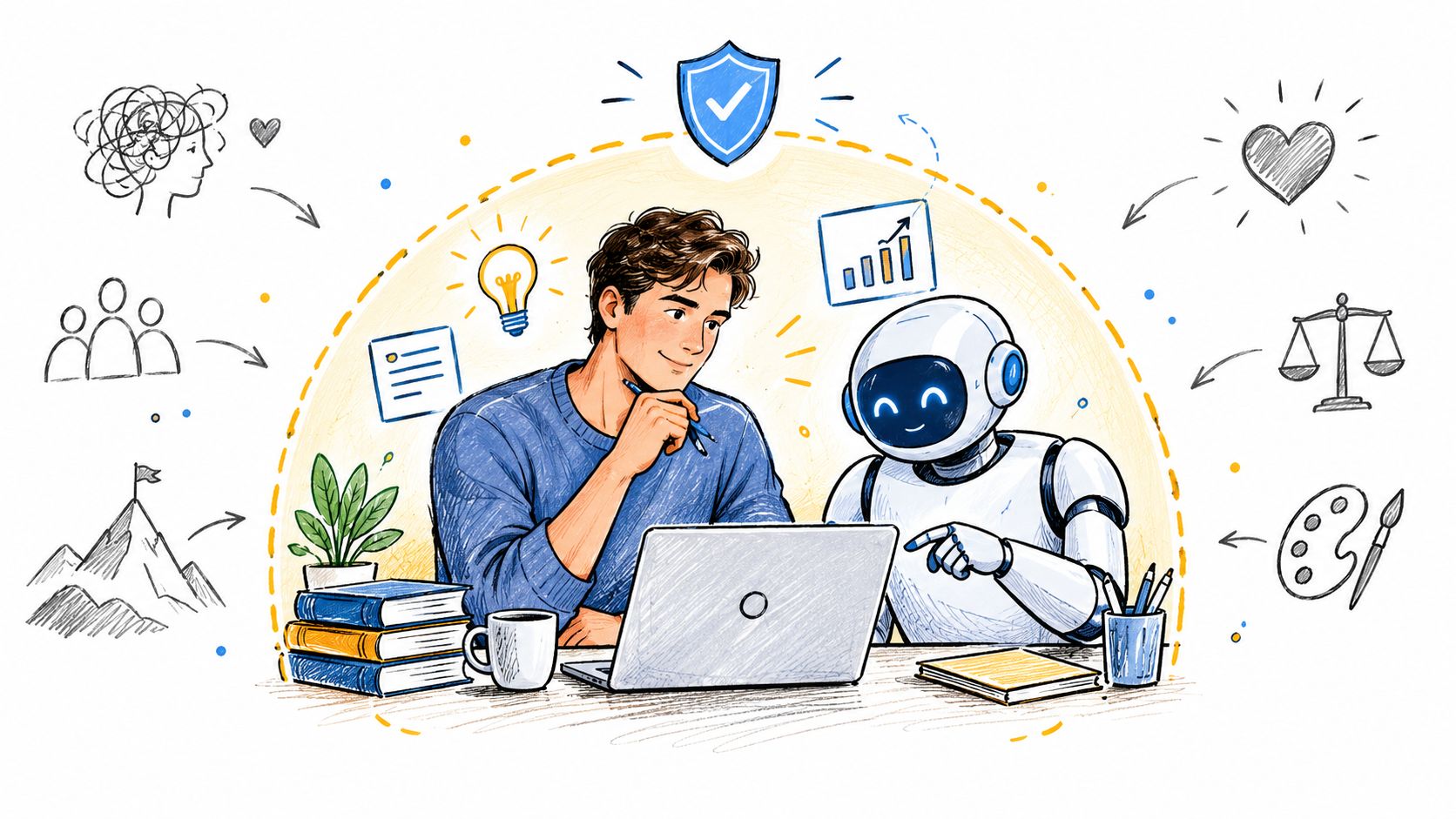
The reversal is the important part. On a task designed to fall outside reliable capability, GPT-only participants performed 13 percentage points worse than the control group in that same MIT Sloan summary, and GPT plus guidance participants performed 24 percentage points worse. Training didn't rescue a bad task match. In some conditions, it may have increased confidence in the wrong output.
What Predicts a Good Task Match
Writing tasks show a more favorable case because users can judge tone, structure and relevance as they read. The separate experiment in the MIT Sloan summary found faster completion and higher rated quality on occupation-specific writing. That doesn't mean every factual claim in the writing was true. It means drafting and editing are easier to supervise than hidden analytical reasoning.
Use three tests before assigning work to AI.
- Verifiability: Can you check the output against a source, test, calculation or known standard?
- Reversibility: Can you discard or correct the output before it affects a customer, grade, publication or system?
- Judgment: Does the user know enough about the subject to notice a plausible but wrong answer?
AI helps most when a competent human can recognize a good answer faster than they can produce one from scratch.
That heuristic covers drafting, summarization, brainstorming, code with tests, data formatting and first-pass research organization. It argues against unsupervised legal conclusions, medical advice, financial calculations without independent checks, and factual publishing without source review. The boundary isn't fixed forever, but you should discover it with holdout tasks from your own work, not with vendor examples chosen to succeed.
Two Real Workflows That Use This Boundary
Abstract rules become useful when they change a sequence of actions. The two workflows below use AI for production speed, then add explicit checks before anyone else sees the result. Neither treats the first draft as finished work.
A Content Marketer Publishing an Article
A marketer briefs AI with an outline, audience, source material and required claims. The model produces a structured draft quickly, including headings, transitions and alternative introductions. That part sits inside the capability boundary because the marketer can judge relevance and rewrite weak sections.
The risk appears in the middle. The draft may repeat formulaic phrasing, overstate a source, invent a connection between two facts or sound unlike the brand. The marketer therefore edits for argument first, checks every number against its source, and only then polishes language.
A before and after edit shows the difference:
- Before: AI solutions can significantly optimize content workflows and enhance overall productivity for modern marketing teams.
- After: The draft arrived in minutes, but the editor still had to verify each claim, cut repeated phrases and rewrite the conclusion before publication.
The second version is specific. It also makes the human work visible, which is where quality is created.
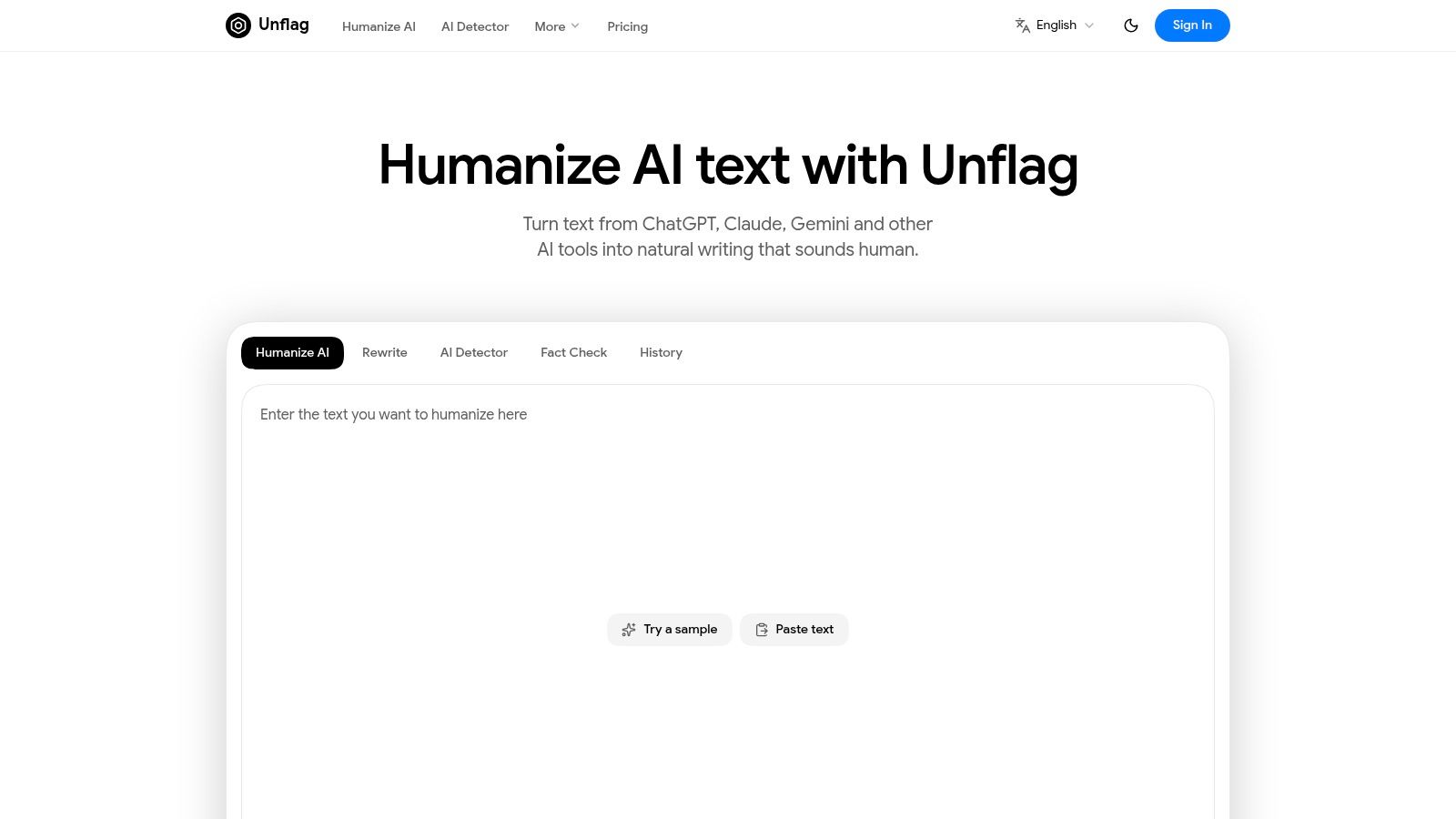
For the checking stage, a team can use AI writing tools for students and other writers as part of a broader review process. One option is Unflag, which combines a humanizer, paraphrasing tool, AI detector and fact checker in one interface. Used factually, that means a writer can revise robotic phrasing, preview an AI score before submission and flag unsupported claims without switching tools. The tool doesn't replace source checking or editorial judgment.
A Student Revising an AI-Assisted Essay
A non-native English speaker drafts an argument, asks AI for clearer phrasing, and receives fluent paragraphs that sound more academic. Fluency is helpful, but it can also distance the text from the student's own reasoning. The student should compare each revised paragraph with their notes, restore examples they understand, and remove claims they can't explain.
The verification step is different from rewriting for style. Dates, quotations, statistics and citations need sources the student has opened and read. If a sentence can't be traced, it should be cut or rewritten as the student's own analysis. That rule protects both accuracy and authorship.
Practical rule: Use AI to produce options, then use sources and your own judgment to decide what survives.
Both workflows follow the same principle. AI plus verification can beat either one alone on speed and quality, while AI alone is weakest exactly where accuracy matters most. The gain doesn't come from trusting the model more. It comes from placing the model where its mistakes are visible and cheap to correct.
Agents Hallucinations and the Legal Clock Are Real Now
Three risks now shape deployment decisions. Agents can act across multiple steps. Hallucination checks are less reliable than their scores suggest. Regulation is moving from principles to dated obligations. Together, they turn oversight from a preference into an operating requirement.
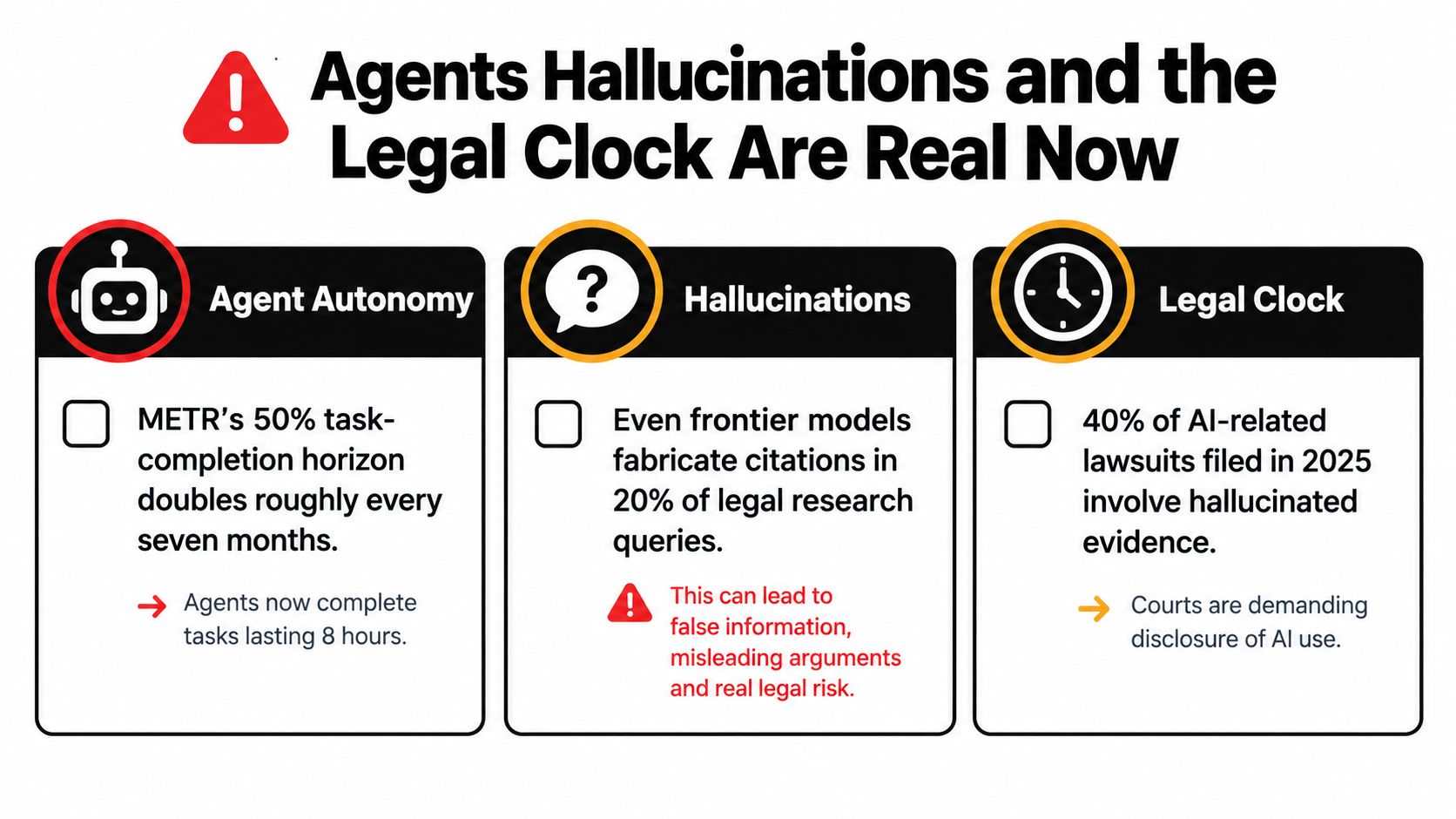
METR reported that the frontier 50% task-completion horizon for AI agents doubled approximately every seven months over the preceding six years, according to METR's measurement of AI ability to complete long tasks. That's rapid progress. It also means that at the stated horizon, the agent is expected to fail about half the time. A research horizon isn't a production service level.
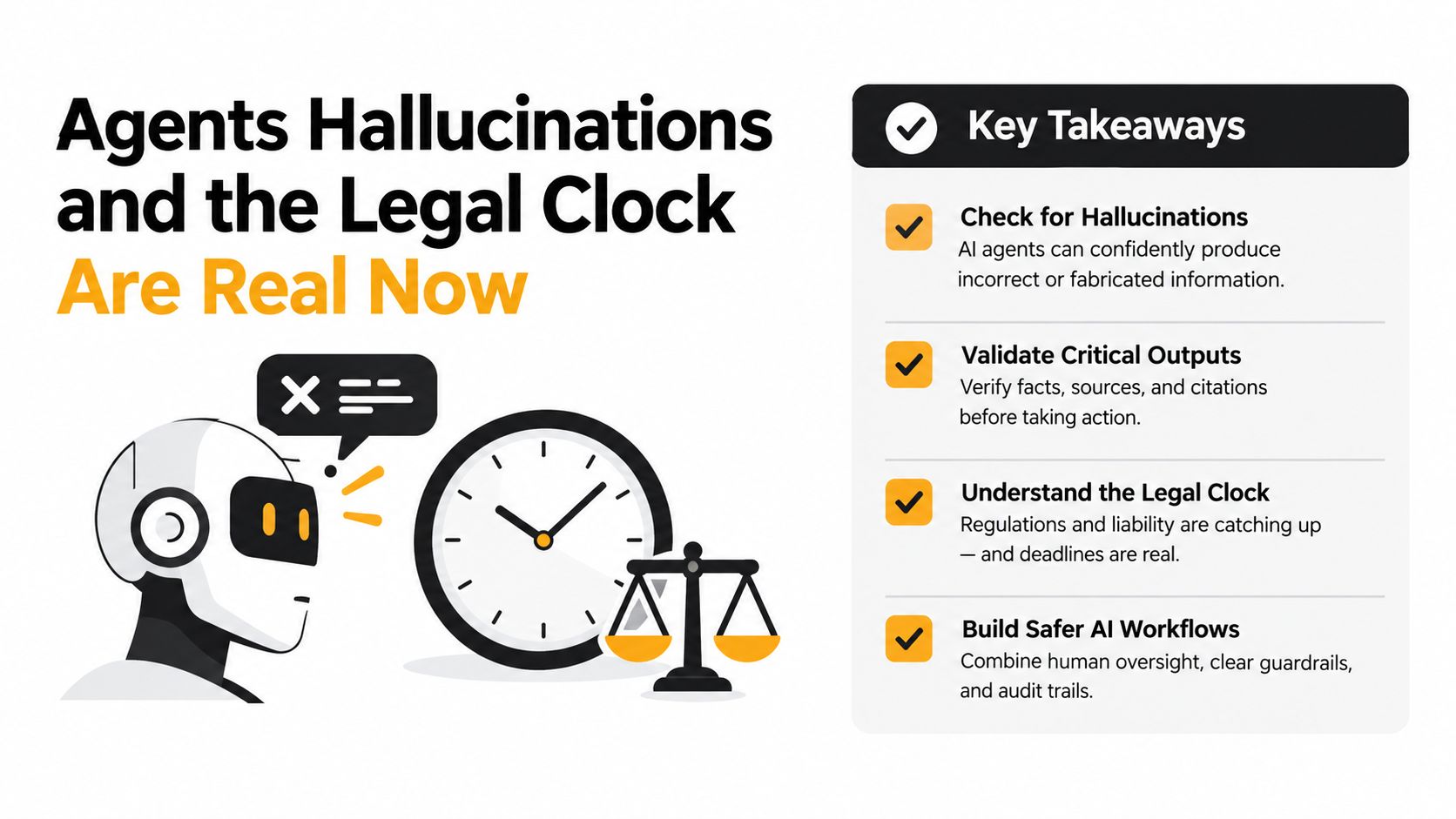
Production agent design should therefore shorten the distance between checkpoints. Break long work into smaller tasks, run automated tests, keep agents in sandboxes, log tool calls and require human approval before irreversible actions such as sending, deleting, purchasing or publishing. Those controls don't slow innovation. They define where autonomy is earned.
Detection Scores Are Not Truth Scores
FaithBench found that hallucination detectors correlated poorly with human-annotated ground truth, with the strongest evaluated detector achieving only 62% balanced accuracy and a 57% macro F1 score, according to the FaithBench hallucination benchmark study. A detector can help prioritize review. It can't certify that a statement is true.
That's why source-based checking remains separate from style or authorship checks. Guidance on fact checking tools is most useful when it leads back to primary sources, quoted evidence and a human decision about whether the source supports the sentence. A green score without that trail is weak evidence.
Regulation adds a deadline to these controls. The European Commission states that rules for prohibited AI practices, certain transparency requirements and general-purpose AI models become enforceable on August 2, 2026, with high-risk Annex III rules applying from December 2, 2027, according to the EU AI Act Service Desk enforcement FAQ. Organizations operating in Europe need records of use, risk controls and accountability before those dates, not after an incident.
Oversight is not a brake on AI adoption. In regulated and public-facing work, oversight is what makes adoption defensible.
The combined lesson is practical. Give agents narrow permissions, treat detector output as a prompt for review, keep source trails for factual claims, and assign a named person to approve consequential output. Teams that build those habits now will adapt more easily as capability and enforcement both increase.
A Five-Step Framework for Evaluating Any AI Claim in 2026
You don't need to predict the future of AI to make a sound decision this quarter. You need a repeatable test that works for a writing assistant, coding tool, research product or agent platform. Apply the same five steps before you buy, scale or publish.
Steps One to Three Define the Test
- Name the verifiable output: State exactly what will be produced, such as a sourced summary, a tested code change or a draft that a subject expert will grade.
- Set a measurable task: Use real examples from your workflow, keep a human-only baseline and include difficult cases rather than only examples from a demo.
- Require human verification: Decide who checks the output, what sources or tests they use, and what error rate stops deployment.
These steps prevent the most common evaluation error, which is measuring volume instead of usable results. Ten drafts aren't a gain if nine require heavy rewriting. A faster answer isn't a gain if it introduces an error that a customer, teacher or regulator finds later.
Steps Four and Five Price the Whole System
- Calculate total workflow cost: Add subscriptions, inference, training, editing, verification, integration, privacy review and error recovery, then compare that total with the current process.
- Design for accountability: Record where AI was used, keep approval points for consequential actions, and check obligations that apply to your sector and region.
Background on AI content detector tools belongs in step three, not as a substitute for it. Detection, paraphrasing and fact checking can support review, but the accountable decision remains human. The same principle applies to code review, research validation and agent approvals.
Judge AI by net, quality-adjusted work completed, not by gross output generated.
That standard produces a clear recommendation for 2026. Use AI aggressively for drafts, options, summaries, transformations and other work you can inspect. Use it cautiously for unsupervised reasoning, factual assertions and long autonomous actions. Expand use only when your own measurements show that quality holds after verification costs are counted.
The hype says AI removes the human from the loop. The evidence says the human's job changes toward task selection, judgment and checking. Teams that accept that shift, train for it and measure it carefully will get more value than teams that either chase every claim or reject the tools outright.
If you're using AI for drafts that still need to read naturally and hold up under checking, Unflag brings humanizing, paraphrasing, AI detection and fact checking together in one place, with a free way to start. Paste in a paragraph you're unsure about, review the score and flagged claims, and decide for yourself whether the revised version is clearer, more accurate and ready to submit.
More guides
View all10 Best AI Humanizer Tools for Natural Writing (2026)
Compare the 10 best AI humanizer tools for natural writing, including languages, pricing, privacy, detection features, and practical use cases.
10 Best AI Writing Checker Tools for 2026
Compare the 10 best AI writing checker tools for detection, grammar, style, and fact-checking, plus practical tips for interpreting results.
Best AI Writing Tools for Students: 10 Picks for 2026
Compare 10 AI Writing Tools for Students, covering drafting, humanizing, citations and AI detection, with honest pros and cons for each.
How to Humanize AI Generated Text Without Losing Meaning
Learn how to humanize AI generated text with proven techniques, real before and after examples, and a workflow that preserves facts, voice, and accuracy.